2mins read
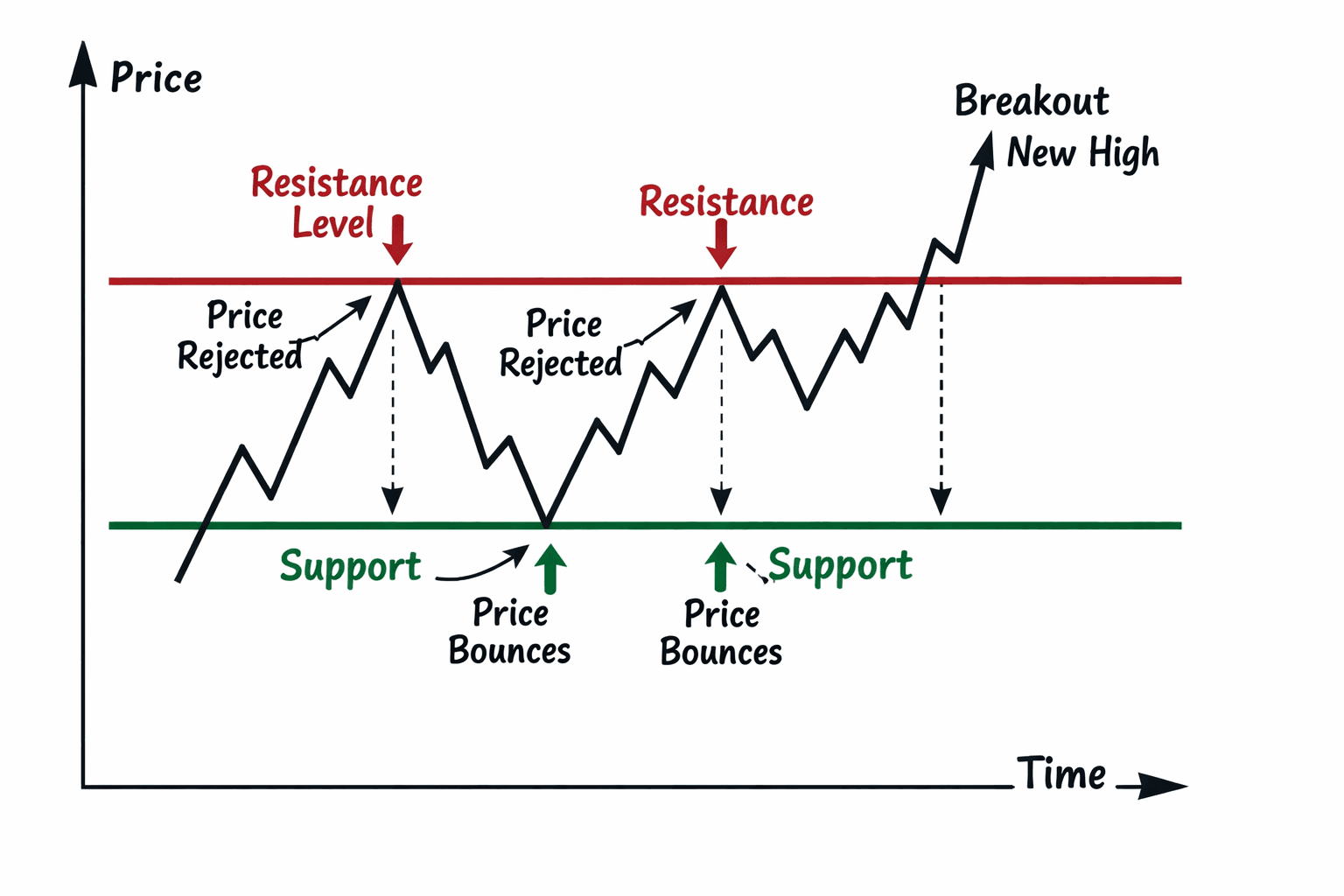
Every trader, at some point, stares at a price chart and wonders why the market keeps bouncing off the same price over and over again. Why does EUR/USD seem allergic to 1.1000? Why does gold always stall near $2,400? The answer is support and resistance — two of the most fundamental and powerful concepts in all of technical analysis.
Support and resistance levels are price zones where supply and demand forces have repeatedly clashed, leaving behind visible footprints on the chart. These levels act as invisible barriers that either hold price back or propel it forward. They form the foundation for countless professional trading strategies, entry and exit decisions, stop-loss placement, and risk management frameworks. Whether you are a complete beginner just learning to read a chart or an experienced swing trader refining your edge, understanding how to correctly identify and trade support and resistance is not optional — it is essential.
In this comprehensive guide, we will walk you through everything you need to know: what support and resistance actually are, how to identify them accurately on any timeframe, the psychology behind why they work, how to build a complete trading strategy around them, and the common mistakes that cost traders money. By the end, you will have a clear, repeatable process for using price levels to your advantage in the forex and CFD markets.
What Is Support and Resistance? A Clear Definition for Traders
Before diving into strategy, it is worth building a solid conceptual foundation. In its simplest form, support is a price level where buying interest is strong enough to prevent the price from falling further. Resistance is the opposite — a level where selling pressure is strong enough to prevent price from rising. Think of support as a floor and resistance as a ceiling.
These levels emerge organically from market behaviour. When price approaches a level where many traders have previously bought or sold, those same traders — along with new ones who have observed the pattern — tend to react in similar ways. This clustering of orders around specific prices is what creates the visible bounces you see on charts. The more times a level has been tested and held, the more significant it becomes. It is self-reinforcing market psychology at work. If you want to understand why this matters for your entries, it helps to first have a solid grasp of how to read forex charts, since support and resistance only make sense when you can accurately interpret what price action is telling you.
Static Support & Resistance
Static levels are fixed horizontal price zones derived from previous highs, lows, and consolidation areas. They do not change over time. A swing high from three months ago that acted as resistance remains relevant as a static level on the chart today. These are the most commonly referenced levels and form the core of most price-action strategies.
Dynamic Support & Resistance
Dynamic levels change as price moves. Moving averages — particularly the 20 EMA, 50 EMA, and 200 SMA — act as dynamic support and resistance in trending markets. Trend lines also qualify as dynamic levels. These are especially useful for traders who prefer to trade with the trend rather than against it.
Psychological Levels
Round numbers such as 1.1000, 1.2000, or 1.5000 in forex — and $2,000 or $50,000 in commodities and crypto — carry enormous psychological weight. Central banks, institutional traders, and retail participants all pay attention to these levels, creating self-fulfilling price reactions. Always mark round numbers on your chart.
How to Identify Support and Resistance Levels on Any Chart
Identifying support and resistance correctly separates profitable traders from those who struggle. Many beginners make the mistake of trying to pin a level to a single pip-precise price, when in reality, support and resistance are zones, not lines. Here is a reliable step-by-step process:
Step 1 — Start on the Higher Timeframe
Always begin your analysis on the daily or weekly chart. Higher timeframes cut through market noise and reveal the levels that institutional traders and fund managers are watching. Once you have mapped the major levels on the daily, you can drop to lower timeframes to refine your entry. This concept of top-down analysis is crucial, and it works particularly well when combined with knowledge of the best timeframes for scalping and swing trading. Aligning your support and resistance zones with the appropriate timeframe for your trading style is one of the most impactful habits you can develop.
Step 2 — Look for Swing Highs and Swing Lows
A swing high is a candle with at least two lower highs on either side. A swing low is a candle with at least two higher lows on either side. These turning points are your raw material. Draw horizontal lines or zones connecting multiple swing highs at similar prices (resistance) and multiple swing lows at similar prices (support).
Step 3 — Mark Price Consolidation Zones
When price moves sideways for an extended period before breaking out, the boundaries of that range become future support and resistance. These consolidation zones are extremely reliable because they represent areas where a large number of orders were placed and filled. When price returns to those zones, similar order clusters tend to react.
Step 4 — Note Role Reversals
One of the most powerful — and often misunderstood — concepts in support and resistance is role reversal. When price breaks through a resistance level convincingly, that level often becomes support on a pullback. When a support level is broken, it frequently transforms into resistance. Trading these role reversals is one of the highest-probability setups available to technical traders.
Step 5 — Validate with Volume
A support or resistance level becomes more significant when it was formed on high volume. High volume means a large number of market participants agreed on the price at that level. When you can see volume spikes coinciding with major turning points, those levels deserve extra weight in your analysis.
The Psychology Behind Support and Resistance: Why These Levels Actually Work
Support and resistance levels are not magical lines on a chart. They work because of deeply ingrained human psychology — specifically, how traders remember prices and make decisions based on those memories.
Consider a trader who bought EUR/USD at 1.0800 and watched it immediately fall to 1.0700. They are now sitting on a loss, anxious, hoping price returns to their entry so they can "break even." When price eventually climbs back to 1.0800, they sell to exit their position with no loss. This same scenario plays out for thousands of traders simultaneously, creating a surge of selling pressure at 1.0800 — which is now a resistance level. This interplay of fear, greed, and hope drives price action more than any economic indicator. Understanding this also helps explain why managing trading spreads and transaction costs matters — when price finally reaches a key level after an extended move, even a few extra pips of spread can be the difference between a good fill and a bad one.
There are three primary psychological forces at key price levels: traders trying to break even, traders adding to winning positions, and new traders entering in the direction of the previous bounce. All three groups create concentrated buying or selling at the same price, reinforcing the level's significance.
Building a Complete Support & Resistance Trading Strategy
Knowing where support and resistance are is only half the battle. The real skill lies in building a consistent, rule-based strategy around these levels. Below is a framework that covers entries, stops, and targets.
The Bounce Strategy (Trading the Reaction)
This is the most straightforward support/resistance approach. You wait for price to approach a well-defined support or resistance zone, then look for a confirmation candle that signals a rejection. Common confirmation signals include pin bars (long-tailed candles that reject the level), bullish or bearish engulfing candles, and inside bars that break in the opposite direction.
For a long trade at support: wait for price to touch the support zone, look for a bullish reversal candle, enter on the close of the signal candle (or on a small retracement), place your stop below the recent swing low or below the support zone, and target the next resistance level. The risk-to-reward ratio should ideally be at least 1:2.
The Breakout Strategy (Trading the Break)
When price breaks through a key support or resistance level with strong momentum and volume, it often continues in the breakout direction before pulling back. Breakout traders enter immediately on the close of a candle that breaks the level, with a stop just on the other side. The challenge with breakouts is false breakouts — where price briefly pierces the level and then reverses. To filter false breakouts, require a candle close beyond the level (not just a wick), or wait for a retest of the broken level as new support or resistance.
The Retest Strategy (The Optimal Entry)
Many experienced traders consider the retest entry the most reliable and highest-probability variant. After a breakout, price often pulls back to retest the broken level (now acting in its new role). This is where the entry occurs. The logic is sound: you have confirmation of the break, a cleaner entry price, and a tighter stop. It requires patience, but the resulting trade has a better risk-reward profile than chasing the initial breakout.
Combining Support/Resistance with Other Confluence Factors
No strategy works in isolation. A support or resistance level becomes significantly stronger when it aligns with other technical factors: a round number, a moving average, a Fibonacci retracement level, or a key daily close. The more confluence you have, the higher the probability of the level holding. This multi-factor thinking is especially valuable in pairs with tighter spreads, so understanding how to choose the right forex platform for your trading style becomes relevant here — having access to clean charting tools and accurate pricing makes marking these confluence zones far more reliable.
Support & Resistance Across Different Timeframes: Multi-Timeframe Analysis
One of the most common errors newer traders make is operating in a single-timeframe bubble. They mark support and resistance only on their trading timeframe and ignore what the higher timeframes are doing. This creates blind spots.
Professional traders use multi-timeframe analysis as a matter of course. A daily resistance level sitting just above your hourly buy signal is a warning that should not be ignored. Conversely, a daily support zone that aligns perfectly with your 15-minute bounce setup is a high-conviction trade.
A practical framework: use the weekly chart to identify the major trend direction and the most significant support/resistance zones, use the daily chart to identify your key trading levels and the overall context, use the 4-hour or 1-hour chart for your entry setup, and use the 15-minute or 5-minute chart to time and refine your entry. This is the same concept that applies across different trading styles — whether you prefer scalping or position trading. Reviewing how demo and live trading platforms compare when practising this multi-timeframe approach matters, because the platform must display multiple timeframes cleanly without lag or discrepancies between charts.
Risk Management When Trading Support and Resistance
A strong understanding of support and resistance does not guarantee profits without equally strong risk management. The most elegant setup in the world can fail if your position sizing or stop placement is careless.
Stop Loss Placement
When trading a bounce from support, your stop should be placed below the support zone — not below a single candle's wick, but below the zone itself. This gives the trade room to breathe and avoids being stopped out by normal price fluctuation. A common mistake is placing stops too tight to a round number, where stop hunts are common. Give yourself a few extra pips of breathing room beyond the obvious level.
Position Sizing
Determine your risk per trade first (typically 1-2% of account equity), then work backward to calculate position size based on the distance between your entry and stop loss. Never let your position size be determined by a desire for a specific dollar amount. Risk is always defined in percentage terms relative to your account.
Take Profit Levels
Target the next logical support or resistance level on the chart. Avoid holding through major levels unless the trade has strong momentum and fundamentals supporting the move. Partial profit-taking at the first target while letting the remainder run to a larger target is a common and effective approach.
Using the Right Tools for Execution
Execution quality matters at key levels. When price reaches a major support or resistance zone, it can move very quickly. Having a reliable trading platform with fast order execution, tight spreads, and the ability to set conditional orders is non-negotiable. Understanding the features every forex trading platform must have before you start trading real money at these levels will save you from painful slippage and execution errors. Similarly, many traders wonder whether MT4 or MT5 is better suited for this kind of analysis — the comparison of MT4 vs MT5 for forex trading comes down to charting features, order types, and the indicators available to you, all of which affect how precisely you can execute support/resistance strategies.
Common Mistakes Traders Make With Support and Resistance
Even traders who understand the concept theoretically often make avoidable errors when applying it in live markets.
Treating Levels as Exact Prices Rather Than Zones
Price does not stop at a precise pip. Support and resistance are zones — areas of interest, not absolute numbers. If your level is 1.0800, price might bounce from 1.0793 or 1.0807. Mark zones, not lines, and your analysis will be far more forgiving and accurate.
Ignoring the Overall Market Structure
A support level in a strong downtrend is much less likely to hold than the same level in a sideways market or an uptrend. Always evaluate your levels in the context of the larger trend. Trading against the primary trend requires stronger confluence and tighter risk management.
Overcomplicating the Chart
Some traders mark dozens of levels, creating a chart so cluttered it becomes impossible to interpret. Focus on the three to five most significant levels on your trading timeframe. Quality always beats quantity. The levels that have been tested three or more times on the daily chart are the ones that matter most.
Not Waiting for Confirmation
Price approaching a support level is not a trade. Price showing a clear rejection signal at a support level is a trade. The difference is a confirmation candle. Patience at key levels is one of the most important discipline skills a trader can develop. Acting too early — before confirmation — is one of the fastest ways to accumulate losing trades.
Forgetting About News Events
High-impact news — central bank decisions, non-farm payrolls, inflation data — can blow through the strongest technical levels without hesitation. Always check the economic calendar before entering a trade near a major support or resistance level. A technically perfect setup can be destroyed by a data release in seconds.
Advanced Techniques: Taking Your Support & Resistance Analysis Further
Fibonacci Retracements as Dynamic S&R
Fibonacci retracement levels — particularly the 38.2%, 50%, and 61.8% levels — frequently align with or act as support and resistance. When a Fibonacci level coincides with a previous swing high or low, the confluence is powerful. Many institutional algorithms use Fibonacci-based levels for entry and exit decisions, which is part of why they work so consistently.
Supply and Demand Zones
Supply and demand zone analysis takes the support/resistance concept a step further by focusing on the origination point of strong moves. An area where price consolidated briefly before launching into a sharp move up is called a demand zone; the equivalent on the downside is a supply zone. These zones often produce explosive reactions when revisited, because the imbalance between buyers and sellers that created the original move tends to still be present.
Order Blocks
Popularised by institutional and Smart Money Concepts (SMC) trading frameworks, order blocks are specific candles that represent institutional order placement. Typically, the last bearish candle before a strong bullish impulse move defines a bullish order block, and vice versa. These refined support and resistance zones are favoured by traders who want to align their trades with suspected institutional activity.
Volume Profile
Volume profile tools show the distribution of volume across price levels. The Point of Control (POC) — the price level with the highest traded volume — often acts as a magnet for price and a strong support or resistance zone. Volume profile analysis adds a quantitative dimension to traditional support/resistance work.
Support & Resistance in Trending vs. Ranging Markets
The same levels behave differently depending on whether the market is trending or ranging, and understanding this distinction will improve your win rate significantly.
In a ranging market, price oscillates between a defined support floor and a resistance ceiling. The strategy is straightforward: buy near support, sell near resistance, and place stops just outside the range boundaries. Ranging markets provide clean, repeatable setups, but they require you to exit before the opposing level rather than holding for larger moves.
In a trending market, the dynamics shift. In an uptrend, support levels hold more reliably while resistance levels break more frequently. In a downtrend, resistance holds while support breaks. The best approach in a trending market is to look for pullbacks to former resistance (now support in an uptrend) and enter in the direction of the primary trend. Trading counter-trend bounces in a strong trend is a lower-probability activity best left to experienced traders with excellent risk management.
Putting It All Together: A Sample Support & Resistance Trade Walk-Through
Let us walk through a realistic example on EUR/USD to illustrate the complete process from analysis to execution.
Step 1 — Higher Timeframe Context: On the weekly chart, EUR/USD is in a broad uptrend, making higher highs and higher lows. The most recent significant swing low on the weekly is at 1.0750, which is also a previous consolidation area from several months ago.
Step 2 — Daily Level Identification: On the daily chart, you notice price has pulled back toward the 1.0750 zone after a strong rally. This level has been tested twice previously on the daily chart and held both times. The 50-day EMA is currently sitting at 1.0745, adding dynamic support confluence.
Step 3 — Entry Timeframe Setup: Dropping to the 4-hour chart, you see price has formed a bullish pin bar candle at 1.0752, rejecting below 1.0750 and closing above it. This is your confirmation signal.
Step 4 — Trade Execution: Entry: 1.0760 (on the open of the next 4-hour candle). Stop loss: 1.0720 (below the zone and the pin bar's low, giving 40 pips of risk). Target: 1.0950 (the next daily resistance zone, 190 pips away). Risk-to-reward ratio: approximately 1:4.75.
Step 5 — Trade Management: Move the stop to breakeven once price reaches +50 pips. Consider taking 50% of the position off at 1.0860 (half-way target, roughly 100 pips) and letting the remainder run to 1.0950 with a trailing stop.
Conclusion: Why Support and Resistance Will Always Be Relevant
Markets change. Algorithms evolve. New instruments emerge. But support and resistance will never go out of style, because the psychology underpinning them — human fear, greed, memory, and herd behaviour — is timeless. As long as humans (and the machines they program) are participating in financial markets, price will react at levels where large numbers of decisions were previously made.
The traders who consistently profit from support and resistance are not the ones who use the most sophisticated tools. They are the ones who keep it clean: identify the key levels with discipline, wait for clear confirmation before entering, manage risk without emotion, and repeat the process over hundreds of trades. It is not glamorous, but it is what works.
Start by marking support and resistance on just one currency pair across two timeframes. Study how price behaves at those levels for a few weeks without trading. You will quickly develop an intuitive feel for the dynamics discussed throughout this guide. Then, when you begin executing trades, that intuition — grounded in real chart observation — will become your most valuable trading asset.