2mins read
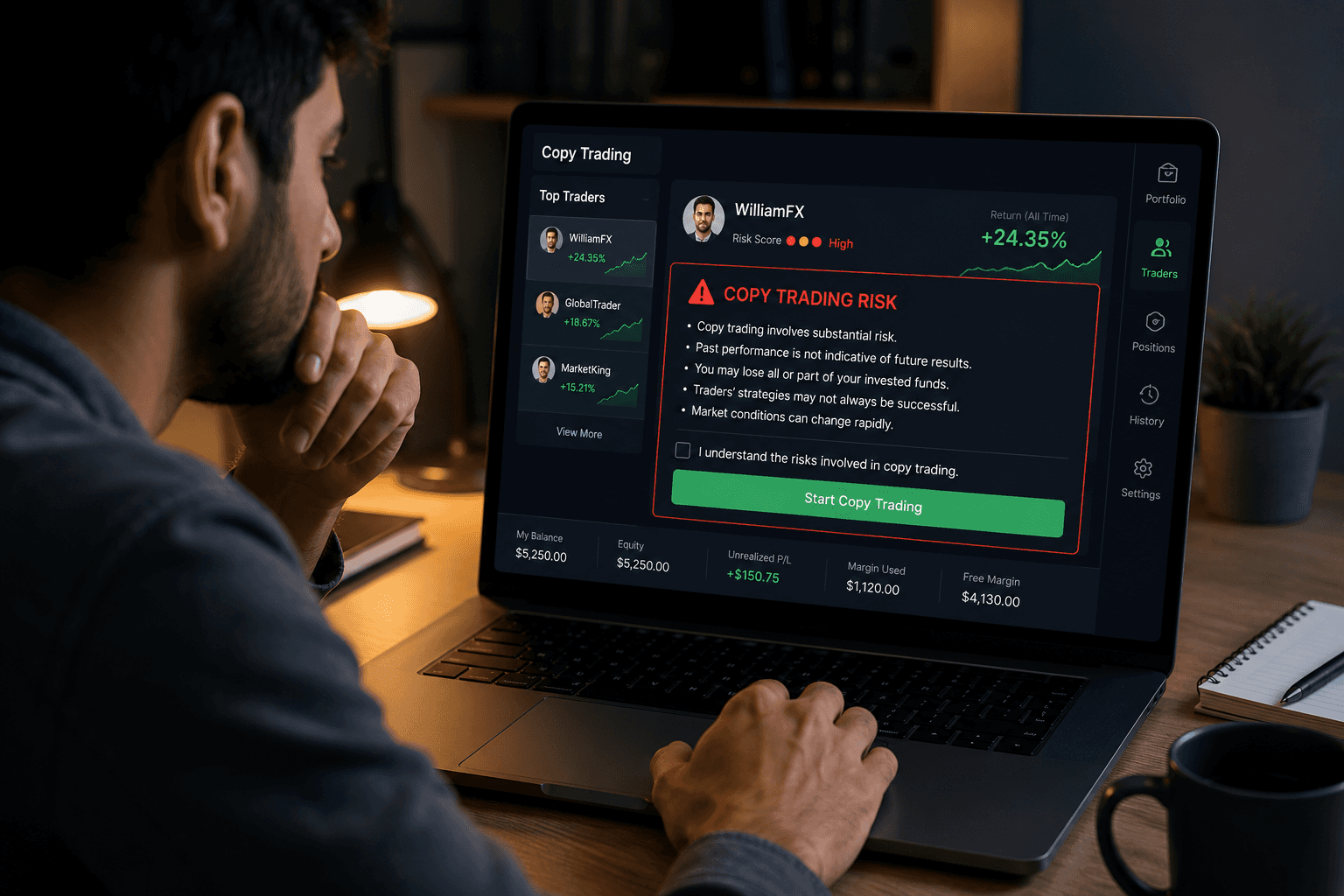
Over the past decade, copy trading has exploded in popularity. Retail investors who once felt locked out of profitable trading strategies can now replicate the exact moves of seasoned professionals with just a few clicks. Platforms have made it effortless: browse trader profiles, check their track records, hit copy, and go. For millions of people around the world, it has become the gateway to forex and CFD markets. But there is a dangerous illusion baked into this convenience. Copy trading feels passive — and that feeling is precisely what makes it risky. When investors stop thinking critically about who they are copying, how much risk is being taken on their behalf, and whether the strategy actually fits their own financial goals, losses become almost inevitable.
1. What Is Copy Trading? A Quick Refresher
Before we dig into risks, it helps to be clear on what copy trading actually is. In simple terms, copy trading is a feature offered by brokers and platforms that allows you to automatically replicate the trades of another trader — called a signal provider or master trader — in real time and in proportion to your own account size.
For example, if the master trader opens a 2% position on EUR/USD, your account automatically mirrors that same 2% allocation. If they close the trade at a 50-pip profit, you close at roughly the same profit (minus fees and slippage). If they lose, you lose.
To understand the fundamentals of how this mechanism works before assessing the risks, read the full breakdown in
→ Copy Trading Explained: How It Works and Who It's For
2. The Core Risks Every Copy Trader Faces
Copy trading is not investing in a fund managed by a regulated professional. You are handing control of your capital to another retail trader whose motivations, discipline, and risk management practices you cannot fully verify. Here are the major risk categories you must understand.
2.1 Blind Following Risk
The most fundamental risk in copy trading is what analysts call "blind following" — copying a trader without genuinely understanding their strategy, their risk appetite, or the conditions under which their approach works.
A trader with a 6-month winning streak might be using a martingale strategy that doubles position sizes after every loss. Everything looks great until one bad run wipes out their entire account — and yours along with it. Past performance on a leaderboard tells you nothing about what strategy is being used or whether it is sustainable.
⚠ Key Insight: Always look beyond the profit percentage. Examine maximum drawdown, win rate, average trade duration, and consistency over at least 12 months before copying any trader. |
2.2 Over-Leverage Risk
Leverage is a double-edged sword in forex. It amplifies both gains and losses. Some high-profile signal providers on copy trading platforms use extremely high leverage — sometimes 1:500 or beyond — to generate eye-catching returns. Those returns attract copiers. But when the market moves against a heavily leveraged position, accounts can be margin-called and zeroed out in minutes.
New traders especially misunderstand leverage. They see a 200% annual return and do not realise it was generated by risking 50% of the account on a single trade. To fully understand how leverage affects your risk exposure, read:
→ How Does Leverage Work in Forex?
2.3 Strategy Mismatch Risk
Even if a signal provider is a genuinely skilled trader with a solid strategy, their approach might be completely wrong for you. Consider these mismatches:
• A scalper who trades 50 times a day may generate excessive fees on your account.
• A swing trader who holds positions for weeks may require a drawdown tolerance you simply do not have.
• A high-risk, high-reward trader may suit someone with $50,000 but devastate someone trading with $500.
Strategy mismatch is one of the most overlooked risks in copy trading. The question is not just "is this trader good?" but "is this trader right for me?"
2.4 Slippage Risk
Even when copying is automated, your trades do not always execute at the exact same price as the master trader's. This difference — called slippage — can eat into your profits on every single trade, and in high-frequency strategies, the effect compounds significantly over time.
Slippage occurs because there is always a tiny delay between when the signal is sent and when your broker executes the order. During that delay, prices move. On volatile currency pairs or during news events, slippage can be substantial.
2.5 Platform and Broker Risk
Not all copy trading platforms are created equal. A platform with poor execution infrastructure can compound slippage. A broker without solid regulatory oversight might freeze withdrawals, manipulate spreads, or simply disappear with your funds.
Choosing a regulated, transparent broker is not optional — it is the baseline. Before you copy a single trade, make sure you understand the broker behind the platform:
→ Is Olympus Capital FX Safe? Regulation, Funds & Security Explained
2.6 Hidden Fees and Cost Drag
Copy trading platforms typically charge performance fees (a percentage of your profits paid to the signal provider), spread markups, and sometimes subscription fees. While each individual cost may seem small, their combined effect over months of trading can dramatically reduce your net returns.
A trader showing 40% annual returns might only deliver 22% to copiers after fees, spread costs, and slippage are accounted for. Always model the total cost of copying before committing capital.
2.7 Psychological Detachment Risk
This one is subtle but important. When you copy a trader, you are no longer making your own decisions — and that creates a psychological problem. Investors who copy trades do not develop the emotional discipline required to withstand drawdowns. When losses mount, they panic-stop copying, often at the worst possible moment — right before the strategy recovers.
Contrast this with PAMM accounts, where your capital is pooled and managed professionally. The differences in how risk is distributed and managed are significant:
→ PAMM Account vs Copy Trading: Which Is Better for Passive Income in Forex?
3. Copy Trading vs PAMM: A Risk Comparison
Many investors who discover copy trading also encounter PAMM accounts (Percentage Allocation Management Module). Both allow you to benefit from another trader's expertise, but they carry different risk profiles.
Risk Type | Level | Mitigation Strategy |
Blind Following | High | Research trader history, verify consistency over 12+ months |
Over-Leverage | High | Set max drawdown limits, use conservative lot sizes |
Platform Failure | Medium | Choose regulated brokers with uptime guarantees |
Strategy Mismatch | Medium | Match trader's risk profile to your own tolerance |
Slippage | Medium | Use limit orders, check execution speed reports |
Hidden Fees | Low | Read fee schedules before connecting to any signal provider |
No Learning Curve | Low | Study trades; don't rely solely on automation |
In copy trading, you retain individual control — you can stop copying at any time. In a PAMM account, your funds are pooled and managed collectively, which can offer benefits in terms of professional oversight and economies of scale.
For a full comparison of both models, including which suits different investor profiles:
→ What Is a PAMM Account in Forex?
→ Best PAMM Forex Brokers 2026
4. 7 Warning Signs of a Risky Signal Provider
When evaluating traders to copy, these red flags should give you serious pause:
1. Unrealistic returns — Consistently 50%+ monthly returns are almost always unsustainable and signal extreme risk-taking.
2. Short track record — Less than 6 months of history is insufficient to evaluate consistency.
3. High maximum drawdown — Any trader with a historical max drawdown above 30% is taking significant risks with your capital.
4. Inconsistent activity — Long gaps followed by bursts of heavy trading suggest emotional decision-making.
5. Heavy use of martingale or grid strategies — These can produce steady profits until one large loss erases everything.
6. No transparent trade history — Providers who hide individual trade details should be avoided completely.
7. Growing copier base without proportional track record — Popularity is not proof of skill. Many copiers chasing recent results is a contrarian warning sign.
5. Risk Management Strategies for Copy Traders
Copy trading does not mean you surrender all responsibility for risk management. Here is how to protect yourself:
Set a Stop-Loss on Your Copy
Most platforms allow you to set a maximum drawdown limit on a copy relationship. For example, if the account you are copying loses 20%, your copy automatically stops. This is non-negotiable risk management — always set it.
Diversify Across Multiple Traders
Copying a single trader concentrates your risk entirely in one strategy, one person's decisions, and one style. Spreading capital across three to five traders with different styles — scalping, swing trading, trend following — provides meaningful diversification.
Start Small
Never allocate your full trading capital to a new copy. Start with 10–20% of what you plan to invest, observe performance for one to three months under real conditions, and only scale up if results remain consistent with the historical record.
Understand What You Are Copying
Even if you are not executing trades yourself, make an effort to understand the strategy. What instruments does the trader favour? How long are positions held? Does their approach match current market conditions? An informed copier is a safer copier.
If you are just starting out and want a structured approach before copying, explore the educational resources available at:
→ Copy Trading in Forex for Beginners: How It Works & What to Expect
6. Regulatory and Legal Risks
Copy trading operates in a regulatory grey area in many jurisdictions. The person or algorithm you are copying is typically not a licensed financial advisor. The platform facilitating the copy may itself be lightly regulated.
Key legal risk considerations include:
• If your signal provider turns out to be fraudulent, you may have very limited legal recourse depending on where the platform is based.
• Profits from copy trading may be taxed differently from other investment income in your jurisdiction — consult a tax professional.
• Platforms operating in unregulated jurisdictions may have no obligation to protect client funds, offer negative balance protection, or provide segregated account security.
This is why broker regulation is a first-line protection for copy traders. Always verify the regulatory status of any platform before depositing funds. You can explore the security and regulatory framework behind Olympus Capital FX here:
→ Is Olympus Capital FX Safe? Regulation, Funds & Security Explained
7. Copy Trading in 2026: Trending Risks to Watch
The copy trading landscape is evolving fast. New risks are emerging alongside new opportunities:
AI-Powered Signal Providers
Increasingly, platforms are listing AI-driven trading algorithms as signal providers. These bots can show impressive short-term results but are often optimised on historical data that may not generalise to live market conditions. The risk of overfitting — where an algorithm performs brilliantly in backtesting but fails in live trading — is significant.
Social Media Influencer Traders
A growing number of social media influencers promote their copy trading profiles as a revenue stream. They benefit from performance fees regardless of your outcomes. Their incentive is to attract copiers, not necessarily to manage risk conservatively. Verify everything independently.
Crypto Copy Trading
Copy trading has expanded beyond forex into cryptocurrency markets. Crypto markets are significantly more volatile than forex, liquidity can drop precipitously during downturns, and the regulatory protections that apply to forex trading often do not extend to crypto platforms.
Signal Aggregator Platforms
New platforms aggregate signals from dozens of sources and automatically blend them. While this sounds like diversification, it can create opaque risk structures where you have no visibility into the underlying strategies or the correlations between them.
Conclusion: Copy Smart, Not Blind
Copy trading is not inherently dangerous — but it is only as safe as the decisions you make before you click copy. The investors who succeed with it are those who approach it the way a professional would: with research, risk management, diversification, and a clear understanding of what they are signing up for.
The risks outlined in this guide — blind following, over-leverage, strategy mismatch, slippage, platform risk, hidden fees, and psychological detachment — are all manageable if you know they exist. Now you do.