2mins read
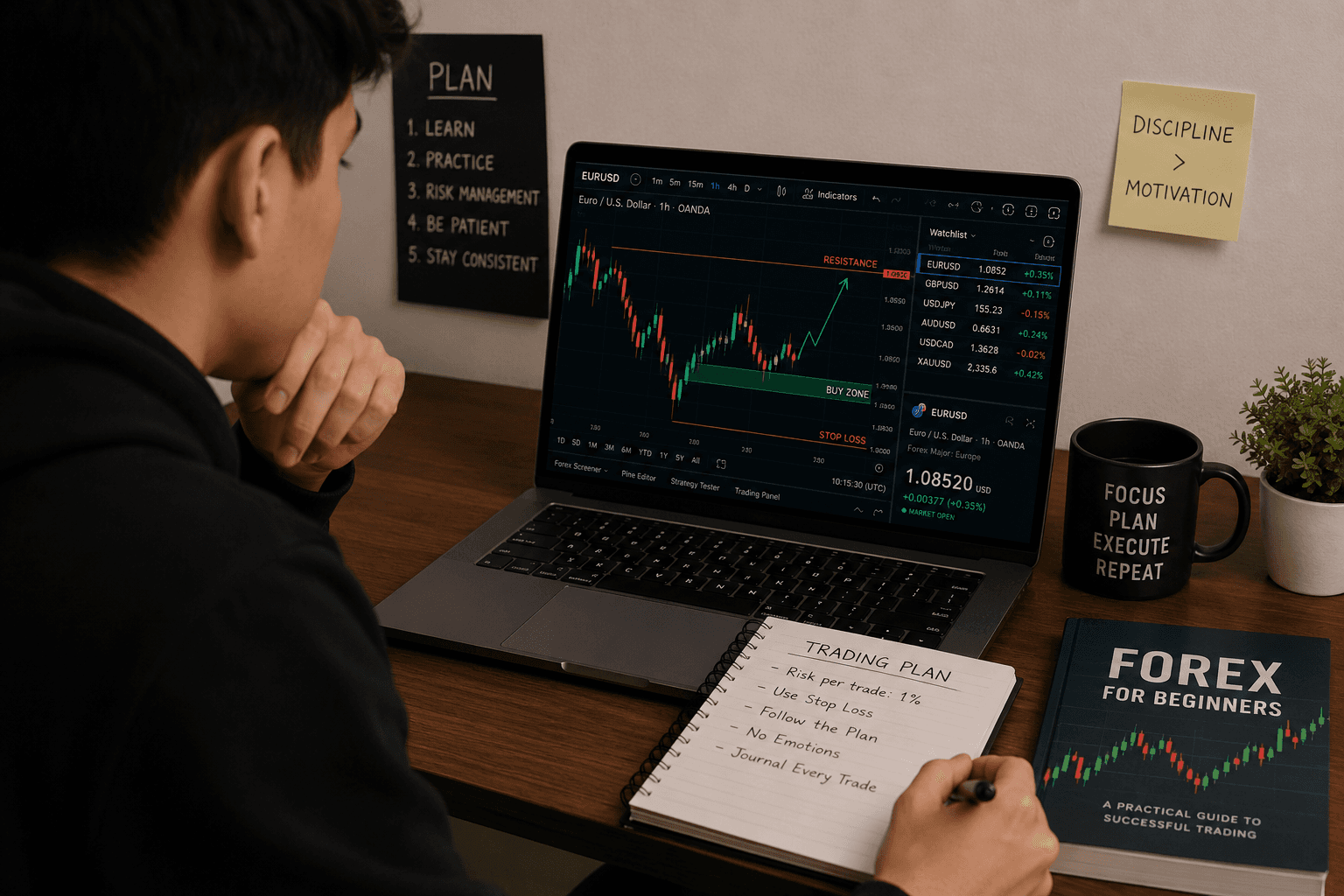
If you're open to it, instead of using a form submission process, we can add a WhatsApp button. This would allow leads to contact you directly on WhatsApp, making the process quicker and more convenient for potential customers. If you've been curious about trading but felt overwhelmed by jargon like "pip spreads", "leverage ratios", or "margin calls", you're not alone. The good news is that the fundamentals of forex CFD trading are more accessible than most beginners expect. You don't need a finance degree. You don't need a large starting capital. What you do need is a solid understanding of how the market works, a reliable broker, and a disciplined risk management approach — all of which this guide will give you.
1. What Is Forex CFD Trading? A Plain-English Explanation for Beginners
"Forex" is short for Foreign Exchange — the global marketplace where currencies are bought and sold. A "CFD" (Contract for Difference) is a financial instrument that allows you to trade on the price movement of an asset without actually owning it.
When you combine the two, you get Forex CFD trading: the ability to speculate on whether one currency will rise or fall against another, without ever physically holding that currency.
How a Forex CFD Trade Works — Step by Step
Here's a simplified example:
• You believe the Euro (EUR) will strengthen against the US Dollar (USD).
• You open a BUY position on EUR/USD at 1.0850.
• EUR/USD rises to 1.0920 — a move of 70 pips.
• You close the position and collect the difference as profit.
If the price had moved against you — falling to 1.0800 — you would have incurred a loss of 50 pips. With CFDs, profits and losses are determined purely by price movement, not by owning any currency.
💡 Key Long-Tail Keywords Covered "what is forex CFD trading for beginners" | "how does forex CFD trading work" | "forex CFD trading explained step by step" |
2. Understanding Currency Pairs, Pips, and Spreads
Every forex trade involves two currencies — and understanding how they are quoted is essential before you place a single trade.
Currency Pairs: Base vs. Quote
A currency pair like EUR/USD is made up of two parts: EUR is the base currency (the one you're buying or selling) and USD is the quote currency (the one used to price the base). The price shown — say 1.0850 — means 1 Euro costs 1.0850 US Dollars.
There are three main categories of pairs:
• Major Pairs — EUR/USD, GBP/USD, USD/JPY. Highest liquidity, tightest spreads.
• Minor Pairs — EUR/GBP, AUD/NZD. Less liquidity but still widely traded.
• Exotic Pairs — USD/TRY, EUR/ZAR. Higher spreads and more volatility.
What Is a Pip?
A "pip" (percentage in point) is the smallest price movement in a currency pair. For most pairs, one pip equals 0.0001. If EUR/USD moves from 1.0850 to 1.0860, that's a move of 10 pips.
What Is a Spread?
The spread is the difference between the buy (ask) price and the sell (bid) price. It's how brokers make money on each trade. At Olympus Capital, spreads on major pairs start from 0.0 pips on Raw and Pro accounts — meaning lower costs for every trade you make.
Explore Olympus Capital's account types and spreads: olympuscapitalfx.com/forex-accounts
3. How Leverage Works in Forex CFD Trading (And Why It Matters)
Leverage is one of the most powerful — and most misunderstood — concepts in forex trading. It allows you to control a much larger position than your actual account balance would normally permit.
A Simple Leverage Example
With 1:100 leverage, a $100 deposit controls a $10,000 position. If that position gains 1%, you profit $100 — a 100% return on your actual deposit. But if it loses 1%, you lose your entire $100.
Olympus Capital offers leverage up to 1:500 on Standard accounts, meaning even small deposits can access meaningful market exposure. But as with any powerful tool, responsible use is critical.
⚠️ Risk Warning Leverage amplifies both profits AND losses. Never risk money you cannot afford to lose. Olympus Capital provides Negative Balance Protection on all accounts. |
For a detailed breakdown of how leverage works in practice, read our full guide:
How Does Leverage Work in Forex? — Olympus Capital Blog
4. What Is Margin in Forex? Understanding Margin Requirements for Beginners
Closely linked to leverage is the concept of margin. Margin is the amount of money your broker requires you to deposit as collateral to open and maintain a leveraged position.
Types of Margin
• Required Margin — The minimum deposit needed to open a position.
• Used Margin — The total margin currently tied up in your open trades.
• Free Margin — Funds in your account not currently used as collateral.
• Margin Level — A percentage showing the health of your account (Equity / Used Margin × 100).
• Margin Call — A warning that your account is running low on free margin.
Monitoring your margin level is one of the most important habits for any forex beginner. If your margin level drops too low, your broker will automatically close open positions — a "stop out" — to prevent your account from going negative.
5. Long-Tail Keywords in Forex CFD Trading: What Beginners Actually Search For
One of the best ways to understand what fellow beginners are asking is to look at real search queries. Here are the most common long-tail questions — each answered briefly below:
Long-Tail Question | Quick Answer |
How do I start forex CFD trading with $100? | Open a Standard account, use low leverage (1:10), trade micro lots. |
What is the best forex CFD strategy for beginners? | Trend-following with risk/reward ratio of 1:2 or better. |
Is forex CFD trading safe for beginners? | It carries risk, but a regulated broker + risk management tools make it manageable. |
What time is best for forex CFD trading? | London-New York overlap (1 PM–5 PM GMT) has highest liquidity. |
Can I lose more than I deposit in forex CFDs? | Not with Negative Balance Protection — Olympus Capital provides this on all accounts. |
What leverage should a beginner use in forex? | 1:10 to 1:50 is considered conservative and appropriate for new traders. |
6. Beginner Forex CFD Trading Strategies That Actually Work
You don't need complex algorithms to start making sense of the forex market. Here are five beginner-friendly strategies:
Strategy 1: Trend Following
Trade in the direction of the prevailing trend. Use moving averages (e.g., 50 EMA and 200 EMA) to identify whether a pair is in an uptrend or downtrend. Buy during pullbacks in an uptrend; sell during rallies in a downtrend.
Strategy 2: Breakout Trading
Wait for price to break through key support or resistance levels with strong momentum. Enter a trade in the direction of the breakout with a tight stop-loss just below (for buys) or above (for sells) the breakout level.
Strategy 3: Copy Trading
If you're a complete beginner, copy trading lets you automatically replicate the trades of an experienced trader. It's a way to learn and earn simultaneously — though it comes with its own risks.
Learn more: Copy Trading in Forex for Beginners: How It Works & What to Expect
Also read: Copy Trading Risks Explained: What Every Investor Must Know
Strategy 4: PAMM Accounts for Passive Income
A PAMM (Percentage Allocation Management Module) account allows you to invest your funds with a professional money manager who trades on your behalf. You allocate capital; they trade it; profits and losses are distributed proportionally.
Explore more: What Is a PAMM Account in Forex? — Olympus Capital
And compare options: PAMM Account vs Copy Trading: Which Is Better for Passive Income in Forex?
7. Risk Management: The Most Important Skill in Forex CFD Trading
Many beginner traders focus entirely on finding profitable trades while ignoring the single most important discipline in trading: risk management. The traders who survive and thrive over the long term are not necessarily those who win the most often — they are those who lose the least when they're wrong.
Core Risk Management Rules for Beginners
• Risk no more than 1–2% of your account on any single trade.
• Always use a Stop-Loss order to cap your maximum loss.
• Target a Risk/Reward ratio of at least 1:2 (risk $50 to make $100).
• Never add to a losing position hoping it will reverse.
• Keep a trading journal to track every trade and learn from mistakes.
• Use a demo account to practise before trading real money.
🛡️ Olympus Capital's Built-In Protections All accounts include Negative Balance Protection, segregated client funds, and access to MT5's full suite of risk management order types including stop-loss, take-profit, and trailing stops. |
8. How to Choose a Forex CFD Broker as a Beginner
Your broker is the foundation of your trading operation. A poor choice here can cost you money through high spreads, slow execution, or — worst of all — by trading with an unregulated firm. Here's what to check:
Factor | What to Look For | Olympus Capital |
Regulation | Licensed by a reputable authority | ✅ St. Lucia IBC license |
Spreads | Low spreads = lower trading costs | ✅ From 0.0 pips (Raw/Pro) |
Leverage | Flexible leverage with risk controls | ✅ Up to 1:500 |
Min. Deposit | Low enough to start with confidence | ✅ From $100 |
Platform | MT4/MT5 industry standard | ✅ MetaTrader 5 |
Client Funds | Segregated accounts essential | ✅ Fully segregated |
Neg. Balance | Must have for beginners | ✅ All accounts |
Verify broker safety and regulation: Is Olympus Capital FX Safe? Regulation, Funds & Security Explained
9. Step-by-Step: How to Start Forex CFD Trading with Olympus Capital
Getting started takes less than 10 minutes. Here is the exact process:
1. Create Your Account — Visit olympuscapitalfx.com, click "Get Started", and complete the quick registration form.
2. Choose Your Account Type — Standard (from $100), Raw (from $200), or Pro (from $10,000). See full comparison at olympuscapitalfx.com/forex-accounts.
3. Practise on a Demo Account — Before depositing real money, explore the MT5 platform in demo mode. This is free and risk-free.
4. Fund Your Account — Deposit instantly via secure global payment options including bank wire and online payment gateways.
5. Start Trading — Open MT5, select a currency pair, set your lot size and stop-loss, and execute your first live trade.
6. Keep Learning — Visit olympuscapitalfx.com/learn for educational resources, and olympuscapitalfx.com/blogs for ongoing market insights from professionals.
10. Common Mistakes Beginners Make in Forex CFD Trading (And How to Avoid Them)
Even the most motivated beginners fall into predictable traps. Here's how to side-step them:
• Over-leveraging — Using maximum leverage from day one is the fastest way to blow an account. Start with 1:10 or lower.
• Ignoring stop-losses — Every trade needs a defined maximum loss. Without a stop-loss, one bad trade can wipe out weeks of gains.
• Trading without a plan — Decide your entry, exit, and risk before opening a trade. Never enter on impulse.
• Chasing losses — After a losing trade, the urge to "win it back" leads to emotional decisions and larger losses. Take a break instead.
• Trading too many pairs at once — Master one or two major pairs first. EUR/USD is the ideal starting point.
• Skipping education — The forex market rewards preparation. Use Olympus Capital's educational resources at olympuscapitalfx.com/learn.