2mins read
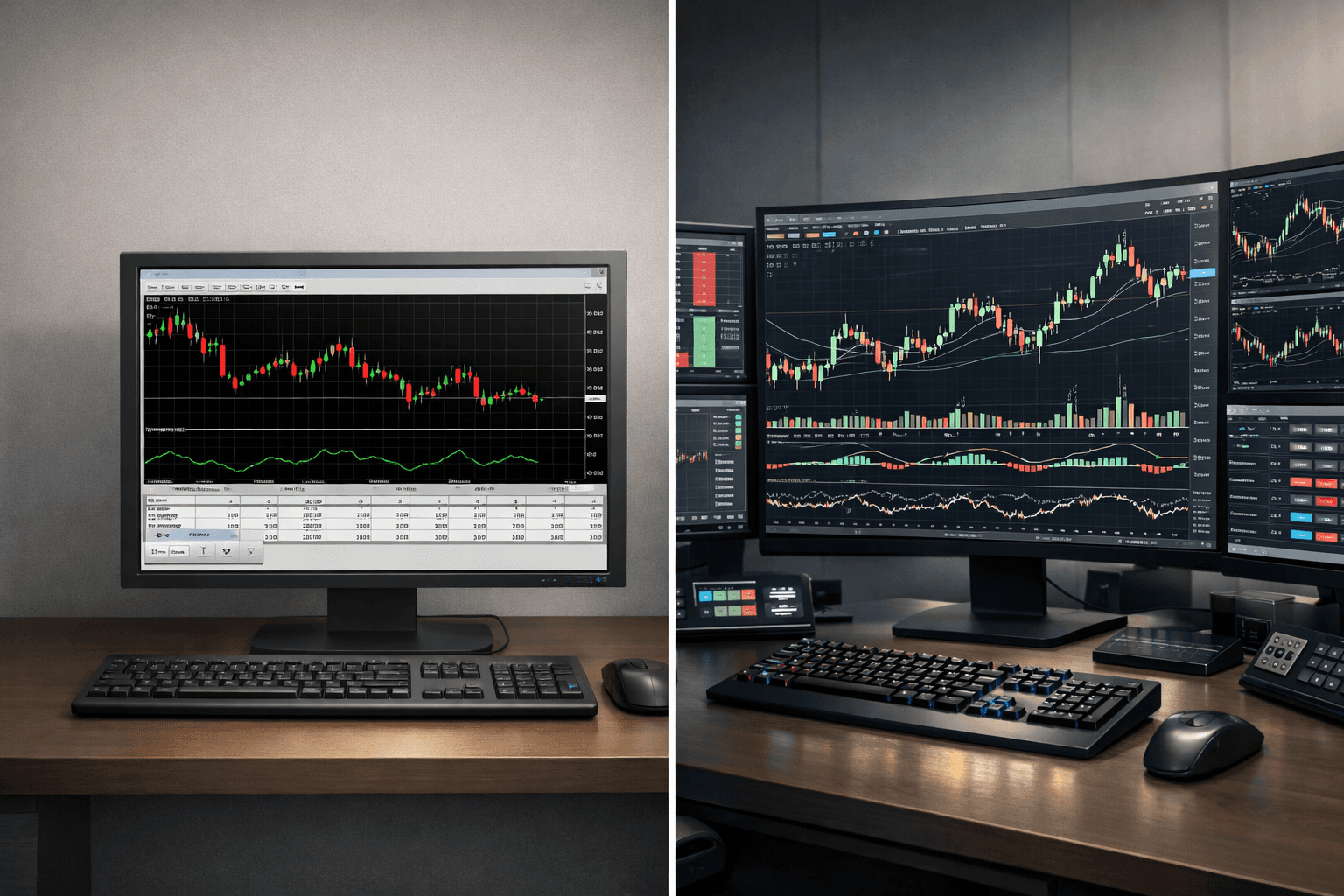
When starting your Forex trading journey, selecting the right platform can directly impact your performance, strategy execution, and overall experience. MetaTrader 4 (MT4) and MetaTrader 5 (MT5) are widely used trading platforms developed to help traders analyze markets and execute trades efficiently. While MT4 is known for its simplicity and Forex-focused environment, MT5 offers advanced features and access to multiple financial markets. What this blog covers: 1. What MT4 and MT5 are and how they work 2. Key differences between MT4 and MT5 3. Comparison of features like charts, indicators, and order types 4. Which platform is better for beginners vs advanced traders 5. Real trading examples for better understanding 6. Common mistakes traders make while choosing a platform
When starting Forex trading, one of the first technical decisions traders must make is choosing a trading platform. Two of the most popular platforms in the world are MetaTrader 4 (MT4) and MetaTrader 5 (MT5). Both are developed by MetaQuotes and are widely used by brokers and traders globally.
However, many beginners feel confused because the names sound similar, yet the platforms work differently in practice.
This raises an important question: MT4 vs MT5 – which one should you use?
In this blog, we will explain MT4 and MT5 in detail, compare their features, provide real trading examples, and help you decide which platform is better for your trading style and experience level.
What Is MT4?
MetaTrader 4, commonly known as MT4, is a trading platform designed mainly for Forex trading. It has been in use for many years and remains one of the most popular platforms among retail Forex traders.
MT4 is known for its simplicity, stability, and strong focus on currency trading. Many beginner and professional traders prefer MT4 because it is easy to understand and does not overwhelm users with unnecessary features.
Example of MT4 in Real Trading
Suppose you are a beginner trading EUR/USD. On MT4, you can easily open a chart, apply basic indicators like Moving Averages or RSI, and place a buy or sell order within seconds.
If your strategy is simple, such as trend following or support and resistance trading, MT4 provides all the tools you need without complexity.
What Is MT5?
MetaTrader 5, or MT5, is the newer version of the MetaTrader platform. It was developed to support not only Forex trading but also stocks, indices, commodities, and futures.
MT5 offers more advanced tools, additional order types, and enhanced technical analysis features. It is designed for traders who want access to multiple markets and more detailed data.
Example of MT5 in Real Trading
Imagine you trade Forex in the morning, stock indices in the afternoon, and commodities during high volatility news events. MT5 allows you to manage all these instruments from one platform.
MT5 also offers more timeframes and built-in indicators, which is helpful for traders who rely on deeper market analysis.
Key Differences Between MT4 and MT5 Explained Simply
Understanding the differences between MT4 and MT5 helps you make a better decision.
1. Market Coverage
MT4 is primarily focused on Forex trading. While some brokers allow CFDs on MT4, it was originally built for currencies.
MT5 supports Forex, stocks, indices, commodities, futures, and sometimes cryptocurrencies. This makes MT5 more suitable for traders who want to diversify beyond Forex.
Example:
If you only trade EUR/USD and GBP/USD, MT4 is more than enough.
If you trade Forex and stock indices like NASDAQ or DAX, MT5 is more suitable.
2. Timeframes and Charting Tools
MT4 offers 9 timeframes, which are sufficient for most traders.
MT5 offers 21 timeframes, allowing more precise analysis across short-term and long-term charts.
Example:
A scalper using 1-minute and 5-minute charts will find both platforms suitable.
A swing trader who analyzes multiple timeframes may prefer MT5 for added flexibility.
3. Order Types and Execution
MT4 supports basic order types such as market orders, buy limit, sell limit, buy stop, and sell stop.
MT5 includes all MT4 order types plus additional ones like buy stop limit and sell stop limit. These advanced orders allow more precise trade execution.
Example:
If your strategy requires entering trades only after a specific price structure forms, MT5 gives you more control.
4. Indicators and Technical Analysis
MT4 includes around 30 built-in indicators and allows custom indicators.
MT5 includes over 80 built-in indicators and analytical tools, along with economic calendar integration.
Example:
A beginner using RSI and Moving Averages will find MT4 sufficient.
An advanced trader combining volume analysis, custom indicators, and news events may benefit more from MT5.
5. Speed and Performance
MT5 is generally faster and more efficient because it uses a newer programming structure.
MT4 is stable and reliable but slightly slower when handling multiple instruments and large datasets.
Example:
If you run multiple charts and indicators at the same time, MT5 may perform better on modern systems.
6. Expert Advisors and Automation
MT4 uses MQL4 for automated trading systems.
MT5 uses MQL5, which is more powerful and faster but also more complex.
Example:
Many existing trading robots and strategies are built for MT4.
Newer and more advanced algorithms are often developed for MT5.
MT4 vs MT5: Which One Is Better for Beginners?
For most beginners, MT4 is often the better choice.
MT4 has a simpler interface, fewer distractions, and a strong focus on Forex trading. This helps new traders concentrate on learning price action, risk management, and basic strategies without getting overwhelmed.
Example:
A new trader learning support and resistance or trend trading can focus entirely on execution in MT4 without worrying about extra features.
MT4 vs MT5: Which One Is Better for Advanced Traders?
Advanced traders often prefer MT5 because of its expanded functionality.
If you trade multiple markets, use advanced technical tools, or rely on detailed market data, MT5 provides a more comprehensive trading environment.
Example:
A trader combining Forex, indices, and commodities with multiple timeframes and news analysis will benefit from MT5.
Common Mistakes Traders Make When Choosing Between MT4 and MT5
Many traders choose a platform based on hype rather than their actual needs.
Some beginners choose MT5 thinking it is automatically better, only to feel confused by its complexity. Others avoid MT5 completely without realizing its advantages for multi-asset trading.
The best approach is to match the platform to your trading style, not the other way around.
Related Articles

Forex Strategy
Aug 21, 2026
Position Sizing & Money Management in Forex: Survive and Profit
Forex Trading Basic
Aug 21, 2026
Position Sizing & Money Management in Forex: Survive and Profit

Forex Strategy
Aug 20, 2026
Stochastic Indicator in Forex: Catch Momentum Shifts

Forex Trading Basic
Aug 19, 2026
Fibonacci Retracement in Forex: Find Hidden Support Levels