2mins read
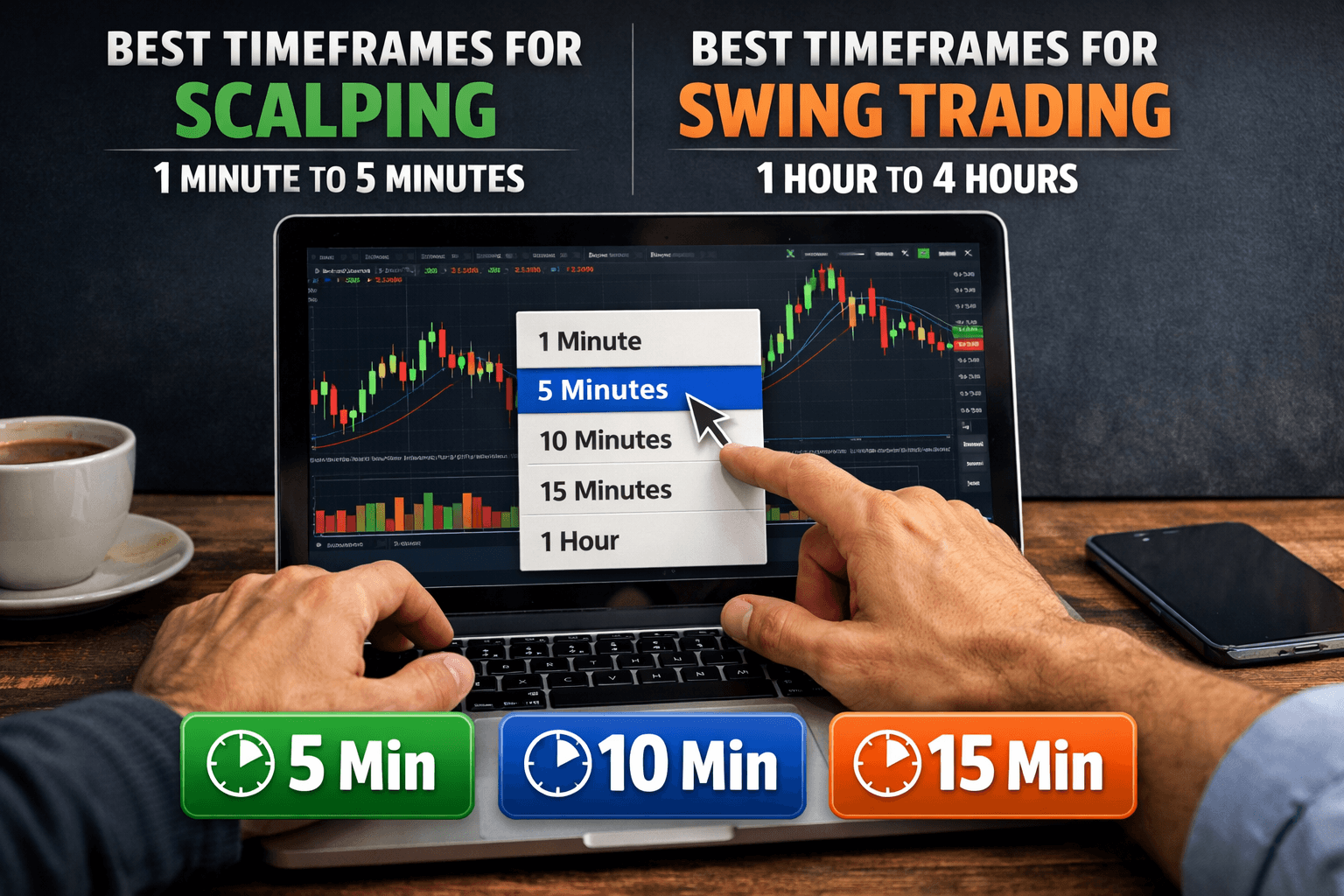
Ask any seasoned forex trader what separates consistent winners from those who constantly struggle, and you'll rarely hear them talk about indicators or secret strategies. More often than not, the answer comes down to something far more fundamental — timeframe selection. The timeframe you trade on isn't just a chart setting. It shapes how you read price action, how long you hold your trades, how many opportunities you see in a session, and how much noise you're exposed to. A strategy that performs brilliantly on the H4 chart can become completely unreliable on the M1 — not because the strategy is flawed, but because it was built for a different market environment.
Choosing the right timeframe isn't just a setting on your chart — it's the foundation of your entire trading strategy. Whether you're a fast-paced scalper chasing micro-movements or a patient swing trader riding multi-day trends, the timeframe you trade on shapes every decision you make.
Why Timeframe Selection Matters
In forex trading, every strategy lives or dies by timing. A scalper using a 4-hour chart will miss dozens of entry opportunities, while a swing trader trying to work off a 1-minute chart will be constantly stopped out by noise. Timeframe selection aligns your strategy with market structure, volatility windows, and your own lifestyle as a trader.
Before diving into specific timeframes, it's crucial to understand how to read market data on each one. Candlestick patterns, support and resistance levels, and moving averages all behave differently depending on the chart interval. If you're still building that foundation, start with mastering the art of reading forex charts — it will make everything else in this guide click faster.
The two most popular trading styles — scalping and swing trading — each thrive on specific timeframes. Understanding why those timeframes work is just as important as knowing which ones to pick.
Scalping: Speed Is the Strategy
Scalping is the art of capturing small price movements, often dozens of times a day. Scalpers hold trades for seconds to minutes, targeting anywhere from 3 to 20 pips per trade. The goal is volume and consistency — many small wins that add up over a session.
Too slow for scalp entries
The M1 chart is the scalper's primary battlefield. It delivers the finest view of price action, allowing traders to spot micro-patterns and execute within tight bid-ask spreads. However, the M1 chart is also the noisiest — false signals are frequent, which is why most experienced scalpers layer in the M5 for trend confirmation before pulling the trigger.
The M15 chart acts as a structural map. If the M15 shows a strong downtrend, a scalper would avoid trying to buy on the M1 — they'd only look for short setups aligned with the higher timeframe bias. This multi-timeframe approach dramatically improves win rate. Your platform's multi-chart layout tools are critical here, and the right execution environment makes all the difference — understanding how to choose a forex platform that fits your trading style can be the difference between a seamless scalp session and constant frustration.
Pro Tip — Session Timing
Scalping works best during the London open (8:00–10:00 GMT) and New York overlap (13:00–16:00 GMT). These windows produce the highest pip movement per hour, giving scalpers the volatility they need to profit from micro-moves.
What Makes a Good Scalping Setup?
A quality scalp entry requires three things in alignment: a clear short-term trend on M5, a clean pullback to a key level, and a trigger candle on M1 that confirms renewed momentum. Scalpers also rely heavily on tight spreads — EUR/USD, GBP/USD, and USD/JPY are the preferred pairs for this reason.
Risk management for scalping is non-negotiable. With such small profit targets, even a handful of outsized losses can wipe out an entire session. Most scalpers risk no more than 0.5%–1% of their account per trade and use hard stop-losses of 5–10 pips. If you're transitioning from demo to live, this discipline becomes even more critical — the psychological dynamics shift significantly, and many traders who perform well on a simulator struggle with the emotional weight of real money. Exploring the differences between demo and live trading before going live can help you avoid the most common transition pitfalls.
Swing Trading: Patience as a Competitive Edge
Where scalpers thrive on speed, swing traders profit from patience. A swing trader aims to capture a single move over 1–5 days, targeting anywhere from 50 to 300+ pips depending on the pair and market conditions. The approach suits traders who can't monitor charts all day but want to participate meaningfully in the markets.
Best Timeframes for Swing Trading
The H4 chart is the heartbeat of swing trading. Each candle represents four hours of price action, filtering out the minute-to-minute noise while still offering actionable signals multiple times per week. Swing traders look for patterns like engulfing candles, pin bars at key support/resistance, and moving average crossovers on the H4 to identify their entries.
The Daily chart defines the macro trend. Most seasoned swing traders have a simple rule: only take H4 buy signals when the Daily chart is trending up, and only take H4 sell signals when the Daily is heading down. This top-down analysis is the foundation of consistent swing trading.
"The trend is your friend — but only when you're trading it at the right timeframe."
The Weekly chart is used less for entries and more for context. A weekly candle near a major resistance zone tells the swing trader to be cautious with bullish setups — even if the Daily and H4 look promising. When all three timeframes align, the probability of a successful swing trade increases substantially.
Tools That Matter for Swing Traders
Swing traders don't need lightning-fast execution like scalpers, but they do need reliable charting tools, clear alert systems, and the ability to run multiple currency pairs simultaneously. A platform's ability to handle advanced indicators, economic calendars, and clean chart rendering over longer timeframes is essential. The debate between MT4 and MT5 is particularly relevant here — MT5's expanded timeframes and improved order management make it a natural fit for swing traders who want more analytical depth without switching platforms.
Pro Tip — The 3-Timeframe Rule
Check the Weekly for direction, the Daily for structure, and the H4 for your entry trigger. If all three point the same way, you've found a high-probability swing trade. If they conflict, wait for alignment before committing capital.
Scalping vs Swing: A Direct Comparison
Factor | Scalping | Swing Trading |
|---|---|---|
Primary Timeframe | M1, M5 | H4, D1 |
Trade Duration | Seconds to minutes | Hours to days |
Pip Target | 3–20 pips | 50–300+ pips |
Trades Per Day | 10–50+ | 1–5 per week |
Screen Time | High (4–8 hrs) | Low (30–60 min/day) |
Ideal For | Full-time traders | Part-time traders |
Spread Sensitivity | Very high | Moderate |
Platform Features That Support Each Style
No matter which timeframe you trade on, your platform needs to keep up with your strategy. For scalpers, the priorities are one-click execution, minimal slippage, and customizable short-timeframe charts. For swing traders, the focus shifts to multi-timeframe analysis tools, custom indicator support, and robust alert functionality so they don't have to stare at charts all day.
Beyond just charting, modern platforms must deliver a range of capabilities to support serious traders. Things like partial close functionality, trailing stops, economic calendar integration, and fast order modification are no longer optional — they're baseline expectations. Knowing exactly what features every forex trading platform must have will help you evaluate your current setup and identify any gaps before they cost you trades.
Combining Timeframes: The Multi-TF Approach
The most sophisticated traders — regardless of style — don't rely on a single timeframe. They use a layered approach where each timeframe serves a distinct purpose: context, confirmation, and entry. This multi-timeframe analysis removes ambiguity and helps traders avoid the trap of entering a trade that looks great on one chart but directly contradicts a stronger move visible one level up.
For scalpers, the workflow is: M15 — Trend M5 — Setup M1 — Entry
For swing traders, it's: W1 — Bias D1 — Structure H4 — Entry
This framework keeps you trading with the market, not against it — and it dramatically reduces the number of low-probability setups you take.
Key Takeaways
The best timeframe isn't universal — it's the one that matches your strategy, personality, and available screen time. Scalpers thrive on M1–M15 charts during high-volatility sessions. Swing traders build their edge on H4 and Daily charts with weekly context. Both styles reward discipline, multi-timeframe awareness, and a platform that doesn't get in the way. Start on the timeframe that fits your schedule, master it, then layer in confluence from higher timeframes as your confidence grows.