2mins read
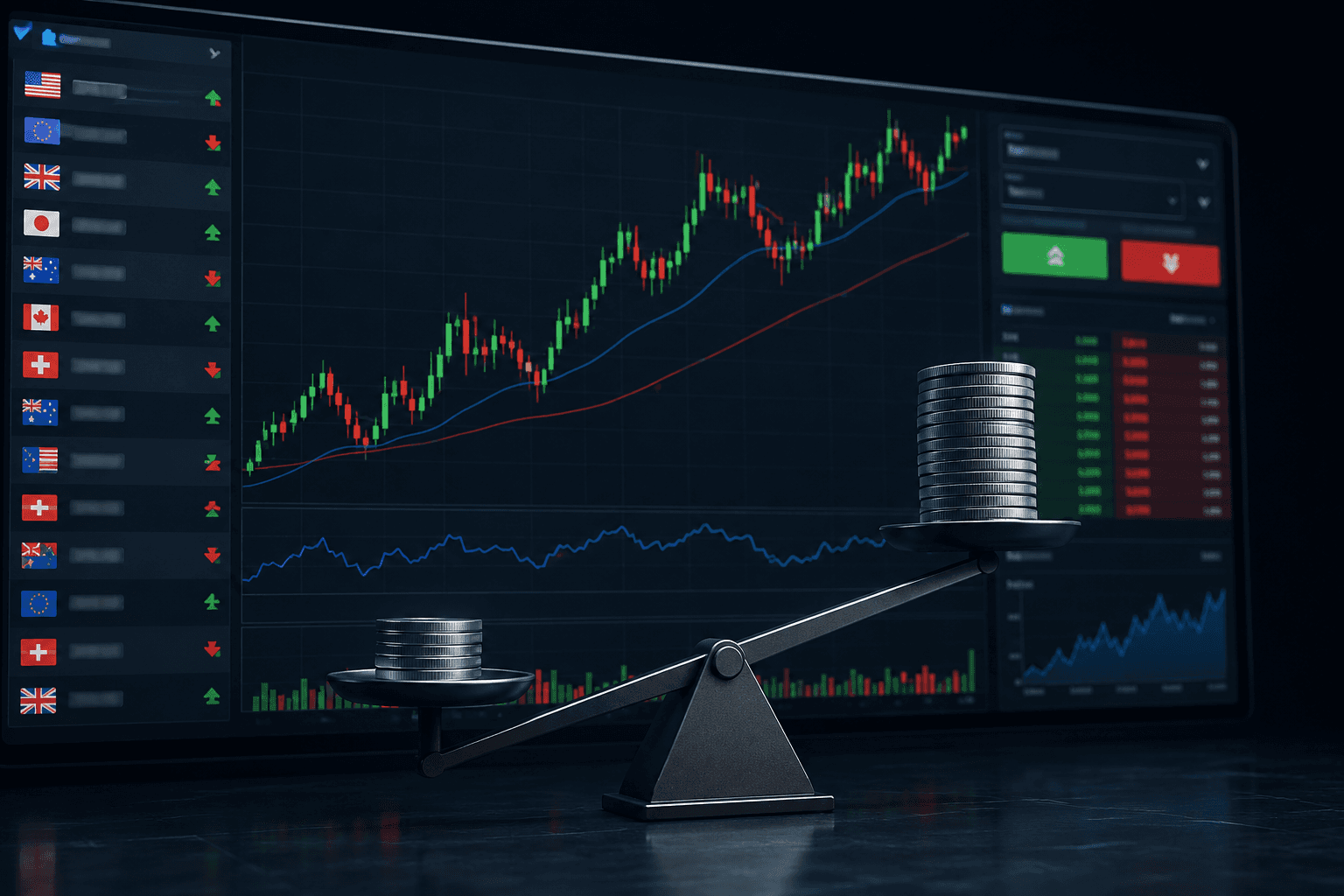
If you have ever opened a forex broker platform and seen ratios like 1:100 or 1:500, you were looking at leverage. It sounds powerful — because it is. But like any powerful tool, using it without understanding it can lead to serious losses. This guide breaks down exactly how leverage works in forex trading, with plain-English explanations and real numerical examples so you can start using it intelligently.
What Is Leverage in Forex?
Leverage allows you to control a large position in the market using a relatively small amount of your own capital. In forex, leverage is expressed as a ratio — for example, 1:100 means that for every $1 you deposit, you can control $100 worth of currency in the market.
Simple Definition Leverage = Controlling more money than you actually have deposited. Your broker lends you the difference. |
Think of it like a car loan. You might put down $5,000 and drive away in a $30,000 car. The bank covered the rest. In forex, your broker does the same thing — temporarily.
How Leverage Works — Step by Step
Step 1: Choose Your Leverage Ratio
When you open a trading account, you select a leverage ratio. Common options include 1:10, 1:50, 1:100, 1:200, and 1:500. Higher ratios mean more purchasing power — and more risk.
Step 2: Deposit Margin (Your Collateral)
To open a leveraged trade, you need to deposit margin — a fraction of the total trade value. This acts as a security deposit held by your broker.
Step 3: Open a Trade
Your broker uses your margin to allow you to control a much larger position. The profit or loss is calculated on the full position size, not just your margin.
Step 4: Close & Settle
When you close the trade, your profit or loss is added to or deducted from your account balance. Unused margin is released.
Margin vs Leverage: What's the Difference?
These two terms are closely related but mean different things:
Term | Definition | Purpose |
Leverage | Ratio of trade size to your capital (e.g., 1:100) | Controls how much you can trade |
Margin | Money you must deposit to open a trade | Acts as collateral / security deposit |
Free Margin | Funds available to open new trades | Equity minus used margin |
Margin Call | Alert when account equity drops near margin level | Broker asks you to top up or close trades |
The margin requirement is the inverse of leverage. With 1:100 leverage, the margin requirement is 1% of the trade value.
Leverage in Action: Real Examples
Example 1: 1:100 Leverage on EUR/USD
Factor | Value |
Trade Size | $10,000 (1 mini lot of EUR/USD) |
Your Leverage | 1:100 |
Margin Required | $100 (1% of $10,000) |
EUR/USD moves up 50 pips | +$50 profit |
Return on Margin | +50% on your $100 deposit |
Key Insight Without leverage, you would need $10,000 to control that position. With 1:100 leverage, you only need $100. The profit is the same — but the required capital is 100x smaller. |
Example 2: The Risk Side — Leverage Can Amplify Losses
Leverage is a double-edged sword. Let's see what happens when the trade goes against you:
Scenario | Value |
Account Balance | $1,000 |
Leverage | 1:100 |
Trade Size Opened | $50,000 (0.5 standard lot) |
Margin Used | $500 |
EUR/USD moves DOWN 100 pips | -$500 loss |
Remaining Balance | $500 (50% of account wiped out) |
EUR/USD moves DOWN 200 pips | -$1,000 = margin call / stop out |
⚠️ Risk Warning A 200-pip move against you with 1:100 leverage on a $50,000 position can wipe out a $1,000 account entirely. Always use stop-loss orders and risk only what you can afford to lose. |
Example 3: Comparing Different Leverage Ratios
Assuming you want to buy 1 standard lot (100,000 units) of GBP/USD at 1.2700:
Leverage | Margin Required | Position Value |
1:10 | $10,000 | $12,700 |
1:50 | $2,000 | $12,700 |
1:100 | $1,000 | $12,700 |
1:500 | $200 | $12,700 |
The potential profit or loss on a 100-pip move is identical across all four scenarios. The difference is how much of your own money is locked up as margin.
Common Leverage Ratios Explained
• 1:10 — Conservative. Good for beginners, minimal risk amplification.
• 1:50 — Moderate. Used by intermediate traders with solid risk management.
• 1:100 — Standard. The most commonly offered ratio by global forex brokers.
• 1:200 — Aggressive. Requires strong discipline and tight stop-losses.
• 1:500 — Very high. Common at offshore brokers. Not suitable for most retail traders.
Olympus Capital FX offers flexible leverage options tailored to your account type and experience level. Explore our forex accounts here.
Pros and Cons of Using Leverage
✅ Advantages | ❌ Disadvantages |
Amplifies profit potential on small capital | Amplifies losses equally — can exceed deposit |
Access to large positions with minimal margin | Margin calls can force position closure at worst time |
Ability to diversify across more trades | Psychological pressure of larger exposure |
Suitable for short-term trading strategies | Not suitable for buy-and-hold or volatile markets without stops |
How to Use Leverage Responsibly
Leverage is not inherently dangerous — using it without a plan is. Here are five rules every forex trader should follow:
• Always set a Stop-Loss — Define your maximum acceptable loss before entering any trade.
• Risk only 1–2% of your account per trade — This rule keeps you in the game even through losing streaks.
• Start with lower leverage — Begin with 1:10 or 1:20 until you are consistently profitable.
• Avoid over-leveraging — Opening too many positions simultaneously multiplies your total exposure.
• Monitor your free margin — If free margin drops significantly, consider reducing positions.
Pro Tip Experienced traders often use far less leverage than their broker allows. Having 1:500 available doesn't mean you should use it. Many professional traders operate at 1:5 to 1:20 even when higher is available. |
Leverage in Copy Trading and PAMM Accounts
If you are using copy trading or PAMM accounts rather than trading manually, leverage still applies — but it is managed by the lead trader or fund manager on your behalf.
This is an important consideration. When you copy a forex trader, you are also copying their leverage decisions. Always review a lead trader's risk profile and drawdown history before copying.
Similarly, in a PAMM Account, the fund manager controls leverage on behalf of all investors in the pool. Understanding their strategy is critical before investing.
Curious about the difference between the two? Read our full breakdown: PAMM Account vs Copy Trading: Which Is Better for Passive Income?
Using Leverage on MetaTrader 5 (MT5)
If you are trading with Olympus Capital FX, you will likely use the MetaTrader 5 platform. Here is how leverage appears in your workflow:
• When placing an order, MT5 automatically calculates and displays the required margin for your selected lot size.
• The 'Trade' tab in MT5 shows your current balance, equity, margin used, and free margin in real time.
• You can calculate position sizes and required margin using the MT5 built-in calculator.
For a full walkthrough of the MT5 platform, see our guide: How to Use MetaTrader 5 (MT5)
Frequently Asked Questions
Is high leverage always bad?
Not necessarily. High leverage is simply a tool. An experienced scalper might use 1:200 with very tight stop-losses on a small position. The danger is using high leverage with large positions and no stop-loss.
Can I lose more than I deposit?
At some brokers, yes — if they do not offer negative balance protection. Olympus Capital FX provides negative balance protection, meaning your account cannot go below zero.
What is a margin call?
A margin call occurs when your account equity falls to or below the required margin level. Your broker will either alert you to deposit more funds or automatically begin closing your positions.
What leverage should a beginner use?
Start with 1:10 or 1:20. Get comfortable with market movements and your emotional response to losses before increasing leverage. Many experienced traders never go above 1:50 for most trades.
Related Articles from Olympus Capital FX
Deepen your forex knowledge with these hand-picked articles from the Olympus Capital FX blog:
Forex Strategy | Copy Trading in Forex for Beginners: How It Works & What to Expect |
Forex Strategy | |
Forex Trading Basic | PAMM Account vs Copy Trading: Which Is Better for Passive Income in Forex? |
Forex Trading Basic | |
Forex Strategy | Is Olympus Capital FX Safe? Regulation, Funds & Security Explained |
Forex Trading Basic | |
Forex Trading Basic |
Conclusion
Leverage is one of the most powerful features of forex trading. It lets you participate in markets with limited capital and amplify returns on winning trades. But it equally amplifies losses — which makes risk management the most important skill you can develop as a trader.
The best approach: understand leverage deeply, start conservatively, use stop-losses religiously, and increase your leverage ratio only as your skills and confidence grow.
Ready to start trading? Open your Olympus Capital FX account today and access competitive leverage with a trusted, regulated broker.
Related Articles

Forex Strategy
Aug 25, 2026
Harmonic Patterns in Forex: Advanced Fibonacci-Based Reversals

Forex Strategy
Aug 24, 2026
Candlestick Patterns in Forex: Read Price Action Like a Pro

Forex Strategy
Aug 21, 2026
Position Sizing & Money Management in Forex: Survive and Profit
Forex Trading Basic
Aug 21, 2026
Position Sizing & Money Management in Forex: Survive and Profit