2mins read
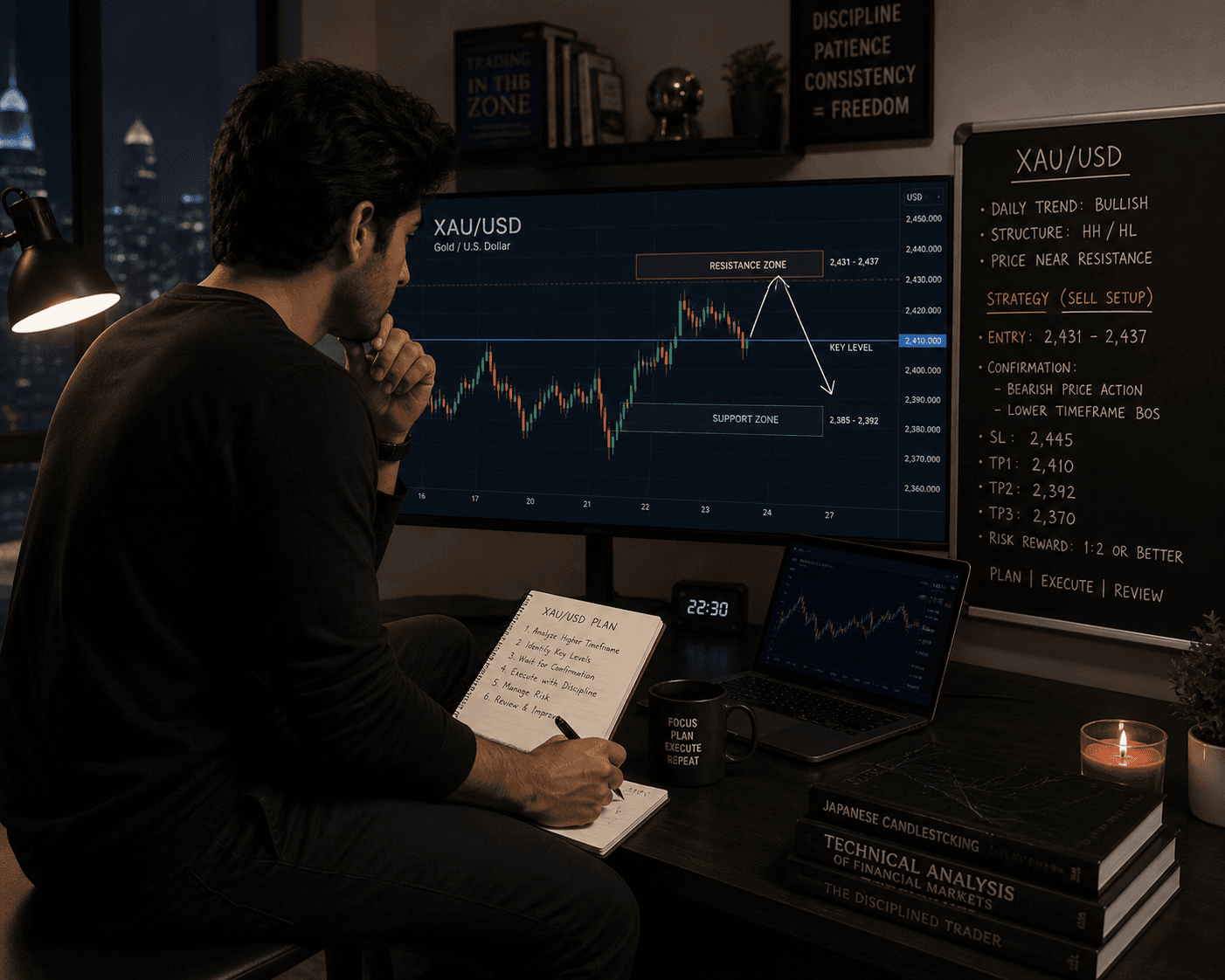
Gold has been a store of value for over five thousand years and in today's financial markets, it trades as XAUUSD, one of the most powerful and unpredictable instruments available to retail traders. On any given day, gold can move 80 to 200 pips, react violently to a single Federal Reserve statement, surge on geopolitical fear, or reverse sharply when the US Dollar strengthens. That kind of movement is both the opportunity and the danger. Most traders who lose money on gold do not lose because the market is unfair. They lose because they approach it without a structured strategy they react instead of plan, they size positions based on emotion rather than math, and they trade every candle instead of waiting for high-probability setups.
Gold has captivated traders for centuries, and in today's financial markets, XAUUSD remains one of the most traded instruments on the planet. Whether you are a seasoned professional or just beginning your journey, understanding how to build a reliable strategy around gold is the difference between consistent profits and costly mistakes. If you are new to the basics of how this market works, our detailed guide on how to trade gold (XAUUSD) is the perfect starting point before diving into advanced strategies.
In this guide, we cover everything — from the unique market structure of gold to the two dominant approaches traders use every day: scalping and swing trading. We will break down specific entry triggers, indicator setups, risk management frameworks, and real-world trade examples so that you can apply these strategies to a live or demo account starting today.
Why XAUUSD Is Unlike Any Other Forex Pair
Before jumping into strategy, it helps to understand what makes gold different. XAUUSD is not just another currency pair — it is a safe-haven asset, an inflation hedge, a geopolitical barometer, and a liquidity magnet all rolled into one instrument. Its volatility is legendary, and that volatility is precisely what makes it both attractive and dangerous for retail traders.
Gold moves on a unique combination of drivers: the US Dollar Index (DXY), real interest rates (particularly US 10-year Treasury yields), central bank buying activity, geopolitical risk events, and broader market sentiment. When equities fall sharply, gold often surges. When the dollar weakens, gold typically climbs. When inflation expectations rise, gold becomes a store of value that institutional investors flood into.
The practical implication for traders is this: XAUUSD often moves 50 to 150 pips in a single session — sometimes more. That makes proper position sizing absolutely critical. One concept that every gold trader must internalize before placing a single trade is understanding pips, lots, and spreads, because the pip value on gold is significantly higher than on most major pairs, and miscalculating your lot size can turn a small adverse move into a catastrophic account loss.
The Two Primary XAUUSD Strategies: An Overview
Professional gold traders generally fall into one of two camps: scalpers who target small, frequent gains inside intraday sessions, and swing traders who hold positions over days or even weeks to capture larger directional moves. Both approaches are legitimate and profitable when executed with discipline — but they require very different mindsets, tools, and schedules.
Feature | Scalping | Swing Trading |
Timeframe | M1, M5, M15 | H4, Daily, Weekly |
Trade Duration | Seconds to minutes | Days to weeks |
Target per Trade | 5–20 pips | 50–300+ pips |
Stop Loss Size | 10–30 pips | 40–100+ pips |
Screen Time Required | High (constant) | Low (1–2x daily check) |
Ideal For | Active, disciplined traders | Patient, part-time traders |
Key Risk | Spread & noise | Overnight gaps & news |
Part 1: XAUUSD Scalping Strategy
Scalping gold is one of the most intense forms of trading available. You are competing with algorithms, institutional desks, and high-frequency traders — all of whom are hunting the same intraday liquidity. To succeed, you need a methodical system, fast execution, and iron-clad discipline.
The Best Sessions for Scalping XAUUSD
Not all hours are created equal. Gold liquidity and volatility concentrate around two key windows:
• London Open (08:00–10:00 GMT): The first major institutional push of the European day. Price often breaks out of the Asian range and creates clean trending moves on the M5 and M15.
• New York Open (13:00–15:00 GMT): The most volatile window of the day. US economic data releases happen here, and gold can move 30–80 pips in minutes. Both breakout and reversal setups appear.
• New York–London Overlap (13:00–17:00 GMT): The sweet spot where both major sessions are open, volume is highest, and trends are most reliable for scalping.
Avoid scalping during the Asian session (00:00–07:00 GMT) unless you have a specific range-trading setup. Price tends to chop with wider spreads and lower volume, eating into your edge.
Setup 1: EMA Crossover Scalping (M5 Chart)
This is one of the most battle-tested scalping frameworks for gold. It uses two Exponential Moving Averages (EMAs) to identify trend direction and momentum shifts, combined with the RSI to avoid entering during exhausted or overbought conditions.
Indicators needed: EMA 9, EMA 21, RSI (14) with levels at 30 and 70
Entry Rules — Long:
• EMA 9 crosses above EMA 21 on the M5 chart
• Price is above both EMAs (confirmation of bullish momentum)
• RSI is between 45 and 65 — not overbought, but showing bullish strength
• Enter on the next candle open after the crossover is confirmed
Entry Rules — Short:
• EMA 9 crosses below EMA 21
• Price is below both EMAs
• RSI is between 35 and 55
• Enter short on the next candle open
Stop Loss: Place 10–15 pips beyond the most recent swing high (short) or swing low (long). For gold on M5, this typically means 15–25 pips.
Take Profit: Target a 1:1.5 to 1:2 risk-reward ratio. If your stop is 20 pips, target 30–40 pips.
Pro Tip: Never scalp gold around major news releases (NFP, CPI, FOMC) without a wider stop. The spread can spike to 30–50 pips during high-impact events, instantly triggering your stop loss even if the direction is correct. |
Setup 2: London Breakout Scalp
The Asian session (00:00–07:00 GMT) creates a consolidation range as gold digests overnight news with lower volume. When London opens, institutional players often drive a clean break of this range — and that break is tradeable.
How to identify the range: Mark the high and low of price action between 02:00 and 07:00 GMT on the M15 chart. This is your Asian range box.
Entry: When price breaks and closes a full M15 candle above the range high (buy) or below the range low (sell), enter in the direction of the break.
Stop Loss: Place just inside the opposite edge of the range, typically 15–20 pips.
Take Profit: Measure the height of the Asian range and project that distance from the breakout point. For example, if the range was 30 pips tall, target 30 pips from the breakout level.
This setup works especially well on days with medium-impact UK or European economic data. On days with US data due, be cautious — the initial breakout may reverse sharply when New York opens.
Setup 3: Support & Resistance Bounce Scalp
Key psychological levels like round numbers ($2,000, $2,100, $2,300) and previous session highs/lows act as major magnets for gold price. Scalpers who understand how to read these levels can enter high-probability bounces with tight stops.
Identify the level on the H1 chart first, then drop to M5 for entry. Wait for a rejection candle — a pin bar, doji, or engulfing pattern — forming directly at the level. Enter in the direction of the rejection, with a stop 10–15 pips beyond the wick extreme.
Understanding how lot sizing affects your risk on these tight scalping setups is critical. Whether you are working with a starter account or something larger, our breakdown on the best strategy for small forex accounts explains exactly how to keep your per-trade risk within safe parameters while still capturing meaningful returns from each scalp.
Part 2: XAUUSD Swing Trading Strategy
Swing trading gold suits traders who cannot monitor charts intraday but still want to participate in gold's powerful directional moves. Rather than chasing every tick, swing traders focus on the big picture — weekly bias, daily structure, and key supply/demand zones — and then wait patiently for price to come to them.
Establishing Weekly Bias First
Every successful swing trade starts on the higher timeframes. Before you look at a Daily or H4 chart, spend five minutes on the Weekly chart asking: is gold in an uptrend, downtrend, or range? Are we near a major historical support or resistance zone? Has the weekly candle closed bullish or bearish?
Answering these questions gives you your directional bias for the week. If the weekly trend is bullish, you will only look for buy setups on lower timeframes. If it is bearish, only sells. This top-down approach eliminates a huge percentage of losing counter-trend trades that newer traders constantly make.
Setup 4: Daily Structure Break and Retest Swing
This is the most reliable swing setup on XAUUSD. It capitalises on the tendency of institutional money to return to broken structural levels before continuing the trend.
Step 1 — Identify a structural level on the Daily chart: This could be a swing high, swing low, a major support/resistance level, or a consolidation zone that has been tested multiple times.
Step 2 — Wait for a clean break: Price must close a daily candle convincingly above (for bullish bias) or below (for bearish bias) the structure level. A convincing break means at least 60–70% of the candle body is beyond the level, not just a wick.
Step 3 — Wait for the retest: After the break, price typically pulls back to test the broken level from the other side. This retest may take 1–5 days to develop. Patience is key.
Step 4 — Enter on the H4 chart: Once price returns to the retest zone, switch to H4 and look for a bullish reversal candle (for longs) or bearish reversal candle (for shorts) to confirm entry.
Stop Loss: Place 40–60 pips beyond the structural level being retested.
Take Profit: Target the next significant structural level on the Daily chart, typically 100–300 pips away, offering a 1:2 to 1:4 reward-to-risk ratio.
Risk Management Note: On swing trades where your stop is 60 pips, ensure your position size is calculated correctly. Many traders dramatically over-leverage swing positions because they forget that a single gold pip at standard lot size is worth $10. A 60-pip stop on a 0.5 lot position means $300 potential loss — always know this before entering. |
Setup 5: Trend-Following Swing with the 200 EMA
The 200 Exponential Moving Average on the Daily chart is the single most watched indicator by institutional traders globally. When gold is above the 200 EMA, the macro bias is bullish. Below it, bearish. Trading with this trend dramatically improves your win rate on swing setups.
Long Setup: Gold is above the 200 EMA on D1. Price pulls back to test the 200 EMA or a Fibonacci retracement level (38.2%, 50%, or 61.8% of the recent swing). A Daily bullish reversal candle appears at the zone. Enter long, stop below the 200 EMA or the Fibonacci zone.
Short Setup: Gold is below the 200 EMA on D1. Price rallies back to test the 200 EMA from below (resistance). A Daily bearish candle appears. Enter short, stop above the 200 EMA.
This setup is particularly powerful during trending market phases. In ranging markets (when gold oscillates around the 200 EMA), avoid this setup and switch to the structure break approach instead.
Setup 6: News-Driven Swing Position
Gold is uniquely sensitive to macroeconomic events. When major news aligns with your technical setup, the resulting moves can be explosive and highly directional, creating exceptional swing opportunities.
Key events to watch include US CPI and PPI data, Federal Reserve interest rate decisions and meeting minutes, Non-Farm Payrolls (NFP), US Dollar Index movements, and geopolitical escalations (conflicts, sanctions, central bank gold reserve announcements).
The critical concept here is confluence — your technical setup should already be pointing in the direction that the fundamental narrative supports. Do not enter a news-driven swing against a strong technical trend. And critically, understand how leverage amplifies both gains and losses in volatile news environments. A single FOMC decision can move gold 200+ pips in minutes, and over-leveraged positions can be wiped out before the move even concludes.
Best Indicators for XAUUSD Trading
Gold traders often suffer from indicator overload — too many lines on the screen creating analysis paralysis rather than clarity. The best setups use a minimal, purposeful combination of tools.
For Scalping
• EMA 9 & EMA 21: Fast crossover system for momentum direction on M5/M15.
• RSI (14): Filters overbought/oversold conditions and momentum exhaustion.
• VWAP (Volume Weighted Average Price): Institutional reference level. Price above VWAP = bullish intraday bias. Below = bearish.
• ATR (Average True Range): Helps set realistic stop losses based on current volatility. Essential for gold given its daily range variability.
For Swing Trading
• 200 EMA (Daily): The macro trend filter. The single most important line on your chart.
• Fibonacci Retracement Tool: 38.2%, 50%, 61.8% levels on Daily swings identify high-probability pullback zones.
• MACD (12, 26, 9): Identifies momentum shifts and divergence on H4/Daily charts. Divergence between price and MACD often precedes major reversals.
• Bollinger Bands (20, 2): When price reaches the upper or lower band on H4, combined with RSI divergence, it signals potential swing exhaustion.
Risk Management: The Difference Between Traders Who Last and Those Who Don’t
No strategy discussion about gold is complete without a dedicated section on risk management. Gold's volatility is a gift and a curse — it creates opportunity, but it punishes reckless position sizing mercilessly.
The 1–2% Rule
Never risk more than 1–2% of your total trading account on a single XAUUSD trade. This is non-negotiable. A string of losing trades is inevitable in any strategy, and the 1–2% rule ensures that even 10 consecutive losses only reduce your account by 10–20%, leaving you fully capable of recovery. For traders who are actively trying to grow a small account, sticking to 1% risk per trade is even more important — it keeps you in the game long enough for your edge to play out.
Stop Loss Discipline
Every single trade — scalp or swing — must have a stop loss placed at the moment of entry. No exceptions. Gold moves too fast for manual exits. If your internet disconnects during a 100-pip adverse move with no stop loss, the damage could be irreversible.
For scalping, stops of 10–25 pips are typical. For swing trading, 40–80 pips is standard. The stop should be placed at a level that invalidates your trade thesis — beyond a structure level, above/below an EMA, or outside a Fibonacci zone — not at an arbitrary round number.
Using Leverage Responsibly
Leverage on gold can be as high as 1:500 with some brokers, which sounds incredible until a bad trade goes against you. Professional traders rarely use more than 1:10 to 1:20 effective leverage on gold positions, even when much higher leverage is available. Our in-depth guide on leverage explains the mechanics with worked examples — essential reading before you size up any gold position.
The Power of Compounding Your Gains
The beauty of disciplined XAUUSD trading is that consistent, modest returns compound dramatically over time. A trader achieving 3–5% per month through disciplined scalping or swing trading will see their account grow exponentially — not linearly. Our compounding method guide shows the real mathematics of how small, consistent percentage gains snowball into life-changing returns over 12–24 months.
Common XAUUSD Mistakes and How to Avoid Them
Mistake 1: Trading Without a Session Filter
Gold behaves completely differently across sessions. Many traders apply the same scalping setup during the Asian session that works beautifully during London, only to find it generates nothing but small losses and whipsaws. Always know which session you are in and whether your strategy is designed for that environment.
Mistake 2: Ignoring the DXY Correlation
Gold and the US Dollar Index move in near-perfect inverse correlation the majority of the time. Before entering any gold trade, glance at the DXY chart. If you are bullish on gold but the DXY is at a key support level and bouncing, your trade thesis is fighting a major headwind. Alignment between a bearish DXY and a bullish gold setup dramatically increases your probability of success.
Mistake 3: Over-Trading
Gold's constant movement is psychologically hypnotic. It always looks like there is a trade available. In reality, A-grade setups on XAUUSD occur perhaps 2–4 times per day for scalpers and 3–5 times per week for swing traders. Trading every perceived opportunity leads to B-grade and C-grade setups, which erode profitability and erode confidence.
Mistake 4: Misunderstanding Pip Value
This is perhaps the most financially dangerous mistake. On a standard lot of XAUUSD, each pip is worth $10. On a 0.1 lot, each pip is $1. Many traders who are comfortable trading EUR/USD fail to adjust their position sizing when they move to gold, taking the same lot size they use on currency pairs without realising that gold's average daily range of 150+ pips makes their effective risk several times larger. Understanding pips, lots, and spread mechanics in detail is foundational before trading gold at any meaningful size.
Mistake 5: Chasing Price After a Big Move
When gold moves 80 pips in 30 minutes — which happens regularly — the FOMO (fear of missing out) is overwhelming. Traders jump in at the top of the move just as institutional players are taking profits, and they find themselves instantly in a losing trade against the reversal. Discipline means watching big moves with admiration and waiting for the next setup, not jumping in late.
Building Your XAUUSD Trading Plan: A Step-by-Step Framework
A strategy without a trading plan is just a collection of ideas. Profitable traders codify their approach into a written plan and execute it consistently. Here is a simple framework:
Step 1: Define Your Session and Style
Decide whether you are a scalper or swing trader — and stick to one approach until you have mastered it. Identify which market sessions align with your schedule. If you can only check charts twice a day, swing trading on H4/Daily is your natural fit.
Step 2: Identify Weekly Bias (Sunday Evening)
Every Sunday evening, spend 15 minutes on the Weekly and Daily chart. Note the trend direction, major support and resistance zones, and any key economic events scheduled for the week (particularly Fed speeches, US inflation data, or geopolitical developments).
Step 3: Mark Key Levels (Daily)
At the start of each day, mark the previous day's high and low, any weekly support/resistance levels, and the current VWAP. These become your reference points for all intraday decisions.
Step 4: Wait for Setups — No Forcing
Set alerts on your platform for when price approaches a key level. Do not sit staring at charts — it leads to impulsive decisions. When your alert fires, come to the screen, assess whether your setup conditions are met, and execute accordingly.
Step 5: Journal Every Trade
The traders who improve fastest are those who review their trades with brutal honesty. After every week, review your journal: which setups worked, which failed, where you broke your rules, and what you would do differently. Iteration based on real trade data is how edge develops over time.
Quick-Reference: Scalping vs Swing Trading XAUUSD
Criteria | Scalping | Swing Trading |
Best Chart | M1, M5, M15 | H4, D1, W1 |
Primary Indicators | EMA 9/21, RSI, VWAP | 200 EMA, Fibonacci, MACD |
Trade Frequency | 5–15 trades/day | 3–5 trades/week |
Average Hold Time | 2–30 minutes | 1–7 days |
Avg Profit Target | 10–25 pips | 80–300 pips |
Avg Stop Loss | 15–25 pips | 40–80 pips |
Min. R:R Ratio | 1:1.5 | 1:2 |
News Sensitivity | Very High | Moderate (plan around it) |
Emotional Demand | Extreme | Moderate |
Final Thoughts: Choose Your Strategy, Master It, and Stay Consistent
The best XAUUSD strategy is not the one with the most complex indicators or the flashiest backtested results — it is the one that you can execute with consistency, discipline, and calm under pressure. Gold rewards patience and punishes impulsiveness. Whether you choose scalping or swing trading, the principles remain the same: understand the market structure, trade with the trend, manage your risk religiously, and review your performance constantly.
Start by mastering one setup — not five. If the EMA crossover scalp on M5 resonates with you, paper trade it for two weeks before going live. If the Daily structure break and retest swing appeals to your style, wait for three or four clean setups to develop before committing capital. The market will always be there. There is no rush.
As you build consistency in your gold trading, you will naturally begin to think about scaling your account and using the power of compounding to accelerate growth. Our guide on how the compounding method turns small accounts into big ones gives you the mathematical roadmap for turning disciplined monthly returns into exponential long-term wealth — the exact philosophy that separates amateur traders from professionals.
Gold is not just an asset. For the prepared trader, it is an opportunity — every single trading day, in every session, across every timeframe. Build your plan, trust your system, and execute with precision.