2mins read
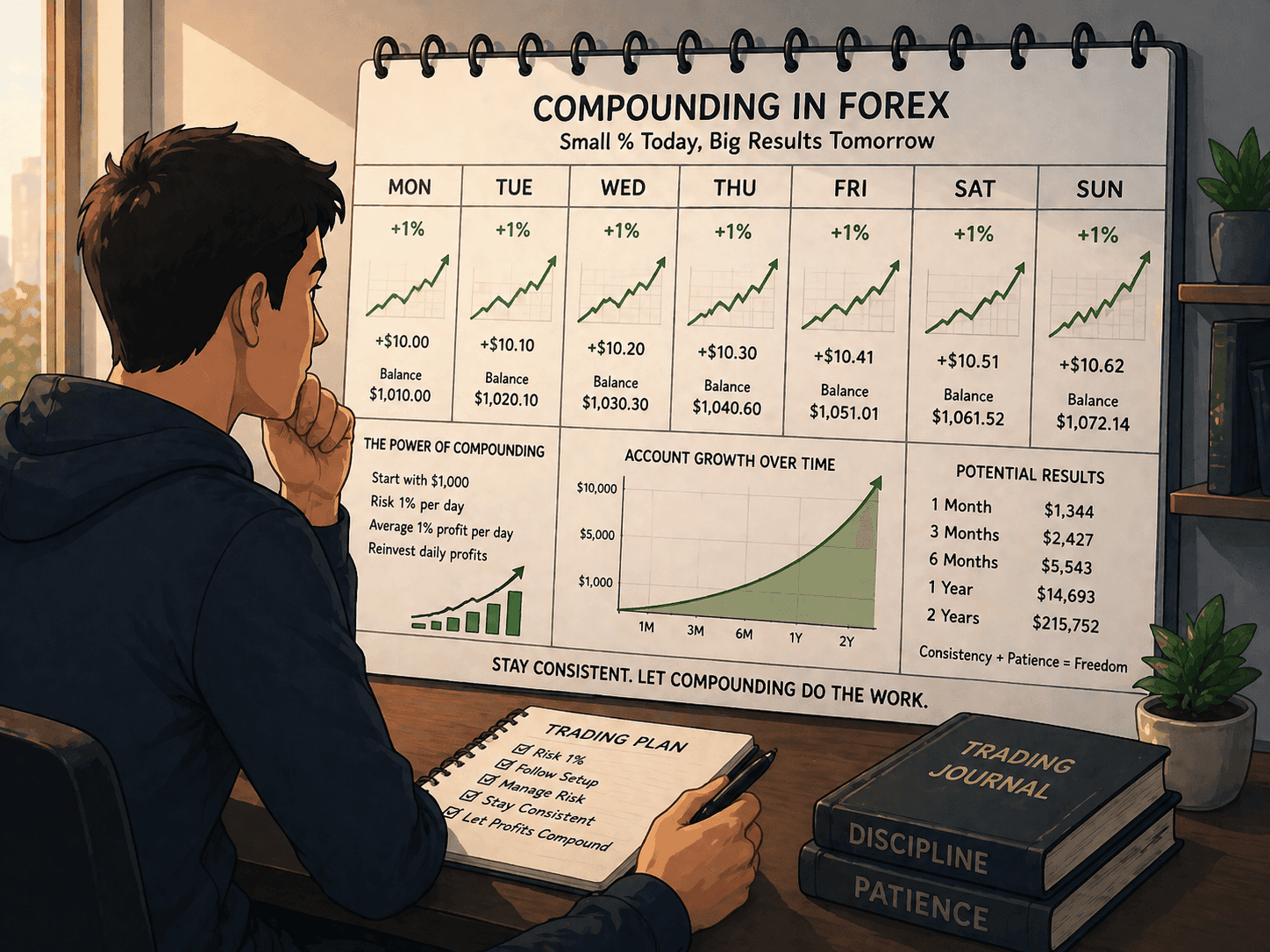
Albert Einstein reportedly called compound interest the 'eighth wonder of the world.' Whether or not he actually said it, the truth behind the statement is undeniable — especially in forex trading. Compounding means you're not just growing your account, you're growing the rate at which your account grows. Starting with $100 might feel small, but with a smart compounding strategy and consistent discipline, the math starts working in your favor very quickly. In this blog, we'll explain exactly how forex compounding works, show you real numbers, and give you a practical plan to apply it to your own small account.
What is Compounding in Forex?
Compounding means reinvesting your profits so that each future trade is calculated on a larger base amount. Instead of keeping your lot size the same forever, you increase it slightly as your account grows — but always staying within your risk percentage.
Simple Example:
• You start with $100
• You risk 1% per trade ($1)
• After growing to $110, your 1% is now $1.10
• After growing to $200, your 1% is now $2
Small increases, but they add up exponentially over time.
The Math Behind Compounding
Let's say you aim for a 5% monthly return (conservative and achievable):
• Month 1: $100 → $105
• Month 2: $105 → $110.25
• Month 3: $110.25 → $115.76
• Month 6: ~$134
• Month 12: ~$179
• Month 24: ~$320
Now imagine 10% monthly growth (possible with skill and discipline):
• Month 6: ~$177
• Month 12: ~$314
• Month 24: ~$985
This is how traders turn $100 into $1000 — not through luck, but through the mathematics of compounding.
How to Apply Compounding to Your Trading
Step 1: Fix Your Risk Percentage
Decide on 1% or 2% risk per trade and never deviate. This is your foundation.
Step 2: Recalculate After Every Milestone
Don't adjust your lot size after every single trade — that's too frequent. Instead, recalculate every time your account hits a new milestone (e.g., every $10 or $20 increase).
Step 3: Track Everything
Keep a trading journal. Write down your balance, lot size, and risk amount before each trade. This keeps you accountable and shows your compound growth clearly.
Step 4: Be Patient
Compounding works over months and years, not days. Traders who try to rush it break their risk rules and blow accounts. The tortoise wins this race.
Compounding Mistakes to Avoid
• Jumping from 1% risk to 10% because the account grew slightly — this breaks compounding
• Withdrawing profits before reaching meaningful growth levels
• Expecting overnight results — compounding is a long-term game
• Not tracking your trades, so you don't know what's actually working
Simple Compounding Plan for $100 Account
• Start: $100 | Risk: $1 per trade (1%)
• At $150: Risk: $1.50 per trade
• At $200: Risk: $2.00 per trade
• At $500: Risk: $5.00 per trade
• At $1000: Risk: $10 per trade — you've 10x'd your account
Final Thought
Compounding isn't magic — it's math. And unlike gambling, math doesn't lie. Set your risk rules, compound your profits, stay consistent, and let time do the work. The traders who win in forex aren't the ones who take the biggest risks. They're the ones who stay in the game the longest.
Keywords: forex compounding strategy, how to compound forex profits, grow $100 forex account, forex compounding calculator, small account forex growth plan