2mins read
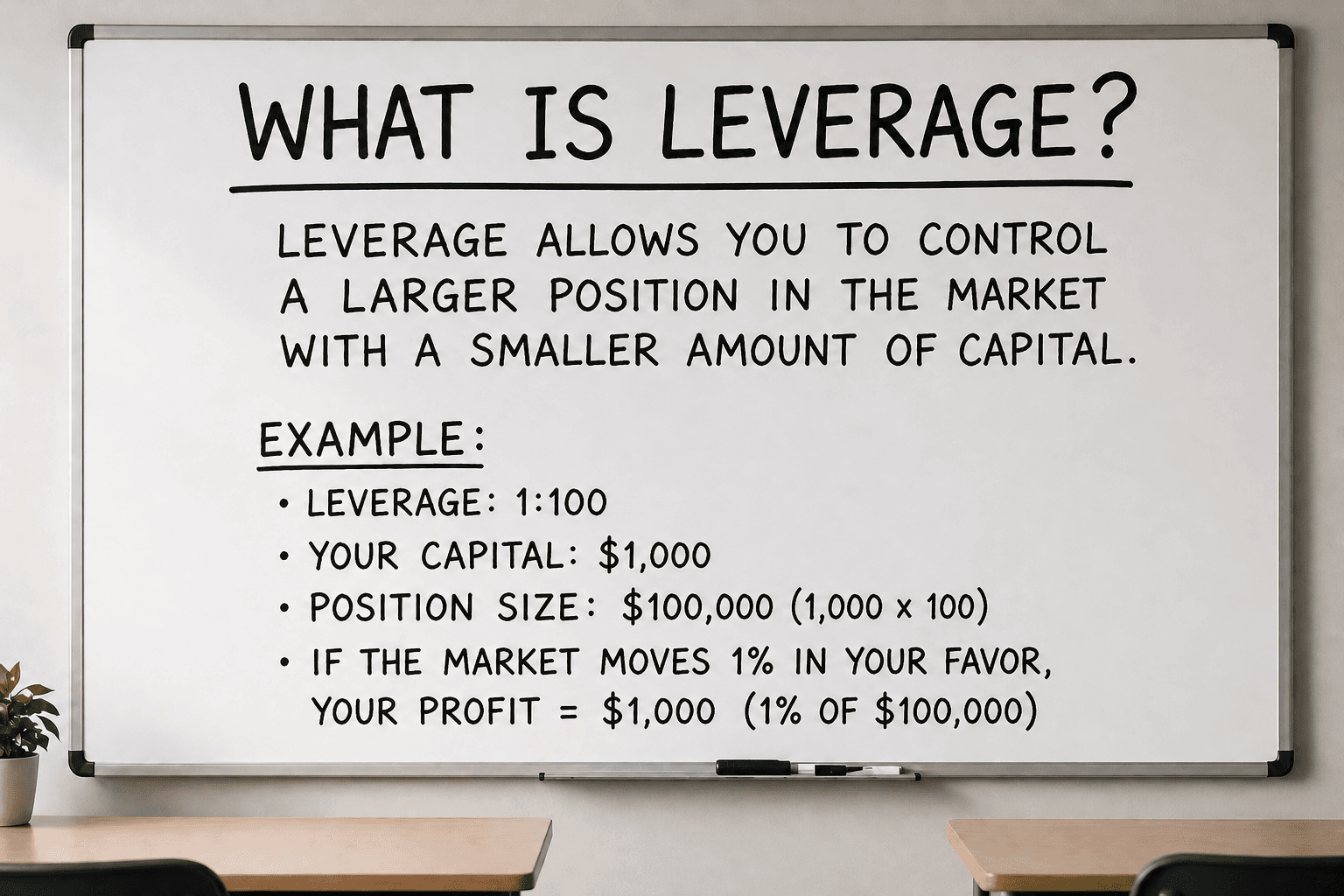
If there's one concept in forex that excites beginners and scares professionals, it's leverage. Brokers advertise '1:500 leverage!' like it's the golden ticket to getting rich quick. And in the wrong hands, it absolutely is — the quickest ticket to losing everything. But used wisely, leverage is a legitimate tool that allows you to control larger positions with a smaller amount of money. In this blog, we're going to demystify leverage completely. You'll learn exactly what it is, how it works with real numbers, what happens when it goes wrong, and — most importantly — how much leverage is actually safe for a small account. No hype. No scare tactics. Just the honest truth with clear examples.
What is Leverage?
Leverage means your broker is letting you control a position larger than your actual deposit. It's expressed as a ratio: 1:100, 1:200, 1:500, etc.
Simple Definition:
1:100 leverage means: for every $1 you deposit, you can control $100 in the market.
Example:
You have $100 in your account. With 1:100 leverage, you can open a trade worth $10,000 (100 × $100). With 1:500 leverage, you could control $50,000.
On the surface, this sounds incredible. But here's the critical part — the risk is magnified by the SAME ratio as the reward.
Leverage in Action — Profit Example
Trade Setup:
• Account balance: $100
• Leverage: 1:100
• You control: $10,000 (0.10 lot = mini lot)
• EUR/USD moves 50 pips in your favor
Profit:
50 pips × $1 per pip (mini lot) = $50 profit. That's a 50% return on your $100 in one trade. Sounds amazing, right?
Leverage in Action — Loss Example (The Reality Check)
Same trade setup, but it goes WRONG:
• The market moves 50 pips AGAINST you
• Loss = 50 pips × $1 = $50 loss
• Your $100 account is now $50 — cut in half
And if you don't have a stop loss and the market moves 100 pips against you? Your account could go to zero. This is why high leverage on small accounts is extremely dangerous.
How Much Leverage Should You Use?
Here's the truth that most brokers won't tell you: the leverage advertised is the MAXIMUM available, not the recommended amount. Professional traders typically use very low effective leverage.
• Beginner: 1:10 effective leverage or lower
• Intermediate: 1:20 to 1:30 effective leverage
• Professional: Rarely above 1:10 even when 1:500 is available
For a $100 account, stick to micro lots (0.01). This means your effective leverage stays very low, protecting your account while still letting you participate in the market.
Margin — The Money You Lock Up
When you use leverage, your broker requires a 'margin deposit' — a portion of your own money held as collateral for the trade. The higher the leverage, the less margin required — but also the less room for error before a margin call.
Example:
EUR/USD trade, 0.01 lot, 1:100 leverage. Contract value = $1,000. Margin required = $1,000 ÷ 100 = $10. So $10 of your $100 is 'locked' in margin. You have $90 as free margin to absorb fluctuations.
Margin Call Warning
A margin call happens when your losses eat into your margin and your broker forces trades to close. This is how accounts get blown up silently — the platform closes your trades automatically at the worst possible time. Prevent this by: using low lot sizes, always using stop losses, and never using the maximum leverage available.
The Golden Leverage Rule for Small Accounts
Use the minimum lot size your broker allows (usually 0.01). Let your stop loss determine your risk, not your leverage. Your effective leverage on a $100 account trading 0.01 lots with a 20-pip stop loss is incredibly low — that's how you protect yourself.
Final Thought
Leverage is not evil. It's a tool. A chainsaw in the hands of a skilled carpenter builds beautiful things. In the hands of someone without training, it causes damage fast. Learn to use leverage responsibly — small lot sizes, strict stop losses, realistic risk percentages — and it becomes an ally. Treat it like a shortcut to riches, and it will take everything you have.
Keywords: forex leverage explained, leverage example forex, how leverage works forex, leverage risk management, leverage for beginners forex, what is margin in forex