2mins read
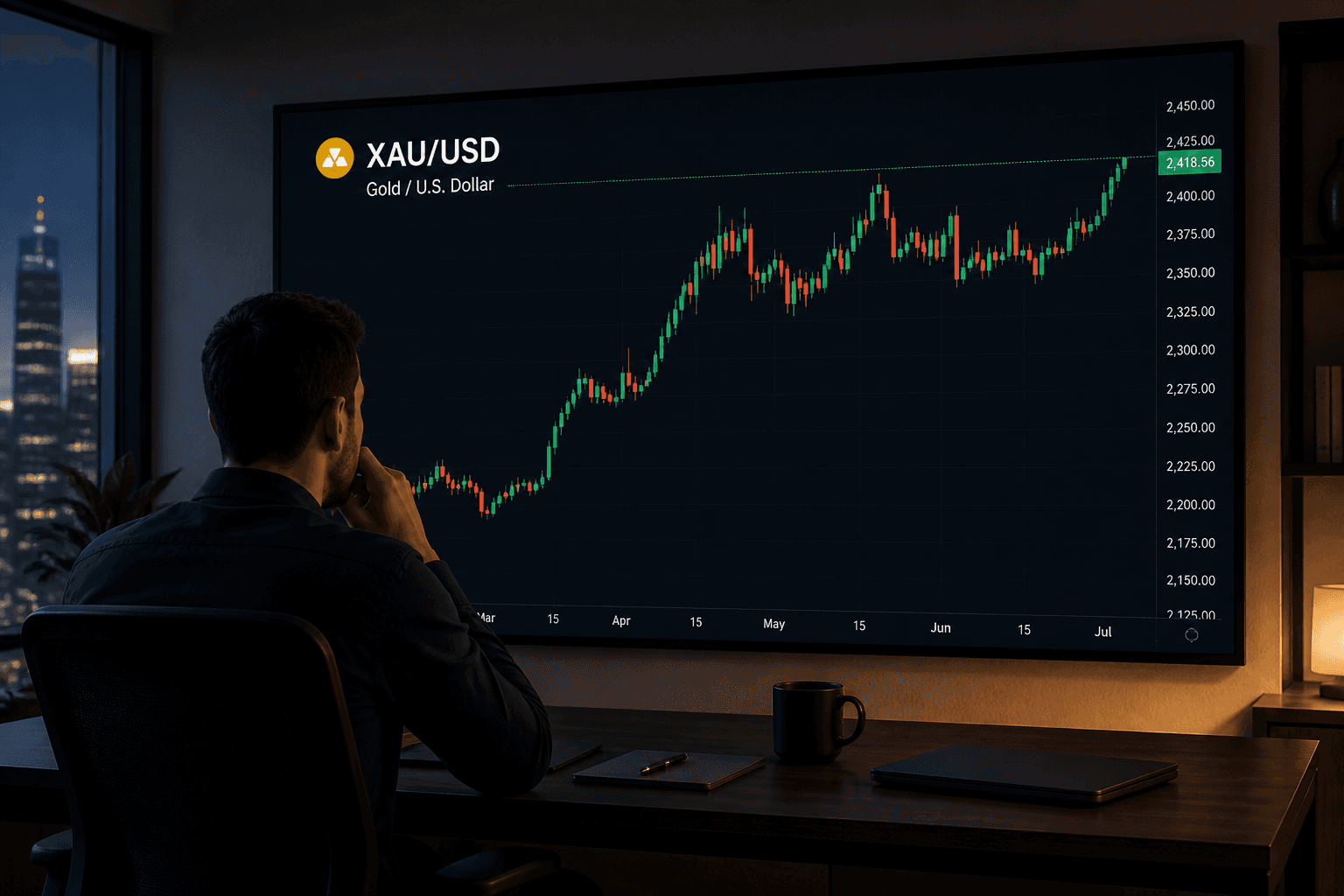
In today’s fast-paced financial world, where markets move in seconds and opportunities appear without warning, few assets command as much attention as gold — traded globally under the symbol XAU/USD. For centuries, gold has been a symbol of wealth, power, and stability. But in the modern era, it has evolved into one of the most dynamic and actively traded instruments in the forex market.
Introduction: Why Gold Is the Most Traded Commodity in Forex
Gold has been the cornerstone of global wealth for over 5,000 years. In the modern financial world, it trades as the currency pair XAUUSD — representing the price of one troy ounce of gold in US dollars — and it remains one of the most popular instruments among forex traders worldwide. Whether you are a beginner searching for 'how to trade gold in forex for beginners' or an experienced trader looking for 'advanced XAUUSD trading strategies with high accuracy,' this comprehensive guide covers everything you need to know.
Gold's appeal lies in its dual identity: it is both a commodity and a currency. It moves independently of stocks and bonds, responds strongly to geopolitical crises, inflation data, and US dollar strength, and offers some of the highest daily volatility of any tradable instrument. Daily trading volume in XAUUSD regularly exceeds $100 billion, giving it the deep liquidity needed for smooth trade execution at virtually any time of day.
In this guide, you will learn step by step how XAUUSD works, which brokers to choose, how to read gold charts, which technical and fundamental strategies consistently produce profits, and how to protect your capital with proven risk management techniques.
Section 1: What Is XAUUSD? — Understanding Gold in Forex
1.1 Decoding the XAUUSD Ticker
The symbol XAUUSD is a combination of two codes. XAU is the ISO 4217 currency code for gold, derived from the Latin 'Aurum,' the Roman word for gold. USD stands for the United States Dollar. Together, XAUUSD tells you the price of one troy ounce of gold expressed in US dollars. When XAUUSD is quoted at 2,350.00, it means one troy ounce of gold costs $2,350.
Unlike stocks or futures, XAUUSD in forex is traded as a contract for difference (CFD) on most retail platforms, meaning you speculate on the price movement without physically owning the metal. This allows traders to go both long (buy) when they expect prices to rise and short (sell) when they expect a decline.
1.2 Key Characteristics of the Gold Market
Characteristic | Detail |
Trading Hours | 24 hours a day, 5 days a week (Sunday 5 PM – Friday 5 PM EST) |
Most Active Sessions | London Open (3 AM – 12 PM EST) & New York Open (8 AM – 5 PM EST) |
Average Daily Range | 1,500 – 3,000+ pips (can spike 5,000+ on high-impact news) |
Standard Lot Size | 100 troy ounces of gold |
Pip Value (1 lot) | $10 per pip (1 pip = $0.10 move in price × 100 oz) |
Typical Spread (ECN) | 20–50 pips on major brokers |
Correlation | Inverse to USD Index (DXY); positive to CHF, AUD |
Leverage Available | Up to 1:500 (jurisdiction dependent) |
Section 2: What Moves Gold Prices? — Fundamental Drivers
Before placing a single trade, every serious gold trader must understand what fundamentally drives XAUUSD. These are the macroeconomic and geopolitical forces that create the big moves — the ones that turn a 50-pip day into a 500-pip opportunity.
2.1 US Dollar Strength (DXY Correlation)
Gold and the US dollar share one of the strongest inverse relationships in financial markets. When the US Dollar Index (DXY) rises, gold typically falls in price, and when the DXY weakens, gold rallies. This happens because gold is priced in dollars: a stronger dollar makes gold more expensive for non-US buyers, reducing demand, while a weaker dollar makes gold cheaper internationally, boosting demand.
Practical application: Always check DXY direction before entering a gold trade. If DXY is breaking a key support level, a long XAUUSD entry is fundamentally supported. If DXY is at resistance and turning up, consider shorting gold.
2.2 US Federal Reserve Interest Rate Policy
Interest rates are the single biggest long-term driver of gold prices. Gold pays no dividend or interest, so when interest rates rise, yield-bearing assets like bonds become more attractive compared to gold, and capital flows away from gold. Conversely, when the Fed cuts rates or signals a dovish pivot, gold tends to surge because the opportunity cost of holding gold decreases.
Key events to monitor: FOMC meeting decisions (eight per year), Federal Reserve Chair press conferences, and the dot plot projections. Any surprise dovish shift by the Fed can trigger 200–500 pip gold rallies within minutes.
2.3 Inflation Data (CPI, PPI, PCE)
Gold is universally regarded as a hedge against inflation. When Consumer Price Index (CPI) readings come in hotter than expected, traders bid up gold as a store of value. The Personal Consumption Expenditures (PCE) index — the Fed's preferred inflation measure — also moves gold significantly. A PCE reading above forecast is historically bullish for XAUUSD.
2.4 Geopolitical Risk and Safe-Haven Demand
Whenever global uncertainty rises — wars, banking crises, political instability, pandemics — investors flood into gold as a safe-haven asset. These 'risk-off' flows can push gold up hundreds of dollars in a matter of days. The Russia-Ukraine conflict in 2022, the COVID-19 pandemic crash in 2020, and the 2008 financial crisis all produced massive gold rallies driven by safe-haven buying.
2.5 Central Bank Gold Purchases
Central banks around the world hold gold as part of their foreign exchange reserves. When major central banks (China's PBoC, Russia's CBR, India's RBI, Turkey's CBRT) increase their gold reserves, it adds sustained buying pressure that supports long-term gold prices. The World Gold Council publishes quarterly demand reports that reveal central bank purchasing trends.
KEY FUNDAMENTAL CHECKLIST — Before Every Gold Trade |
✅ Check DXY direction and nearest support/resistance |
✅ Review upcoming US economic calendar (CPI, NFP, FOMC, PCE) |
✅ Assess current geopolitical risk environment |
✅ Check 10-year US Treasury yield direction (inverse to gold) |
✅ Review latest central bank gold demand data |
✅ Align trade direction with the dominant macro narrative |
Section 3: How to Read Gold Charts — Technical Analysis for XAUUSD
3.1 The Best Timeframes for Trading XAUUSD
Gold can be traded across all timeframes, but the approach must match the timeframe. Here is how professional gold traders use multiple timeframes:
Timeframe | Best Used For |
Monthly / Weekly | Identifying the dominant long-term trend and major S/R zones |
Daily | Swing trade setups, confirming macro bias, key level identification |
4-Hour (H4) | Intermediate-term setups, trend confirmation, entry timing windows |
1-Hour (H1) | Day trading setups, breakout entries, intraday trend following |
15-Min / 5-Min | Scalping entries, precise entry/exit timing, momentum plays |
3.2 Essential Technical Indicators for Gold Trading
Moving Averages (MA)
The 200-period Simple Moving Average (SMA) on the daily chart is the most watched technical level in gold. Price trading above the 200 SMA signals a long-term bull trend; below it signals a bear trend. For shorter-term momentum, the 50 EMA and 21 EMA crossover on the 4H chart provides reliable trend signals. When the 21 EMA crosses above the 50 EMA, it is a bullish momentum signal; below is bearish.
Relative Strength Index (RSI)
RSI measures momentum on a scale of 0–100. For gold, RSI above 70 signals overbought conditions and a potential pullback opportunity; below 30 signals oversold conditions and a potential bounce. The most powerful RSI signals occur when gold makes a new price high but RSI fails to make a new high — this bearish divergence often precedes significant reversals. Bullish divergence (new price low, RSI higher low) often precedes rallies.
Fibonacci Retracement
Fibonacci retracement is arguably the most powerful tool specifically for XAUUSD. Gold respects Fibonacci levels with remarkable precision. The 0.618 (61.8%) retracement level — known as the 'golden ratio' — frequently acts as a key reversal zone. Draw Fibonacci from major swing lows to swing highs in uptrends (or swing highs to swing lows in downtrends) and watch for price reactions at the 38.2%, 50%, and 61.8% retracement levels combined with RSI signals.
Bollinger Bands
Bollinger Bands consist of a 20-period moving average with upper and lower bands set two standard deviations away. When gold's price touches the lower Bollinger Band during an uptrend, it often marks a buying opportunity. When price rides along the upper band with strong momentum, it signals a strong trend continuation. A 'Bollinger squeeze' — when the bands narrow significantly — frequently precedes explosive gold moves.
Average True Range (ATR)
ATR measures volatility and is essential for gold traders to size their stop-losses appropriately. On the daily chart, gold's ATR typically ranges from $15 to $60. Using 1.5 to 2 times the daily ATR as your stop-loss distance ensures you are giving the trade enough room to breathe without being stopped out by normal price noise.
Section 4: The Best XAUUSD Trading Strategies That Actually Work
4.1 The London Open Breakout Strategy
One of the most consistently profitable gold trading strategies for beginners and intermediates is trading the London session open breakout. Gold's volatility surges dramatically when the London forex market opens at 3:00 AM EST because European institutional traders begin positioning themselves.
Setup: Identify the high and low range of the 11:00 PM–3:00 AM EST pre-London consolidation period. When London opens and price breaks decisively above the range high with a full candle close and rising volume, enter long. When price breaks below the range low, enter short. Place stop-loss 30 pips beyond the opposite side of the range. Target the next major support/resistance level or use a 1:2 to 1:3 risk-reward ratio.
4.2 The Trend-Following Strategy Using EMA + RSI
This is the most widely used gold trading strategy among professional day traders. It combines the 21 EMA and 50 EMA with RSI to enter high-probability trend-following trades.
• Step 1: Confirm the trend on the 4H chart using EMA alignment (21 above 50 = bullish; 21 below 50 = bearish).
• Step 2: Wait for price to pull back to the 21 EMA zone without violating the 50 EMA in the direction of the trend.
• Step 3: Look for RSI to dip into the 40–50 zone (in uptrends) or rise into the 50–60 zone (in downtrends) — indicating a healthy pullback, not a reversal.
• Step 4: Enter when a bullish candle pattern (engulfing, pin bar, inside bar breakout) forms at the 21 EMA during a pullback in uptrend.
• Step 5: Set stop-loss 20–30 pips below the 50 EMA. Target the previous swing high or 2x the risk.
4.3 The Key Level Reversal Strategy (Support & Resistance)
Gold is a highly technical market that respects key historical price levels. Major round numbers ($2,000, $2,100, $2,200, $2,300, $2,500) act as powerful psychological support and resistance. Professional traders identify these key levels on the weekly and daily charts and then drop to the 1H or 15M chart for precision entries when price approaches these levels.
This strategy works best when the key level aligns with a Fibonacci retracement level AND a moving average. This 'confluence' of technical factors dramatically increases the probability of a successful reversal trade. Always wait for a confirmation candle before entering — never buy or sell at the exact level in anticipation.
4.4 The News Trading Strategy for XAUUSD
Gold reacts explosively to high-impact US economic data releases. The most important news events for gold traders are: Non-Farm Payrolls (first Friday of each month), CPI (Consumer Price Index, monthly), FOMC interest rate decisions (eight times per year), and Fed Chair press conferences.
The core principle of news trading: Do NOT enter a trade immediately before the news release. Instead, wait for the initial spike to occur, allow the market to 'digest' the data for 2–5 minutes, and then trade in the direction of the sustained move if it breaks a key technical level. This approach avoids the dangerous whipsaw that often occurs in the first 30–60 seconds after a news release.
Section 5: Risk Management for Gold Trading — Protect Your Capital
Risk management is the single most important skill separating profitable gold traders from those who blow their accounts. Gold's high volatility is a double-edged sword: it creates tremendous profit opportunities but can also produce devastating losses in seconds without proper risk controls.
5.1 The 1-2% Rule
Never risk more than 1–2% of your total trading account on any single XAUUSD trade. If you have a $10,000 account, your maximum risk per trade is $100–$200. This rule ensures that even a losing streak of 10 consecutive losses (which can happen to the best traders) only reduces your account by 10–20%, allowing you to recover and continue trading.
5.2 Calculating Correct Position Size for XAUUSD
Variable | Example Calculation |
Account Balance | $10,000 |
Risk Per Trade (1%) | $100 |
Stop-Loss Distance | 50 pips ($5 per pip per mini-lot) |
Correct Position Size | $100 ÷ $5 = 0.20 lots (20 mini-lots) |
If SL = 100 pips | $100 ÷ $10 = 0.10 lots (10 mini-lots) |
5.3 Stop-Loss Placement Rules for Gold
• Always place stop-losses beyond a significant technical level, not at a round number easily swept by the broker.
• Use the ATR indicator to set stops. A minimum of 1.5 × ATR(14) daily protects against normal volatility.
• Never move your stop-loss further away from your entry once a trade is open — this is the most common account-killing mistake.
• Use trailing stop-losses once the trade is profitable by 1.5× your initial risk to lock in gains.
5.4 Take-Profit Strategy and Risk-Reward Ratios
Only take trades that offer a minimum 1:2 risk-reward ratio — meaning for every $100 you risk, you should be targeting at least $200 in profit. Many professional gold traders target 1:3 or higher. This way, you can be wrong 50% of the time and still be net profitable. Place take-profit levels at the next major support/resistance zone, a round-number psychological level, or use partial take-profits at 1:1 and let the remainder run to a 1:3 target with a trailing stop.
Section 6: Choosing the Right Broker for XAUUSD Trading
Not all forex brokers offer the same conditions for gold trading, and choosing the wrong broker can cost you hundreds of pips in unnecessary spreads and slippage every month. Here are the critical factors to evaluate:
Factor | What to Look For |
Spread on XAUUSD | Less than 30 pips on ECN accounts; avoid brokers with 100+ pip spreads |
Execution Type | ECN (Electronic Communication Network) preferred for tight spreads & no requotes |
Regulation | FCA (UK), ASIC (Australia), CYSEC (Cyprus), or SEBI (India) |
Leverage | 1:100 to 1:500 depending on jurisdiction and risk tolerance |
Minimum Deposit | $100–$500 for standard accounts; $1,000+ for ECN accounts |
Trading Platform | MetaTrader 4 (MT4) or MetaTrader 5 (MT5) — industry standards for gold |
Swap Rates | Compare overnight swap rates; they matter significantly for swing traders |
Deposit/Withdrawal | Fast processing, low fees, multiple payment options |
Top regulated brokers frequently recommended for XAUUSD trading include IC Markets, Pepperstone, XM, Exness, and OANDA. Always verify the broker's current regulatory status before depositing funds, and start with a demo account for at least 2–4 weeks before trading real money.
Section 7: Common Gold Trading Mistakes and How to Avoid Them
7.1 Over-leveraging
The most common reason beginners lose money trading gold is using excessive leverage. Because gold moves 200–500 pips per day on average, a position sized too large can generate margin calls in minutes during volatile news events. Rule: Always calculate your position size based on your risk percentage, not the maximum leverage available.
7.2 Trading Without a Stop-Loss
Hoping that gold will 'come back' after a move against you is the fastest way to lose your entire account. Gold can move $50–100 in a single session on strong fundamental catalysts. Always, without exception, enter every trade with a predetermined stop-loss order already placed.
7.3 Ignoring the Macro Environment
Gold is fundamentally driven by macroeconomic factors. Trading purely on technical analysis without considering the current interest rate environment, DXY trend, and geopolitical risk landscape is like navigating with a broken compass. Make sure technical and fundamental analysis align before taking a high-conviction position.
7.4 Overtrading During Low-Liquidity Sessions
The Asian session (6 PM – 3 AM EST) has significantly lower gold liquidity. Spreads widen, movements are choppy and non-directional, and fake breakouts are common. Most professional gold traders focus their activity on the London session and New York session overlap (8 AM – 12 PM EST), when gold's most significant and reliable moves occur.
7.5 Emotional Trading After a Loss
Revenge trading — increasing position size after a loss to quickly recover — is psychologically driven and fundamentally destructive. Every losing trade should be recorded, analyzed, and learned from. The best traders accept losses as a cost of doing business and move to the next trade with full discipline.
Section 8: How to Build a Complete Gold Trading Plan
A trading plan is a written document that defines every aspect of your trading approach before you open a single trade. Traders without a plan are not trading — they are gambling. Here is the framework for a complete XAUUSD trading plan:
Trading Plan Component | Your Defined Rules |
Market | XAUUSD (Gold/USD) only |
Timeframes Used | Daily (bias), 4H (setup), 1H (entry) |
Strategy | EMA Trend-Following + Key Level Reversal |
Session | London Open (3–7 AM EST) + NY Overlap (8–12 PM EST) |
Max Trades Per Day | 3 maximum; stop after 2 consecutive losses |
Risk Per Trade | 1% of account balance |
Minimum R:R | 1:2 (no trades with less than 2:1 reward) |
Daily Loss Limit | 2% (stop trading if daily loss hits 2%) |
Journal Requirement | Screenshot + notes for every trade |
Strategy Review | Weekly performance review every Sunday |
Section 9: Gold Trading FAQs — Long-Tail Keyword Questions Answered
How much money do I need to start trading gold (XAUUSD) in forex?
You can technically start trading XAUUSD with as little as $100 on micro-account brokers. However, for sustainable trading with proper risk management, a minimum of $500–$1,000 is recommended. A $1,000 account allows you to risk 1–2% per trade ($10–$20) while maintaining position sizes that reflect real gold market movement. For full-time professional gold trading, a minimum $10,000–$50,000 account provides the capital base needed to generate meaningful income.
What is the best time of day to trade XAUUSD?
The absolute best time to trade gold is during the London–New York overlap session, which runs from 8:00 AM to 12:00 PM EST (1:00 PM to 5:00 PM GMT). During this 4-hour window, both European and American institutional traders are active simultaneously, creating the highest volume, tightest spreads, and most reliable technical breakouts of the entire trading day. The London open (3–5 AM EST) is also excellent for breakout strategies as European institutions begin their positions.
Is gold easier to trade than forex currency pairs?
Gold has advantages and disadvantages compared to major currency pairs. Advantages include a strong response to macroeconomic themes (making fundamental analysis very reliable), respect for technical levels (Fibonacci, round numbers, moving averages), and clear trend tendencies during inflationary or risk-off periods. Disadvantages include higher pip values (each pip moves money more than EUR/USD), wider spreads on lower-quality brokers, and the potential for extreme volatility during news events that can be harder to manage. Most traders find gold more intuitive than exotic currency pairs but more demanding than EUR/USD.
What is the best indicator for trading XAUUSD?
No single indicator is definitively 'the best,' but the combination of the 200-period SMA (for trend direction), RSI (for momentum and divergence), and Fibonacci retracement (for key entry levels) is widely considered the most powerful toolkit for XAUUSD. Many professional gold traders also add Bollinger Bands for volatility context and ATR for stop-loss sizing. The key is not to use too many indicators simultaneously — typically 2–3 well-understood tools outperform a cluttered chart of 10 conflicting signals.
Can I trade gold profitably with a small account of $500?
Yes, it is possible, but it requires strict discipline. With a $500 account, risk 1% per trade ($5) and use micro-lot sizing (0.01–0.02 lots) with stop-losses of 25–50 pips. Focus exclusively on high-probability setups during the London or New York sessions. Avoid the temptation to over-leverage. The primary goal with a small account should be learning proper process and risk management, not generating significant dollar returns — those come naturally as your account grows through consistent execution.
Section 10: Advanced Gold Trading Concepts
10.1 Gold's Seasonal Tendencies
Gold exhibits consistent seasonal patterns. Historically, gold tends to perform strongly in January (post-year-end flows), during the Indian wedding season (October–November, driving physical demand), and around Chinese New Year. Summer months (June–August) often see lower volatility as institutional trading desks reduce risk. These seasonal tendencies do not override the macro environment but can provide additional conviction when aligned with fundamental and technical signals.
10.2 Using COT (Commitment of Traders) Reports
The Commodity Futures Trading Commission (CFTC) publishes the weekly Commitment of Traders (COT) report every Friday, which reveals the positioning of different market participant categories in gold futures. When commercial hedgers (smart money) are net long and speculators are net short, it often signals a major gold bottom. When speculators are at extreme net long positions, it may signal a top. The COT report is one of the best tools for identifying major trend reversals in gold with weeks of advance warning.
10.3 Intermarket Analysis for Gold
Gold does not trade in a vacuum. Its price interacts with multiple correlated markets. Understanding these relationships gives you an edge: US 10-year Treasury yields have a strong inverse correlation with gold — falling yields are bullish for gold. The US Dollar Index (DXY) has an inverse correlation — a falling dollar is bullish for gold. Silver (XAGUSD) leads gold — silver breakouts often signal incoming gold moves. Oil prices and gold often move together during inflationary periods. Monitor all four simultaneously to build the highest-conviction gold trades.
Conclusion: Your Roadmap to Mastering XAUUSD Trading
Trading gold (XAUUSD) in forex is one of the most rewarding skills you can develop as a financial trader. Gold's powerful trends, respect for technical analysis, and strong response to macroeconomic themes make it uniquely suited for both fundamental and technical traders. Whether your goal is short-term scalping profits or long-term swing trading income, gold offers the volatility and liquidity to achieve it.
The key to success is not a magic indicator or a secret strategy — it is the disciplined combination of sound fundamental understanding, consistent technical execution, iron-clad risk management, and continuous learning. The traders who succeed in XAUUSD over the long run are those who treat every trade as a business decision, maintain a detailed trading journal, and review their performance relentlessly.
Start with a demo account, master one strategy fully before adding another, protect your capital as your primary priority, and let the edge build over time. Gold has made fortunes for disciplined traders throughout history — and with the right knowledge, patience, and process, it can do the same for you.