2mins read
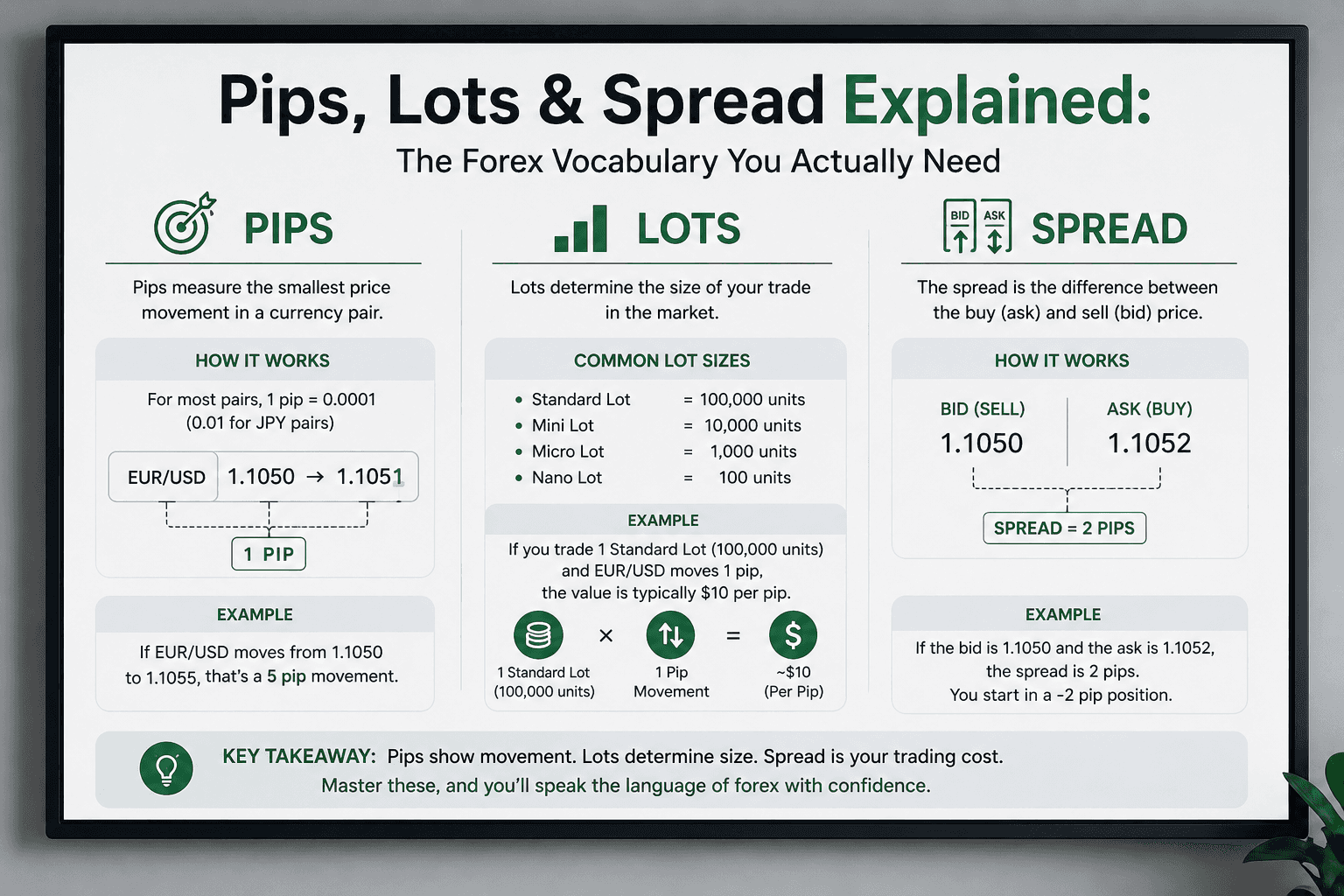
Every profession has its own language, and forex trading is no different. When you first step into the world of forex, words like 'pips,' 'lots,' and 'spread' get thrown around constantly — and if you don't know what they mean, you're already at a disadvantage. The good news is that these three terms are not complicated at all. Once you understand them, everything else in forex starts making much more sense. In this blog, we're going to break down pips, lots, and spread in the clearest possible way — with real examples, simple math, and practical context for your actual trading. By the end of this, you'll never be confused by these terms again.
What is a Pip?
A pip (Percentage In Point) is the smallest standard price movement in a forex currency pair. For most pairs, 1 pip = 0.0001 (the 4th decimal place).
Example:
If EUR/USD moves from 1.1000 to 1.1010, that's a 10-pip movement.
For JPY pairs (like USD/JPY), 1 pip = 0.01 (the 2nd decimal place) because Yen is valued differently.
Why Pips Matter:
Pips tell you how much the price moved and calculate your profit or loss. The pip value depends on your lot size.
Pip Value Calculator
• Micro Lot (0.01): $0.10 per pip
• Mini Lot (0.10): $1.00 per pip
• Standard Lot (1.00): $10.00 per pip
So if you made 50 pips profit on a micro lot: 50 × $0.10 = $5.00 profit.
What is a Lot?
A lot is the size of your trade — how many units of a currency you're buying or selling.
• Standard Lot: 100,000 units
• Mini Lot: 10,000 units (0.10)
• Micro Lot: 1,000 units (0.01)
For small accounts, ALWAYS use micro lots (0.01). Trading standard or mini lots with a $100 account is how accounts get blown in minutes.
What is the Spread?
The spread is the difference between the buy price and the sell price of a currency pair. This is how your broker makes money — you pay the spread on every trade you open.
Example:
EUR/USD: Buy = 1.10020, Sell = 1.10000. Spread = 2 pips. Every time you open a trade, you start 2 pips in the 'negative.' You need the market to move at least 2 pips in your direction just to break even.
Why Spread Matters:
For a $100 account using micro lots, a 2-pip spread costs $0.20. That's small. But if you're overtrading or using large lot sizes, spreads add up fast. Always choose a broker with low spreads.
How They All Connect
Real Trade Example:
• You open EUR/USD at 1.10020 (buy)
• Spread: 2 pips (you effectively enter at 1.10020, market is at 1.10000)
• The price rises 30 pips to 1.10300
• Net profit = 30 pips - 2 pip spread = 28 pips
• At 0.01 lot: 28 × $0.10 = $2.80 profit
Quick Reference Cheat Sheet
• 1 pip = 0.0001 movement on most pairs
• 0.01 lot = $0.10 per pip (best for small accounts)
• Spread = broker's fee, paid on trade open
• Lower spread = lower cost per trade
Final Thought
Pips, lots, and spread are the three pillars of forex mechanics. Master these three concepts, and you'll be able to calculate your risk, understand your costs, and size your trades correctly — every single time. This is the math that separates informed traders from those who trade blind.
Keywords: what is a pip in forex, forex lot size explained, what is spread in forex, pip value calculator, forex basics for beginners