2mins read
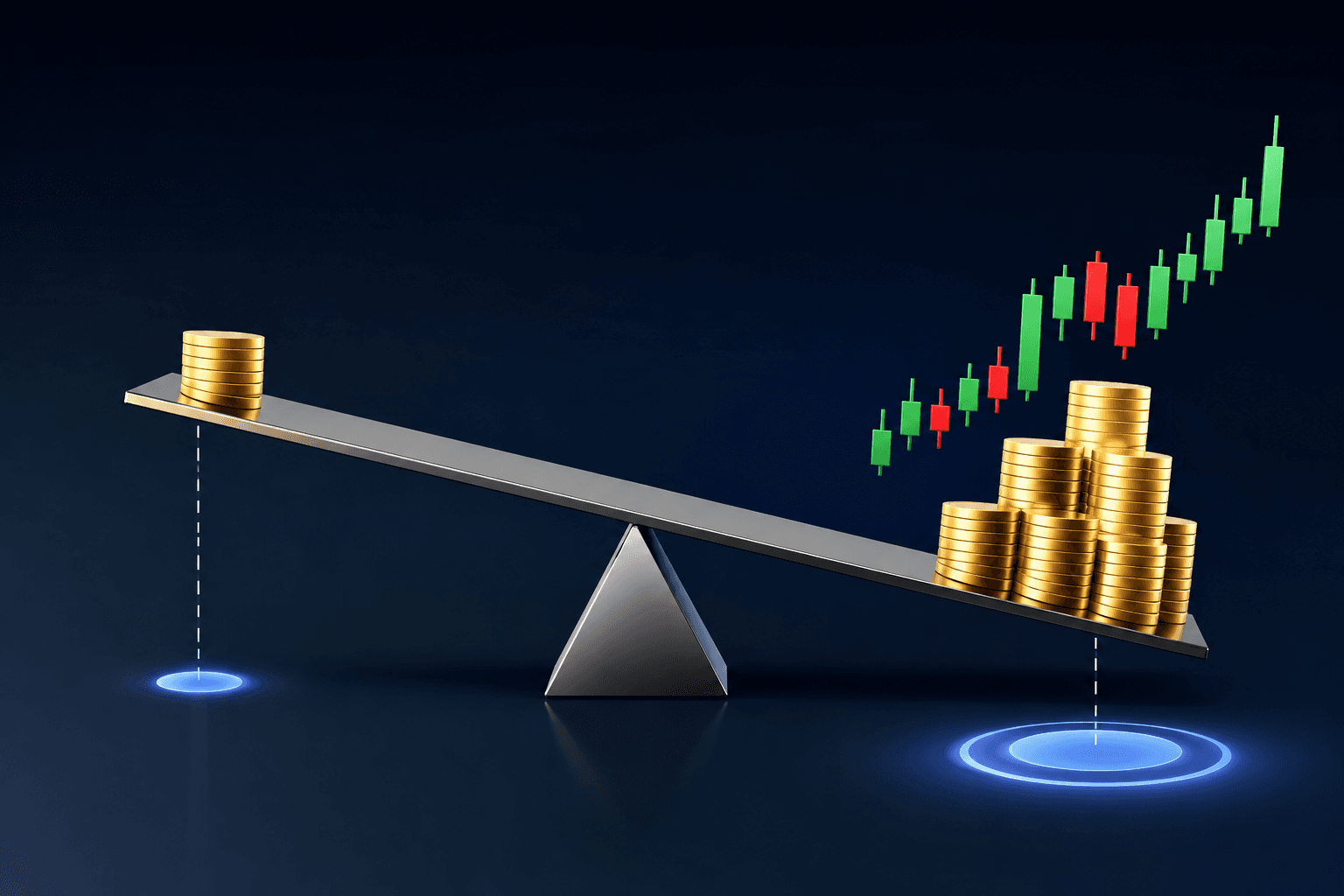
If you have ever wondered how traders control large positions in the forex market with only a small deposit, the answer is leverage. Leverage is one of the most talked-about — and most misunderstood — features of forex and CFD trading. Used wisely, it can amplify your returns significantly. Used carelessly, it can wipe out your account just as fast. In this guide, we break down exactly how leverage works in forex, explain what ratios like 1:100 and 1:500 really mean, walk through practical examples, and show you how to stay safe while using it. Whether you are a complete beginner or someone looking to sharpen their understanding before opening a live account, this guide is for you. You can also explore more beginner-friendly resources in our Forex & CFD trading education hub on the Olympus Capital website.
What Is Leverage in Forex?
Leverage in forex is the ability to control a large trade position using a relatively small amount of your own money. Your broker essentially lends you the rest. This borrowed capital is expressed as a ratio — the most common ones you will see are 1:10, 1:50, 1:100, 1:200, and 1:500.
Think of it like this: with 1:100 leverage, every $1 of your own money controls $100 in the market. With 1:500 leverage, every $1 controls $500. The higher the ratio, the bigger the position you can take — and the bigger both your potential profit and potential loss become.
💡 Simple Definition Leverage = the multiplier applied to your deposit to determine your total market exposure. A $500 account with 1:100 leverage gives you $50,000 of buying power. |
How Leverage Works: Step-by-Step
Here is a simple breakdown of the mechanics:
• You deposit funds into your trading account (called your margin or collateral).
• You choose a leverage ratio — for example, 1:200.
• Your broker multiplies your deposit by that ratio to determine your maximum position size.
• You place a trade. Your deposit is held as security, and profits or losses are calculated on the full position size.
• When you close the trade, your profit or loss is applied to your account balance.
Practical Example: EUR/USD Trade
Suppose EUR/USD is trading at 1.0850. You want to buy 1 standard lot (100,000 units).
Scenario | Your Deposit | Leverage | Position Size | 1% Move = Profit/Loss |
No leverage | $100,000 | 1:1 | $100,000 | $1,000 |
10x leverage | $10,000 | 1:10 | $100,000 | $1,000 |
100x leverage | $1,000 | 1:100 | $100,000 | $1,000 |
500x leverage | $200 | 1:500 | $100,000 | $1,000 |
Notice that the profit or loss on a 1% move is the same regardless of leverage — what changes is how much of your own capital you need to commit. That is the power of leverage. It makes large markets accessible with smaller capital.
What Does 1:500 Leverage Mean?
1:500 leverage is among the highest ratios offered by retail forex brokers, and it is available on select account types at Olympus Capital FX. At this ratio, a $100 deposit can control a $50,000 position. A $1,000 deposit can control a $500,000 position.
This sounds incredible — and it is, as long as you pair it with a strict risk management strategy. Because when a position moves against you, the losses are also multiplied by the same factor.
⚠️ Important With 1:500 leverage, a market move of just 0.2% against your position can wipe out a 100% of your deposited margin. Always use stop-loss orders when trading with high leverage. |
Margin and Leverage: What Is the Difference?
Margin and leverage are two sides of the same coin. Here is how they relate:
Leverage Ratio | Required Margin (%) | Margin for $10,000 Trade |
1:10 | 10% | $1,000 |
1:50 | 2% | $200 |
1:100 | 1% | $100 |
1:200 | 0.5% | $50 |
1:500 | 0.2% | $20 |
Margin is the deposit required to open and maintain a leveraged position. The higher your leverage, the lower your margin requirement — meaning you need less capital up front. If the market moves against you and your account equity falls below the required margin level, your broker may issue a margin call, requiring you to deposit more funds or close positions.
Understanding how margin and leverage interact is fundamental. We recommend reading our related article on Forex CFD Trading for Beginners for a broader overview of how CFD mechanics work.
The Risks of Leverage in Forex
Leverage is the reason many beginner traders blow up their accounts — and it is also the reason experienced traders can generate outsized returns. Here are the key risks you must understand:
1. Amplified Losses
The same multiplier that increases your profits also magnifies your losses. If you are using 1:200 leverage and the market moves 0.5% against you, your margin is gone. Without a stop-loss, losses can exceed your deposit in volatile markets.
2. Margin Calls
If your account equity drops below the required margin, your broker will close your open positions — often at the worst possible moment. Keeping sufficient free margin in your account is essential.
3. Emotional Overtrading
High leverage can tempt traders to open much larger positions than they should. The excitement of big potential gains often overrides sound risk management logic — especially for beginners.
4. Volatility Risk
During major news events (such as central bank decisions or NFP data), the forex market can move sharply in seconds. High leverage in such conditions is extremely dangerous if you do not have proper stop-losses in place.
To learn about how to manage the risks of copy trading strategies that involve leverage, check out our blog: Copy Trading Risks Explained: What Every Investor Must Know.
Best Leverage for Beginners: What Should You Use?
This is one of the most common questions new traders ask. The short answer: start low.
Trader Level | Recommended Leverage | Why |
Complete Beginner | 1:10 to 1:30 | Low risk, builds discipline |
Intermediate | 1:50 to 1:100 | Balanced risk/reward |
Experienced | 1:100 to 1:200 | Larger positions, strict stops required |
Professional | 1:200 to 1:500 | High risk, very experienced traders only |
The best leverage for a beginner is not the highest available — it is the one that keeps your risk per trade at 1-2% of your total account balance. With lower leverage, you give yourself more room to breathe even when a trade moves against you.
At Olympus Capital, we offer multiple account types suited to different experience levels. Visit our forex trading accounts page to choose the option that fits your goals and risk tolerance.
How to Calculate Your Leverage and Margin
Here are two key formulas every forex trader should know:
📐 Formulas Leverage Ratio = Total Position Size ÷ Your Margin Deposit Required Margin = Trade Size ÷ Leverage Ratio |
Example Calculation
You want to open a 0.5 lot (50,000 units) EUR/USD trade at 1:100 leverage.
• Required Margin = 50,000 ÷ 100 = $500
• If EUR/USD moves 100 pips (1%) in your favour, profit ≈ $500
• If it moves 100 pips against you, loss ≈ $500 — your full margin is at risk
This is why position sizing and stop-loss placement are so critical when trading with leverage.
Leverage vs. No Leverage: A Side-by-Side Comparison
Factor | Without Leverage | With Leverage (1:100) |
Capital Required | Full trade value | 1% of trade value |
Profit on 1% move | 1% of capital | 100% of margin |
Loss on 1% move | 1% of capital | 100% of margin |
Accessibility | High capital needed | Low capital needed |
Risk level | Low-Moderate | High |
Using Leverage Through PAMM Accounts and Copy Trading
Not all traders want to manage leverage themselves. Two popular alternatives at Olympus Capital are PAMM accounts and copy trading — both of which allow you to benefit from leveraged trading while having an experienced trader manage the positions.
With a PAMM account, your funds are pooled with other investors and managed by a professional trader. You gain exposure to leveraged trades without placing orders yourself. Read our full guide: What Is a PAMM Account in Forex?.
Copy trading works similarly — you automatically mirror the trades of experienced traders in real time. To understand how it works and what to expect, see our article on Copy Trading in Forex for Beginners.
Wondering whether a PAMM account or copy trading is better for generating passive income? We compare both options in detail in our guide: PAMM Account vs Copy Trading: Which Is Better for Passive Income?.
7 Leverage Risk Management Tips Every Forex Trader Needs
• Always use a stop-loss order — define your maximum acceptable loss before entering any trade.
• Risk no more than 1-2% per trade — this keeps losses manageable even during a losing streak.
• Start with a demo account — practice leverage mechanics without risking real money.
• Choose leverage appropriate to your experience — do not jump straight to 1:500 as a beginner.
• Monitor your free margin — keep a buffer above your required margin to avoid margin calls.
• Avoid trading major news events with high leverage unless you have a clear strategy.
• Use smaller position sizes when increasing leverage rather than opening larger trades.
Frequently Asked Questions About Forex Leverage
Is high leverage always bad?
Not necessarily. High leverage in the hands of a disciplined trader with a strict risk management strategy can be a powerful tool. The danger lies in using high leverage without proper stop-loss orders or position sizing rules.
Can I lose more than my deposit with leverage?
With most regulated CFD brokers — including Olympus Capital — negative balance protection ensures you cannot lose more than your account balance. However, always verify your broker's policy before trading.
What is a margin call?
A margin call occurs when your account equity falls below the required margin level. Your broker will either ask you to deposit additional funds or automatically close your open positions to prevent further losses.
What leverage do professional traders use?
Professional traders often use surprisingly low leverage — frequently 1:5 to 1:20 — because they focus on capital preservation and consistent returns rather than trying to maximise gains on every trade.
Does leverage cost money?
Leverage itself does not cost money directly, but overnight positions (swap rates) may incur a small fee depending on the currency pair and direction of your trade. Check your broker's swap rates for details.
Final Thoughts: Leverage Is a Tool, Not a Shortcut
Leverage is neither good nor bad on its own — it is a tool. Like any tool, its value depends entirely on how you use it. A beginner trading with 1:500 leverage and no stop-loss is gambling. An experienced trader using 1:50 leverage with clear entry and exit rules is using leverage as intended.
The key takeaways from this guide are simple: understand what leverage is, choose a ratio that matches your experience and risk tolerance, always use stop-loss orders, and never risk money you cannot afford to lose.
Ready to put your knowledge into practice? Explore our forex trading platform and account options at Olympus Capital, or deepen your knowledge further by browsing our full library of trading insights and educational blogs. Trading involves significant risk — trade responsibly.