2mins read
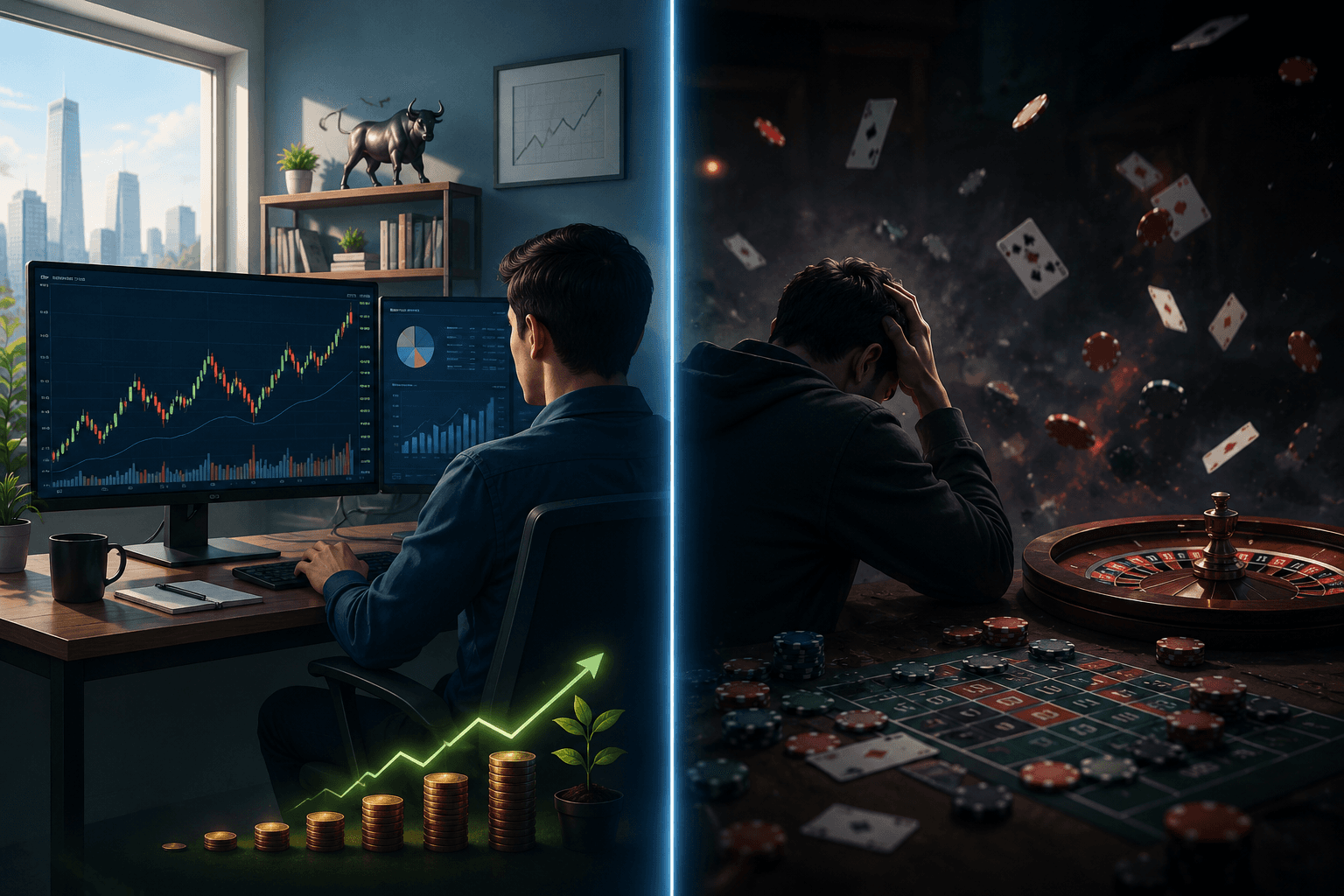
Every new trader hears it at least once: "You're basically just gambling." It's a criticism thrown casually — often by well-meaning friends or skeptical family members who watch someone pour hours into charts, indicators, and financial news. On the surface, the comparison seems reasonable. Both activities involve money. Both involve uncertainty. Both can result in loss. But the moment you examine the mechanics beneath that surface, the comparison falls apart entirely.
The global forex market processes over $7.5 trillion in transactions every single day. It operates across 24 hours, five days a week, spanning every major financial centre from Tokyo to London to New York. Institutional banks, hedge funds, multinational corporations, sovereign wealth funds, and millions of individual traders all participate in this ecosystem — not to entertain themselves, but to generate returns, manage currency exposure, and hedge against economic risk. This is not a casino floor. It is the largest and most liquid financial market in the world.
Yet the criticism persists, and it's worth taking it seriously. Why? Because for some traders — those who ignore risk management, abandon their strategies, over-leverage their accounts, and chase losses impulsively — trading genuinely does become gambling. The line between disciplined speculation and reckless betting is real, and understanding it is the foundation of every successful trading career.
This blog examines exactly where that line sits. What makes professional trading a skill-based activity? What makes gambling a fixed-odds game? And critically — how do you ensure you stay on the right side of the divide?
The answers require us to look at six core dimensions: the role of analysis and strategy, risk management frameworks, the concept of edge, skill development over time, the psychological dimension of both activities, and the structural design of each. Across every dimension, trading and gambling reveal themselves to be profoundly different — not just in degree, but in kind.
Whether you are a curious beginner wondering whether the markets are worth your time, or an experienced trader looking to sharpen your self-awareness, this guide will give you a clear, honest framework. By the end, you'll not only understand why professional trading is not gambling — you'll understand precisely the conditions under which it could become gambling, and how to guard against them.
1. The Structural Difference: Skill vs Chance
At its core, gambling is a contest between a player and a fixed-odds system designed to return less money than it takes in. A roulette wheel, a slot machine, a lottery ticket — all are engineered to produce a negative expected value for the player. Over a statistically significant number of games, the house always wins. This isn't speculation; it's mathematical certainty.
Trading operates on entirely different principles. When you buy a currency pair — for example, going long on EUR/USD — you are not playing against a fixed-odds machine. You are entering into a transaction with another market participant who has the opposite view. The market is not designed to take money from you. Its price movements reflect the collective decisions of millions of participants reacting to real-world economic data, central bank policy, geopolitical events, and institutional flows.
Skill, analysis, and preparation genuinely matter. A trader who understands how the Federal Reserve's interest rate decisions affect the US dollar, who can read a price action setup, and who applies disciplined position sizing will systematically outperform a trader who places orders randomly. This improvement in outcomes with skill is the defining characteristic of a non-gambling activity.
2. Risk Management: The Trader's Greatest Weapon
If there is one concept that most cleanly separates trading from gambling, it is risk management. A gambler cannot control the size or nature of the risk they accept — it is fixed by the game's structure. A trader controls risk precisely and deliberately before each position is opened.
Professional traders use stop-loss orders to cap the maximum loss on any single trade. They use position sizing formulas to ensure that no trade risks more than 1–2% of total capital. They define risk-to-reward ratios before entering, ensuring that potential gains justify potential losses. Over time, these practices transform trading from a series of unpredictable coin flips into a systematic process with measurable, manageable outcomes.
This disciplined framework is explored in depth in the Olympus Capital guide on risk management for gold traders, which demonstrates how capital protection and growth can be pursued simultaneously through structured frameworks.
3. Analysis and Strategy: The Foundation of Trading Edge
Professional trading is built on analysis. Technical traders study price charts, identify patterns, and use indicators to assess probable future price movements. Fundamental traders analyse economic releases, interest rate differentials, trade balances, and central bank commentary to forecast currency direction. Many traders combine both approaches.
A well-defined strategy is the vehicle through which this analysis translates into consistent results. The best XAUUSD scalping and swing trading strategies illustrate this clearly: entry criteria, stop levels, target levels, and trade management rules are all defined in advance. Nothing is left to impulse or chance.
Choosing the right market is itself a strategic decision. The comparison of gold versus major currency pairs shows how traders evaluate volatility, spread, correlation, and session activity before committing capital — a level of deliberation entirely absent from gambling.
4. The Right Tools Make the Difference
Professional trading requires professional infrastructure. Serious traders use sophisticated platforms that provide charting tools, technical indicators, one-click execution, and advanced order management. The reason MT4 and MT5 are the most popular trading platforms in the world is precisely because they provide the analytical and operational environment that rigorous trading demands.
A gambler walks to a table. A trader opens a platform, analyses the market, sets alerts, defines entry and exit parameters, and — only then — places a trade. The process is deliberate, measured, and repeatable.
5. Compounding: The Long Game Gamblers Cannot Play
One of the most powerful advantages of disciplined trading is access to compounding. When risk is managed well and a strategy has genuine edge, profits can be reinvested to grow the account exponentially over time. The compounding method for small accounts demonstrates exactly how modest starting capital, grown patiently and systematically, can achieve significant scale.
Gambling offers no such path. The house edge ensures that the longer a gambler plays, the closer their outcome converges to a guaranteed loss. Compounding in gambling is a mathematical fiction.
6. When Trading Becomes Gambling
Intellectual honesty demands acknowledgment: trading can become gambling when discipline collapses. This happens when traders place positions with no analytical basis, use leverage so extreme that a single trade threatens the account, chase losses emotionally, ignore their stop levels, or treat trading as entertainment rather than a profession.
If you find yourself trading for excitement rather than executing a plan, you are no longer trading — you are gambling with your capital.
Recognising these patterns early is essential. The debate around whether forex trading is gambling addresses this nuance directly, providing a framework for honest self-assessment.
7. The Verdict
For the undisciplined and unprepared, forex trading can resemble gambling. For the educated, strategic, and disciplined trader, it is as far from gambling as owning a diversified investment portfolio.
The market does not care about your opinions, your hopes, or your emotional state. It rewards preparation, discipline, and patience — and it punishes impulsivity, overconfidence, and poor risk management. That is not gambling. That is professional speculation, and it is one of the most demanding and rewarding skills in the world of finance.
Start your structured trading journey today — and learn how to trade gold (XAUUSD) as a practical first step into disciplined market participation.
Risk Warning: Trading Forex and CFDs involves a high level of risk. Always ensure you fully understand the risks involved before trading.
Related Articles

Forex Strategy
Aug 21, 2026
Position Sizing & Money Management in Forex: Survive and Profit
Forex Trading Basic
Aug 21, 2026
Position Sizing & Money Management in Forex: Survive and Profit

Forex Strategy
Aug 20, 2026
Stochastic Indicator in Forex: Catch Momentum Shifts

Forex Trading Basic
Aug 19, 2026
Fibonacci Retracement in Forex: Find Hidden Support Levels