2mins read
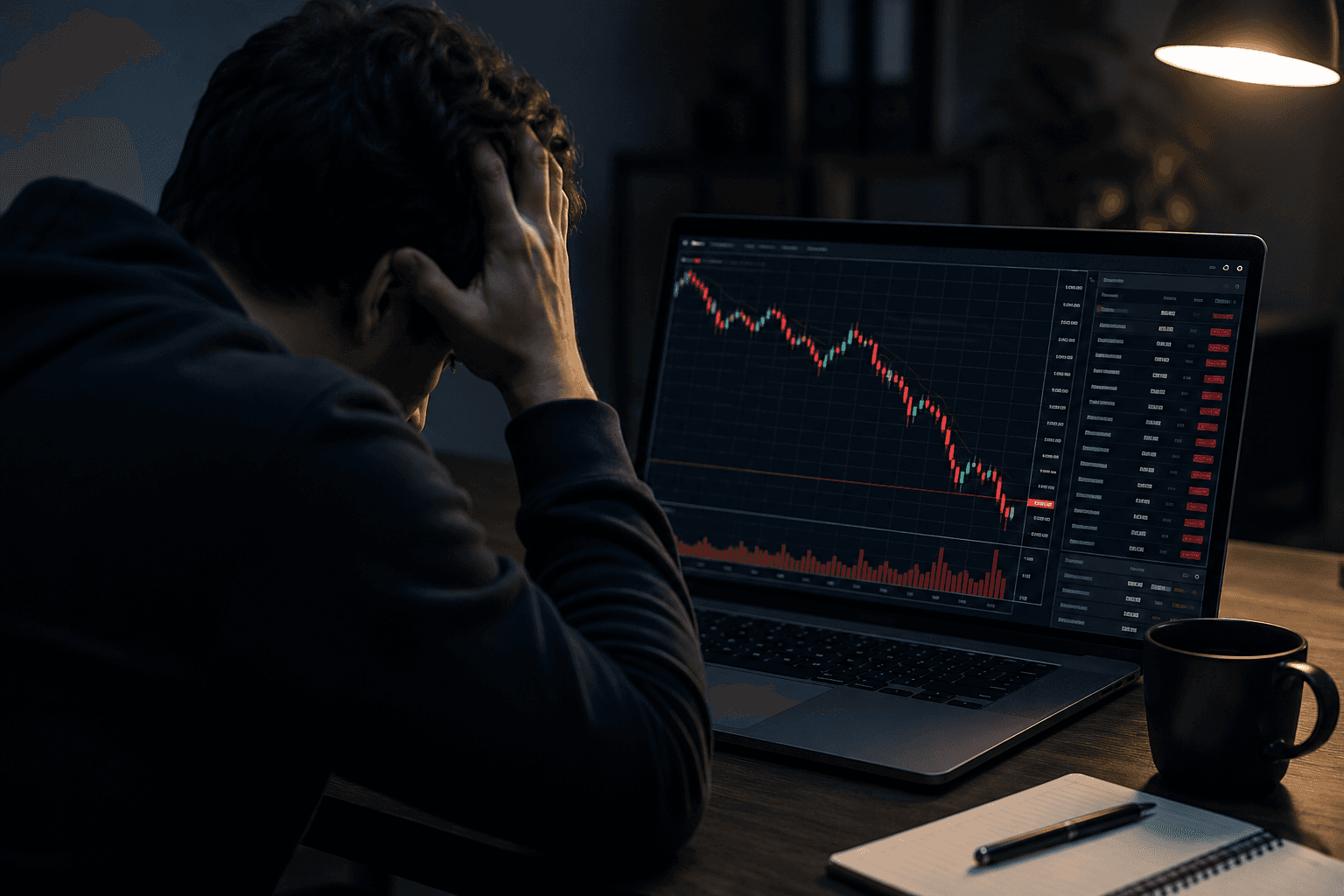
Every day, thousands of people open forex trading accounts with big dreams — and most of them lose money within months. The forex market moves over $7.5 trillion a day, making it the largest financial market on the planet. Yet studies consistently show that over 70% of retail traders end up in the red. So what goes wrong? It's rarely about bad luck. It's about predictable, repeatable mistakes that destroy accounts before traders even understand what hit them. In this blog, we'll break down exactly why most people lose money in forex — and more importantly, what you can do to trade differently. Before diving in, if you're just getting started, read our foundational guide on forex trading basics — understanding the fundamentals is the first line of defence against losses.
1. They Start Without a Real Education
This is the most common reason — and the most preventable. Most new traders watch a few YouTube videos, read a couple of forum posts, and then deposit money and start clicking buttons. That's not preparation; that's gambling.
The forex market is an inter-bank, over-the-counter market where institutional players — banks, hedge funds, and sovereign wealth funds — operate with sophisticated tools and years of experience. A retail trader entering without structured education is at an immediate and severe disadvantage.
What successful traders do instead: They invest weeks or months studying price action, understanding currency correlations, learning how to read economic indicators, and practising on demo accounts before committing real capital.
Explore our structured trading education resources to build the knowledge foundation every serious forex trader needs.
2. They Have No Trading Plan — and No Strategy
Would you open a business without a business plan? Of course not. Yet the majority of retail traders enter the forex market with zero structured plan. They have no defined entry criteria, no exit rules, no position sizing strategy, and no clear idea of what edge they're trying to exploit.
A trading plan isn't just about which currency pairs you trade. It covers: when you trade, why you enter, when you exit, how much you risk per trade, what market conditions you avoid, and how you review and improve your performance.
Common strategy mistakes include:
• Switching strategies after every loss instead of following one consistently
• Using strategies from social media influencers with no verified track record
• Trading multiple conflicting signals without a hierarchy of rules
• Ignoring market context — trying to scalp in a low-volatility range or swing-trade in a news-driven spike
If you're serious about developing a robust trading approach, our guide on the best XAUUSD trading strategy is an excellent example of how to build a structured, rules-based strategy.
3. Poor Risk Management — The Silent Account Killer
You can have a winning strategy and still blow your account if your risk management is broken. This is the hard truth that most losing traders only accept after their account hits zero.
The classic mistake is risking far too much per trade — sometimes 10%, 20%, or even 50% of the account on a single position. Even with a 60% win rate, a few large losing trades can wipe out months of gains. Professional traders typically risk between 0.5% and 2% of their account per trade. That's it.
The Reward-to-Risk Ratio Problem
Another critical error is taking trades with poor reward-to-risk ratios. If you're risking 50 pips to make 20 pips, you need to win 72% of your trades just to break even — an almost impossible standard to maintain consistently.
The minimum benchmark most professionals use is a 1:2 reward-to-risk ratio. Even with a 40% win rate, you'll be profitable at that ratio over enough trades.
For a complete breakdown, read our detailed resource on risk management for gold traders — the principles apply equally to all currency pairs.
4. Overleveraging: The Double-Edged Sword
Leverage is one of the most attractive — and most dangerous — features of forex trading. Brokers offer leverage of 50:1, 100:1, or even 500:1. This means you can control a $100,000 position with just $200 in your account. It sounds exciting. In practice, it turns normal market volatility into account-destroying swings.
A currency pair like EUR/USD routinely moves 80–120 pips on a normal trading day. If you're leveraged at 500:1, that 100-pip move equals a 50% move on your account margin. One bad trade at excessive leverage can trigger a margin call before you have time to react.
The professional rule of thumb: Use leverage to enhance returns on high-conviction, well-positioned trades — not to inflate position sizes beyond what your account can absorb. Real traders use leverage conservatively and focus on position sizing based on stop-loss distance, not on how much leverage they want to use.
5. Letting Emotions Run the Trade
This is where forex trading separates itself from most other skills. In forex, your biggest enemy isn't the market — it's your own psychology. Fear, greed, impatience, overconfidence, and revenge trading are responsible for more account blow-ups than any technical failure.
The Most Destructive Emotional Patterns
• Revenge trading: After a loss, the trader immediately opens a larger trade to 'win it back' — often compounding losses.
• Holding losers too long: Refusing to accept a loss, moving the stop loss further away, and hoping the market will reverse.
• Cutting winners too early: Taking a small profit out of fear the trade will reverse, leaving the majority of a move on the table.
• Overtrading: Taking low-quality setups out of boredom or impatience, eroding the edge of a good strategy.
Understanding whether you're truly trading or succumbing to gambling instincts is crucial. Our popular post on trading vs gambling: key differences every investor must know provides an honest look at this distinction that every trader should read.
If you're unsure where you stand, our companion piece Is Forex Trading Gambling? explores this question in depth with actionable insights.
6. Trading with the Wrong Tools and Platform
Execution quality matters more than most traders realise. A slow platform, poor charting tools, unreliable order execution, or confusing interface can all contribute to costly mistakes — especially in fast-moving markets.
Professional traders use platforms built for serious trading. MetaTrader 4 and MetaTrader 5 have become the global standard not by accident — they offer robust charting, algorithmic trading capabilities, and a deep ecosystem of indicators and expert advisors.
Read our in-depth analysis of why MT4 & MT5 are the most popular trading platforms in the world to understand what separates professional-grade tools from the rest.
At Olympus Capital FX, we offer access to institutional-grade trading infrastructure through our forex trading accounts — built for both beginner and advanced traders.
7. Ignoring Market Context: Trading Against the Trend
'The trend is your friend' is perhaps the most quoted rule in trading — and the most ignored by losing traders. Consistently attempting to pick tops and bottoms in strong trends is one of the fastest ways to drain an account.
Many traders fall in love with counter-trend trading because occasional wins feel spectacular. But statistically, trend-following strategies vastly outperform mean-reversion approaches for retail traders, especially when they lack access to real-time institutional flow data.
This is particularly relevant when trading instruments like XAUUSD (Gold), where understanding momentum and macro trends is essential. Explore strategies for trading this market in our post on Gold vs Major Pairs: Which Is Better for Forex Traders?
8. Choosing the Wrong Broker
Not all forex brokers are equal — and the wrong broker can sabotage a perfectly good strategy. Spreads, slippage, execution speed, and regulatory protections all directly impact your profitability.
Warning signs of a bad broker:
• Requotes on fast-moving markets — preventing fills at your price
• Artificially widened spreads during news events
• Unclear or non-existent regulation
• Difficulties with withdrawals or opaque fee structures
• Lack of professional trading platform support
Olympus Capital FX is incorporated under the International Business Companies Act of Saint Lucia (registration no. EA–2024–00085) and operates with full regulatory compliance. Our forex trading infrastructure is designed to give traders a transparent, professional-grade environment with competitive execution.
9. Failing to Keep a Trading Journal
Without a trading journal, you're flying blind. You can't identify your recurring mistakes, you can't track which strategies are working, and you have no data to improve your decision-making. Professional traders treat their journal the way doctors treat patient records — it's non-negotiable.
Your journal should capture:
• Date, time, and currency pair
• Entry and exit price, stop loss, and take profit
• The rationale for the trade setup
• Your emotional state before and during the trade
• Outcome and key lessons learned
Reviewing your journal weekly allows you to identify edge-destroying habits, spot high-probability patterns, and continuously refine your approach with real evidence.
10. Unrealistic Expectations
The forex industry is rife with marketing promising overnight riches, 'signals' with 95% win rates, and 'systems' that guarantee monthly returns of 50% or more. This noise sets new traders up for inevitable disappointment — and often leads to reckless risk-taking in pursuit of impossible returns.
The reality: Top professional traders consistently achieve 15–30% annual returns on their capital. Hedge funds that deliver 20% per year are considered exceptional. If someone is promising you 10% per week, they are either lying or taking risks that will eventually destroy the account.
Entering the market with realistic expectations — and a commitment to consistent, process-driven improvement — is what separates traders who last from those who blow up and quit.
The Bottom Line: Losing Is Preventable
Losing money in forex is not inevitable. The market doesn't have it in for you. The reasons traders lose are well-documented, well-understood, and entirely addressable with the right education, discipline, tools, and mindset.
The path to consistent profitability runs through structured learning, disciplined risk management, emotional control, and continuous self-improvement. None of these are secrets — they're just hard work that most people aren't willing to do.
At Olympus Capital FX, we're committed to helping serious traders build the foundation they need to trade with confidence. Whether you're just starting out or refining an existing approach, explore our full library of trading insights, dive into our learning centre, or open a trading account designed to give you every advantage the market allows.
Related Articles

Forex Strategy
Aug 21, 2026
Position Sizing & Money Management in Forex: Survive and Profit
Forex Trading Basic
Aug 21, 2026
Position Sizing & Money Management in Forex: Survive and Profit

Forex Strategy
Aug 20, 2026
Stochastic Indicator in Forex: Catch Momentum Shifts

Forex Trading Basic
Aug 19, 2026
Fibonacci Retracement in Forex: Find Hidden Support Levels