2mins read
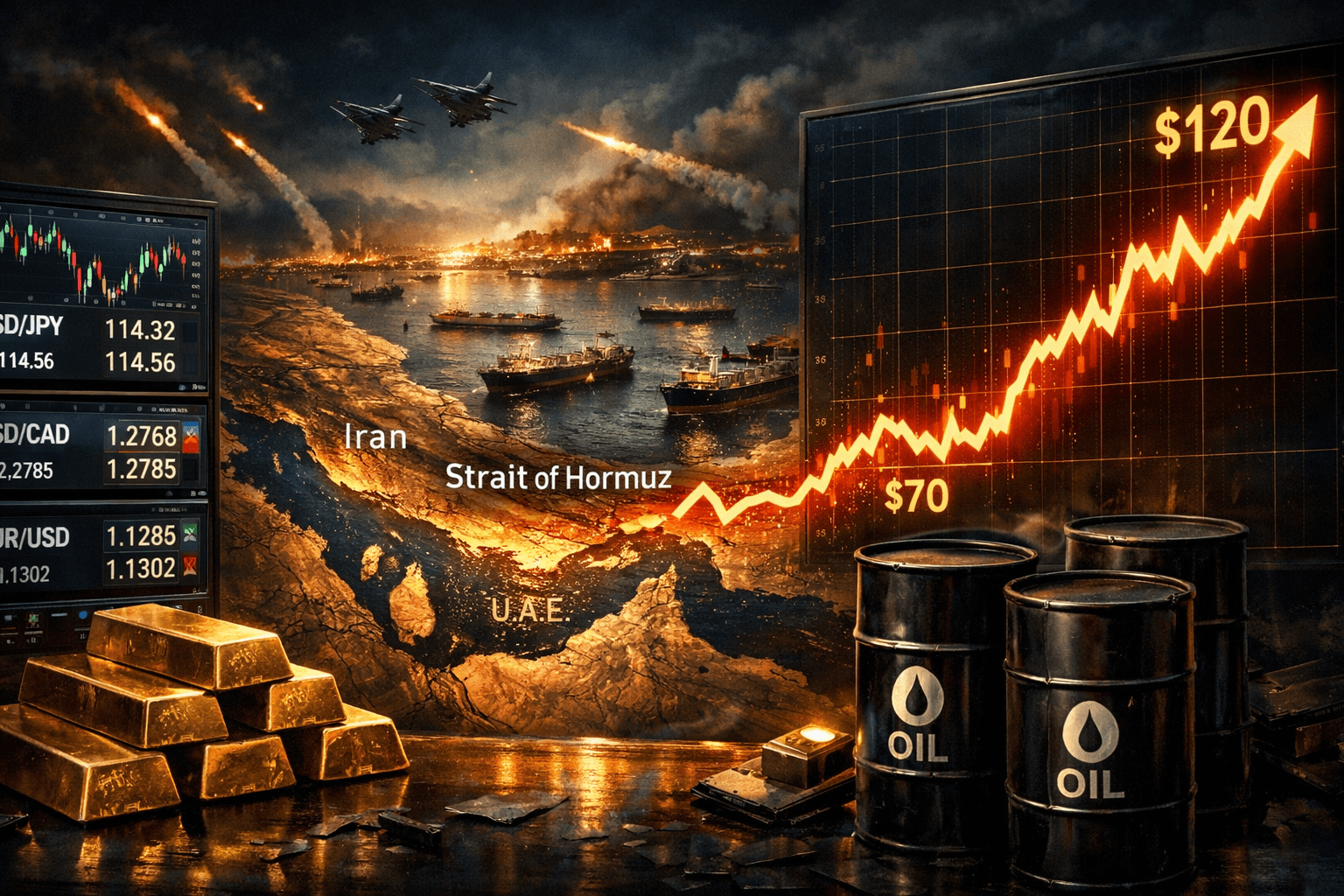
The 2026 Iran war has rapidly evolved into one of the most significant geopolitical events affecting global financial markets this year. Following the US–Israel military campaign against Iran and the resulting disruption of the Strait of Hormuz, oil prices surged dramatically, sending shockwaves across energy markets, global economies, and the foreign exchange market. What This Blog Covers • Overview of the Iran War 2026 and the geopolitical events triggering the crisis • How the Strait of Hormuz disruption affected global oil supply and energy markets • Why oil prices surged from $73 to nearly $120 per barrel in days • The relationship between oil prices and currency movements in forex markets • Which currencies are benefiting from the crisis (USD, CAD, NOK, Gold) • The broader economic impact on global markets and inflation • Possible scenarios for how the conflict could affect oil prices and forex markets going forward
Snapshot: March 12, 2026
Brent crude: ~$91.98/bbl (+26% from pre-war $73). WTI: ~$87.25/bbl (+30% from $67). Petrol up in 85+ countries. IEA released a record 400 million barrels. USD, CAD, and NOK surging. JPY, INR, and PKR under severe pressure.
1. The Crisis in Brief: What Happened and Why
On February 28, 2026, the United States and Israel launched a coordinated military campaign — Operation Epic Fury — targeting Iran's nuclear facilities, missile infrastructure, and leadership. Iranian Supreme Leader Ali Khamenei was killed in the opening strikes. Iran retaliated immediately with hundreds of ballistic missiles and drones across Gulf military bases and oil infrastructure.
The most economically devastating consequence was the near-closure of the Strait of Hormuz — the narrow waterway through which roughly 20% of the world's daily oil and gas supply normally flows. Saudi Arabia's Ras Tanura terminal closed. Qatar declared force majeure on LNG exports. Oil prices surged from $73 to nearly $120 per barrel in just nine days — the fastest spike since 1973.
Indicator | Pre-War (Feb 27) | Peak (Mar 9) | Now (Mar 12) |
Brent Crude | $73/bbl | ~$120/bbl | ~$91.98/bbl |
WTI Crude | $67/bbl | >$100/bbl | ~$87.25/bbl |
US Avg. Gasoline | $2.94/gal | ~$3.80+/gal | $3.58/gal |
Strait of Hormuz Traffic | 100+ ships/day | Near-zero | Severely disrupted |
2. Why Oil Barrel Prices Spiked: The Economics
Oil markets operate on razor-thin supply-demand balances. The world consumes about 103 million barrels per day. Even losing 3–5% of supply causes outsized price swings because global storage is finite. Before this war, inventories were already at a five-year low — meaning the market had almost no buffer when supply collapsed.
Three forces drove the surge:
▸ Direct supply loss: Iran's ~3 million bbl/day output disrupted; Gulf producers forced to cut production as trapped crude filled storage.
▸ Hormuz risk premium: Traders added a massive geopolitical premium to every barrel because the strait physically cannot be bypassed by most Gulf producers.
▸ LNG panic: Qatar's force majeure on gas exports sent energy markets into a secondary crisis, pushing natural gas prices sharply higher alongside oil.
💡 Why It Matters to Every Market The IMF formula: every 10% rise in oil prices → ~0.4% rise in inflation + ~0.15% reduction in global GDP growth. Oil is currently 26% above pre-war levels — implying roughly +1.0% inflation and -0.4% GDP impact before any policy response. |
3. Forex Market Impact: How the Iran War Is Moving Currencies
For forex traders, geopolitical oil shocks are among the most powerful and predictable currency-moving events in global markets. The Iran-Hormuz crisis has created sharp, definable trends across multiple currency pairs — creating both significant risk and significant opportunity.
The Core Mechanism: Oil Price → Currency Value
The link between oil prices and currencies runs through two channels. First, oil-exporting nations see their trade surpluses, government revenues, and GDP rise when oil prices surge — directly strengthening their currencies. Second, oil-importing nations face rising import bills, growing trade deficits, and inflationary pressure — weakening their currencies. Understanding which side of this equation each currency sits on is the foundation of oil-driven forex analysis.
Currency | Oil Relationship | Direction | Key Driver |
USD (US Dollar) | Net exporter + safe haven | ↑ Bullish | Safe haven + rising oil revenues |
CAD (Canadian Dollar) | Major oil exporter | ↑ Bullish | Direct petro-currency benefit |
NOK (Norwegian Krone) | Major oil exporter | ↑ Bullish | North Sea oil windfall |
RUB (Russian Ruble) | Oil exporter (sanctioned) | ↑ Latent | Higher revenues, limited flow |
JPY (Japanese Yen) | Imports ~95% of oil | ↓ Bearish | Massive import cost surge |
INR (Indian Rupee) | Imports ~85% of oil | ↓ Bearish | CAD + inflation pressure |
PKR (Pakistani Rupee) | Heavy import dependency | ↓ Bearish | Thin reserves, FX crisis risk |
EUR (Euro) | Net importer | ↓ Mixed | Import costs vs. safe haven |
CNY (Chinese Yuan) | World's #1 oil importer | ↓ Pressure | Trade deficit widening |
CHF (Swiss Franc) | Safe haven | ↑ Bullish | Risk-off flow during war |
XAU (Gold / USD) | Crisis hedge | ↑ Strong | Inflation + geopolitical fear |
The US Dollar: War's Biggest Beneficiary
The USD has strengthened across the board since the war began, driven by two simultaneous forces. The United States' own surge in oil production (over 13 million bbl/day) means higher domestic energy revenues — an actual economic benefit from higher prices. Simultaneously, global financial stress always triggers a 'flight to safety' into USD-denominated assets. The DXY (Dollar Index) has risen approximately 2.8% since February 28.
Key pairs to watch: USD/JPY has spiked sharply as the yen weakens (Japan's energy import bill is surging). USD/INR has pushed higher as India's current account deficit widens. USD/PKR is under extreme pressure as Pakistan's thin reserves face an import cost surge.
CAD and NOK: The Petro-Currency Winners
The Canadian dollar (CAD) and Norwegian krone (NOK) are the two most direct beneficiaries in forex markets. Both countries are major oil exporters whose trade balances improve dramatically when crude prices rise. USD/CAD has fallen (CAD strengthening) by roughly 1.8% since the war began — a meaningful move in a major pair. EUR/NOK has also declined sharply, reflecting Norway's Brent-linked windfall.
📈 Trader's Rule of Thumb: CAD & NOK Historically, a $10 rise in Brent crude corresponds to approximately a 1.5–2.0% CAD appreciation against the USD over a 4–6 week window, and roughly 2.5–3.0% NOK appreciation against EUR. With Brent still ~$19 above pre-war levels, both currencies retain upside if the conflict persists. |
JPY: The Most Vulnerable Major Currency
Japan is acutely exposed. The country imports nearly 95% of its oil, almost entirely from the Gulf. Every $10 rise in crude oil adds approximately ¥2–3 trillion to Japan's annual import bill. The Bank of Japan is caught in a trap: raising rates to defend the yen risks destabilizing its fragile domestic recovery, while staying passive allows the yen to slide further. USD/JPY has broken above key resistance levels and is trading near multi-decade highs at time of writing.
EUR/USD: The Tug-of-War
The euro is caught between two opposing forces. As an oil importer, the Eurozone's trade balance deteriorates with rising crude prices — bearish for EUR. But European economies have a larger gas import exposure from the Middle East (via Qatar LNG) than the US, amplifying the pressure. On the other hand, ECB hawkishness and safe-haven flows within Europe provide some floor. EUR/USD has been range-bound but with a slight downward bias since the war began.
Gold (XAU/USD): The Classic Crisis Trade
Gold has surged strongly since February 28 — its most reliable performance characteristic. As a hedge against both inflation and geopolitical uncertainty, gold benefits from both channels simultaneously during an oil war. The combination of rising consumer prices worldwide and genuine existential uncertainty about Middle Eastern stability has driven strong institutional and retail buying. Gold has risen approximately 6–8% since the war began and many analysts expect continued strength if the conflict prolongs.
Key Forex Pairs & Technical Levels to Monitor
Pair | War-Start Level | Mar 12 Level | Key Level to Watch | Bias |
USD/JPY | ~149.50 | ~153.80+ | 155.00 resistance | Bullish (USD) |
USD/CAD | ~1.4430 | ~1.4175 | 1.4000 support | Bearish (CAD stronger) |
EUR/USD | ~1.0510 | ~1.0390 | 1.0300 key support | Mildly bearish |
GBP/USD | ~1.2650 | ~1.2520 | 1.2400 support | Mildly bearish |
USD/INR | ~86.50 | ~87.80+ | 88.50 resistance | Bullish (USD) |
XAU/USD | ~$2,850 | ~$3,050+ | $3,000 now support | Bullish (Gold) |
USD/NOK | ~10.80 | ~10.52 | 10.30 key support | Bearish (NOK stronger) |
Forex Trading Strategies During an Oil War
Oil price shocks create high-conviction directional opportunities but also extreme volatility and gap risk. Experienced traders typically adjust their approach in the following ways:
▸ Widen stops: Geopolitical events cause sharp intraday moves and weekend gaps. Standard stop distances can be easily triggered. Sizing down and widening stops is standard risk management during war-driven volatility.
▸ Trade the petro-currency pairs: USD/CAD long (CAD strength) and EUR/NOK short (NOK strength) are the cleanest oil-linked expression trades with the most established correlation history.
▸ Watch for verbal intervention turning points: As seen on March 10, a single Trump statement caused an 11% single-day oil drop — and parallel sharp forex reversals. Monitor official communications closely and treat them as event risk.
▸ Gold as portfolio hedge: XAU/USD long positions provide natural hedging during prolonged uncertainty. Gold's negative correlation with risk assets is performing as expected in this environment.
▸ Fade extreme moves carefully: Oil spiked to $120 and reversed to $87 within three days. Currency moves linked to oil also overshoot — creating mean-reversion opportunities for disciplined traders after the initial panic settles.
▸ Monitor Strait of Hormuz headlines as the primary catalyst: Any credible report of the strait reopening — even partially — will trigger sharp oil selling and corresponding forex reversals (JPY rally, CAD/NOK selling).
⚠️ Risk Disclaimer for Traders Risk Warning: Trading during active geopolitical conflicts involves materially elevated risk. Spreads widen dramatically, liquidity can evaporate, and weekend gaps can exceed normal daily ranges. Always use appropriate position sizing and ensure stop-losses account for extreme volatility. This article is for informational purposes only and does not constitute financial advice. |
4. Global Impact: Who Is Hurt Most
At least 85 countries have reported fuel price increases since February 28. The severity tracks closely with oil import dependence and the strength (or fragility) of domestic currencies — exactly as forex market movements suggest.
▸ Japan & South Korea: Most exposed major economies. Japan imports 95% of oil from Gulf; South Korea 70%. Both have enacted emergency reserve measures.
▸ South Asia (India, Pakistan, Bangladesh): Significant currency and inflation pressure. Bangladesh closed universities to conserve fuel. Pakistan introduced a four-day government workweek.
▸ Europe: Rising gas and oil import costs weighing on growth and the euro, though strategic reserves provide partial buffer.
▸ United States: Retail gas up 20% to $3.58/gallon, but the US benefits from domestic production revenue — hence USD strength.
▸ Middle East producers (Saudi, UAE, Kuwait): Trapped oil in storage as Hormuz closes — paradoxically hurting their own revenues despite high prices
5. The World's Response
The International Energy Agency's 32 member nations unanimously agreed on March 11 to release 400 million barrels of emergency oil — the largest such action in the IEA's history, dwarfing the 60 million barrels released after Russia's 2022 Ukraine invasion. Analysts view this as sufficient to bridge a short conflict but inadequate for a multi-month war. Saudi Aramco has also ramped crude flows through its overland Petroline pipeline to the Red Sea, partially bypassing Hormuz — enough to restore roughly 70% of its normal shipments.
6. How Long Could This Last? Three Scenarios
Scenario | Duration | Oil Price Outlook | USD Bias | JPY/INR Bias |
Short war | 2–4 weeks | $70–80 (recovery) | Neutral to weaker | Recover |
Extended conflict | 2–3 months | $100–115 range | Strong | Further weakness |
Protracted + infrastructure damage | 3+ months | $120+ re-test | Very strong | Crisis levels |
The single most important variable — for both oil prices and forex markets — is the Strait of Hormuz. Any credible move toward reopening the strait will immediately compress the geopolitical risk premium in oil and trigger sharp reversals in every oil-linked currency pair.
7. Key Takeaways for Traders & Readers
▸ The 2026 Iran war is the largest geopolitical oil supply disruption in history, affecting ~20% of global supply.
▸ Oil surged from $73 to nearly $120 in 9 days; currently ~$92 after partial recovery.
▸ USD, CAD, NOK, and Gold are the primary beneficiaries in forex markets.
▸ JPY, INR, PKR, and EUR are under pressure due to oil import dependency.
▸ The IEA's record 400-million-barrel release buys time but cannot substitute for Hormuz reopening.
▸ The Strait of Hormuz is the single most important headline to track for all oil-linked forex moves.
▸ Stagflation risk is real: +26% oil implies ~+1% global inflation impact per IMF models.
▸ Traders should widen stops, size down, and treat official statements as high-impact event risk.