2mins read
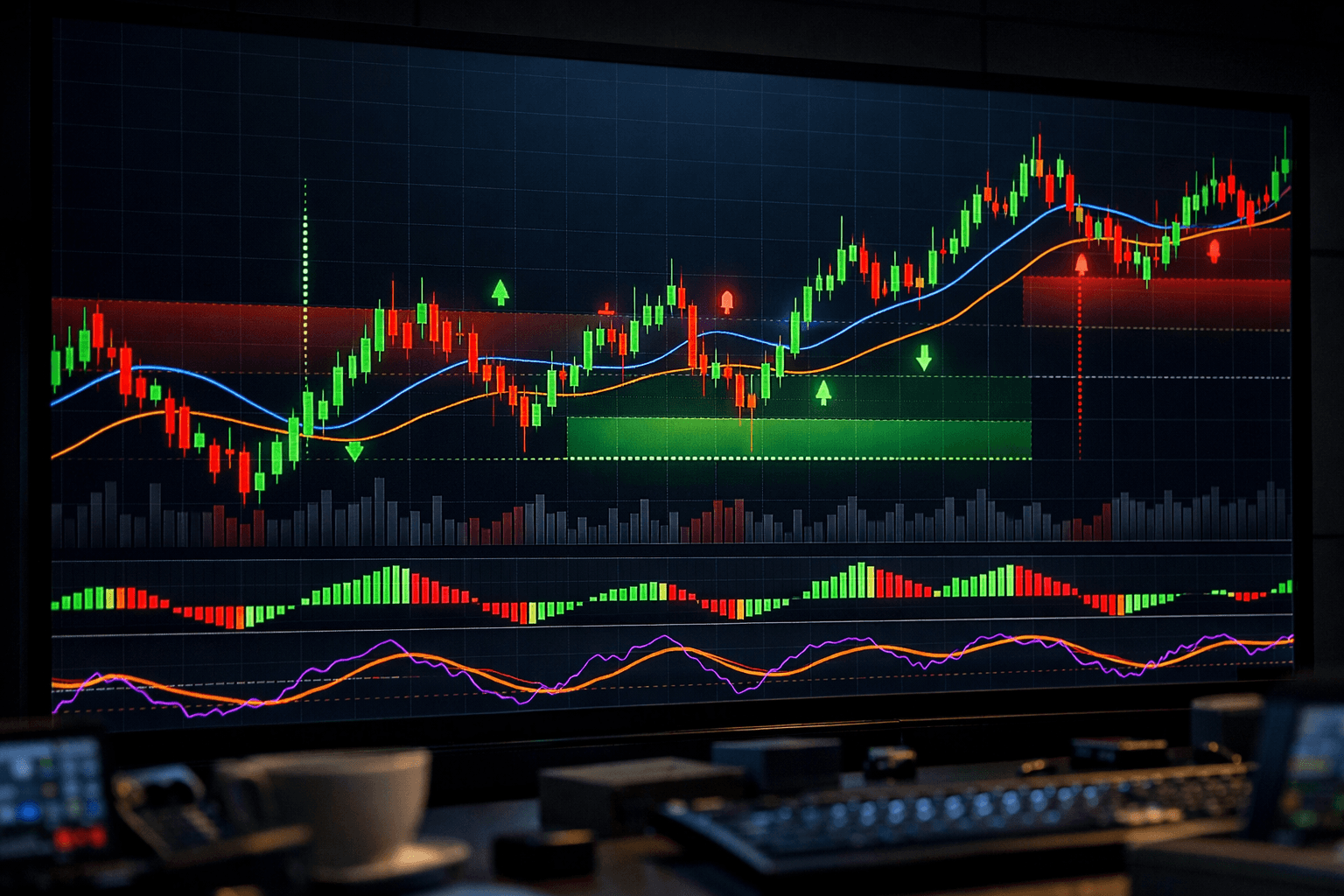
Forex chart indicators are the instruments that give your trades a logical, data-driven foundation. They don't predict the future, but they do reveal what the market has been doing — and that's often enough to tilt the odds in your favour. In this guide, we break down the best indicators for forex charts in 2026, covering everything from the classics to underrated gems — with actionable tips on how to combine them for consistent, high-probability setups.
What Are Forex Chart Indicators?
Forex chart indicators are mathematical tools built on historical price and volume data. They transform raw market information into visual signals — lines, histograms, bands, or oscillators — that appear directly on your chart.
They fall into four main categories:
Trend Indicators — tell you the direction price is moving
Momentum Indicators — show how fast price is moving
Volatility Indicators — reveal how much price is fluctuating
Volume Indicators — measure trading participation behind price moves
Pro tip: The best traders don't pick just one indicator. They combine one from each category to get a 360° view of the market.
The 9 Best Indicators for Forex Charts in 2026
1. Moving Average (MA) — The Trend Identifier
Type: Trend Indicator Best for: Identifying trend direction, dynamic support and resistance Platforms: MT4, MT5, TradingView
The Moving Average is the foundational forex indicator — and for good reason. It smooths out price data over a set period, giving you a clean view of trend direction while filtering out short-term noise.
There are two main types:
Simple Moving Average (SMA): Gives equal weight to all periods — slower to react
Exponential Moving Average (EMA): Weights recent prices more heavily — faster and more responsive
Most popular settings:
20 EMA → Short-term trend (scalping/day trading)
50 EMA → Medium-term trend (swing trading)
200 EMA → Long-term trend filter (position trading)
How to use it: When price is above the 200 EMA, look for buy setups only. When price is below the 200 EMA, look for sell setups. This single rule keeps you on the right side of the market 90% of the time.
Long-tail keyword win: "how to use 200 EMA as trend filter in forex" — high intent, easy to rank.
2. RSI (Relative Strength Index) — The Momentum Meter
Type: Momentum Indicator Best for: Spotting overbought/oversold conditions and divergence Platforms: MT4, MT5, TradingView, cTrader
The RSI measures the speed and size of recent price changes on a scale from 0 to 100.
RSI above 70 = Overbought (potential sell setup)
RSI below 30 = Oversold (potential buy setup)
RSI at 50 = Neutral momentum
But here's what most beginners miss: RSI divergence is far more powerful than overbought/oversold signals alone.
RSI Divergence Explained:
Bullish divergence — Price makes a lower low, but RSI makes a higher low → reversal to the upside likely
Bearish divergence — Price makes a higher high, but RSI makes a lower high → reversal to the downside likely
Best settings: RSI (14) is the standard. For scalping, try RSI (7) for faster signals.
Combine with: 50 EMA + RSI for one of the cleanest, most reliable setups in forex trading.
3. MACD (Moving Average Convergence Divergence) — Trend + Momentum in One
Type: Trend/Momentum Hybrid Best for: Identifying momentum shifts and trend changes Platforms: All major platforms
The MACD is arguably the most versatile indicator on this list. It uses the relationship between two EMAs (typically 12 and 26) to show whether momentum is building or fading.
Three components:
MACD Line (12 EMA minus 26 EMA)
Signal Line (9-period EMA of the MACD line)
Histogram (difference between MACD line and signal line)
Trading signals:
MACD line crosses above signal line → Bullish signal (buy)
MACD line crosses below signal line → Bearish signal (sell)
Histogram shrinking → Momentum slowing, potential reversal ahead
Pro tip for 2026: Use MACD on higher timeframes (H4 or Daily) to avoid the noise of intraday scalping. This is one of the most common pieces of advice among experienced traders this year.
4. Bollinger Bands — The Volatility Reader
Type: Volatility Indicator Best for: Identifying breakouts, squeezes, and dynamic price ranges Platforms: MT4, MT5, TradingView
Bollinger Bands consist of three lines: a 20-period SMA in the middle, with an upper and lower band plotted 2 standard deviations away.
When the bands are wide, the market is volatile. When they squeeze together, the market is consolidating — and a big breakout is likely coming.
Key strategies:
Bollinger Squeeze → Bands narrow → Wait for a breakout candle to confirm direction
Band Walk → Price hugs the upper band in a strong uptrend — don't fight it
Mean Reversion → Price bounces between bands in a ranging market
Avoid this mistake: Don't assume price will reverse just because it touches the upper or lower band. In trending markets, price can hug a band for extended periods.
5. ADX (Average Directional Index) — The Trend Strength Gauge
Type: Trend Strength Indicator Best for: Knowing when a trend is strong enough to trade Platforms: MT4, MT5, TradingView
The ADX answers the question most traders forget to ask: Is this trend actually strong enough to trade?
ADX below 20 → Weak trend / ranging market (avoid momentum strategies)
ADX 20–40 → Emerging trend (good to enter)
ADX above 40 → Strong trend (great for trend following)
ADX above 60 → Extremely strong trend (be cautious, reversal risk increases)
ADX doesn't show direction — only strength. Pair it with a trend indicator like EMA or MACD to know which way to trade.
6. Fibonacci Retracement — The Price Level Predictor
Type: Support & Resistance / Price Level Tool Best for: Finding entry points within a trend pullback Platforms: All major charting platforms
Fibonacci Retracement is not technically a traditional indicator — but it's one of the most used tools on forex charts worldwide, and for good reason.
After identifying a clear swing high and swing low, Fibonacci levels show where price commonly pulls back to before continuing the trend. The key levels are:
38.2% — Shallow pullback, strong trend
50.0% — The "golden mean" pullback
61.8% — Deep pullback, the most watched level globally
How to use it: In an uptrend, wait for price to pull back to the 38.2%, 50%, or 61.8% level — then watch for a bullish candlestick confirmation (like a pin bar or engulfing candle) to enter long.
Long-tail keyword opportunity: "how to use fibonacci retracement in forex for beginners" gets solid monthly searches with low competition.
7. ATR (Average True Range) — The Risk Management Tool
Type: Volatility Indicator Best for: Setting stop losses and take profits based on market conditions Platforms: MT4, MT5, TradingView
The ATR tells you the average price movement over a set period. It doesn't give buy or sell signals — but it's one of the most practical tools for smart risk management.
How traders use ATR:
Stop loss placement: Place stop loss at 1.5× to 2× ATR below your entry (prevents getting stopped out by normal volatility)
Take profit targets: Use 2× or 3× ATR to set realistic profit targets based on how much the pair actually moves
Example: If GBP/USD has an ATR of 80 pips on the H4 chart, a stop loss of 120 pips (1.5× ATR) makes sense. A stop of 25 pips would almost certainly get hit by normal price noise.
8. Stochastic Oscillator — The Short-Term Momentum Signal
Type: Momentum Indicator Best for: Scalping and short-term entries in ranging markets Platforms: MT4, MT5, TradingView
The Stochastic Oscillator compares a currency pair's closing price to its price range over a given period. Like RSI, it moves between 0 and 100.
Above 80 = Overbought
Below 20 = Oversold
The key signal is the %K and %D crossover within overbought/oversold zones.
Best use case: Stochastic works brilliantly in ranging markets where RSI may give false signals. In strong trending markets, price can stay overbought or oversold for long periods, so use ADX to confirm the market context first.
9. VWAP (Volume Weighted Average Price) — The Institutional Benchmark
Type: Volume/Price Indicator Best for: Intraday trading, identifying institutional value areas Platforms: TradingView, cTrader (less common on MT4)
The VWAP calculates the average price a currency pair has traded at, weighted by volume. Institutional traders use this as their "fair value" benchmark.
Price above VWAP → Bullish bias — institutions paying premium prices
Price below VWAP → Bearish bias — institutions getting a discount
For intraday traders, VWAP acts like a magnetic centre line — price often moves away from it, then snaps back. This makes it excellent for mean-reversion setups during slower sessions.
The Best Indicator Combinations for Forex Trading
Single indicators are weak. Combinations are powerful. Here are three proven setups:
🔵 Setup 1: The Trend Confirmation Stack (Swing Trading)
Indicators: 200 EMA + 50 EMA + RSI (14) + ADX
Rules:
Price must be above 200 EMA (bullish bias) or below (bearish bias)
50 EMA must be sloping in the same direction
ADX must be above 20 (trend is strong enough)
RSI dips below 50 (for buys) — then re-crosses above 50 to enter
Stop loss: Below recent swing low. Target: 2:1 reward-to-risk minimum
🟢 Setup 2: The Breakout + Momentum Combo (Day Trading)
Indicators: Bollinger Bands + MACD + ATR
Rules:
Wait for Bollinger Band squeeze (bands narrowing)
Enter when price breaks above/below the band with a strong candle
Confirm with MACD histogram expanding in the direction of the breakout
Use ATR × 1.5 for stop loss. Target: 2× ATR
🟡 Setup 3: The Reversal Hunter (Counter-Trend / Scalping)
Indicators: RSI (14) + Stochastic + Fibonacci Retracement
Rules:
Identify the major trend using 200 EMA
Wait for a pullback to a key Fibonacci level (50% or 61.8%)
RSI must be below 40 (for buy) or above 60 (for sell)
Stochastic must be in oversold zone with %K crossing above %D
Enter on confirmation candle at the Fibonacci level
Which Platform is Best for Using These Indicators?
Platform | Best For | Notable Features |
|---|---|---|
MT4 | Beginners, EA automation | Thousands of free indicators, most broker support |
MT5 | Advanced traders, multi-asset | More timeframes, economic calendar built-in |
TradingView | Chart analysis, community | Pine Script custom indicators, cloud-based, social sharing |
cTrader | ECN trading | Clean interface, advanced order types |
Common Mistakes Traders Make With Forex Indicators
1. Using too many indicators More is not better. Five indicators showing the same thing is worse than two indicators showing different dimensions of market data. Keep it to 2–4 maximum.
2. Ignoring market context An overbought RSI in a strong uptrend is not a sell signal. Context — the overall trend direction and ADX strength — always overrides individual indicator readings.
3. Treating indicators as prediction tools Indicators describe what has happened. They do not predict what will happen. Use them to confirm conditions, not to forecast.
4. Optimising too much (curve-fitting) Tweaking indicator settings to match historical charts perfectly leads to strategies that fail in live markets. Stick to standard, widely-used settings.
5. Skipping risk management Even the best indicator setup fails if you're not sizing your positions correctly or placing stops at logical levels. ATR-based stop losses are non-negotiable.
FAQs: Best Indicators for Forex Charts
Q: What is the single best indicator for forex trading?
A. There is no single "best" indicator. Most professional traders combine a trend indicator (EMA), momentum indicator (RSI or MACD), and volatility indicator (ATR or Bollinger Bands) for a balanced setup.
Q: What forex indicators work best for beginners?
A. Start with the 50 EMA + 200 EMA crossover combined with RSI. This setup is clean, widely documented, and teaches you to read trend and momentum simultaneously.
Q: Are forex indicators reliable?
A. Indicators are tools, not crystal balls. They are reliable for confirming market conditions — not for predicting the future. Combine them with price action, economic context, and strict risk management.
Q: Which indicator is best for scalping forex?
A. Stochastic Oscillator, RSI (7), and VWAP are commonly used for scalping. Pair them with MACD on a slightly higher timeframe to filter out low-quality signals.
Q: Do professional forex traders use indicators?
A. Yes, though many also incorporate pure price action. Even price-action-focused traders use tools like ATR for risk sizing and moving averages as trend filters.
Final Thoughts: Build Your Forex Indicator Toolkit Wisely
The best indicators for forex charts in 2026 are the ones you understand deeply, not the ones with the most features. Start with the classics:
✅ EMA (50 + 200) for trend direction
✅ RSI for momentum and divergence
✅ MACD for trend confirmation and entries
✅ ATR for stop loss and position sizing
✅ Bollinger Bands for volatility and breakout timing
Master these five, and you'll have a more powerful toolkit than 80% of retail traders — most of whom are chasing the next "secret indicator" that doesn't exist.
Trade smart, manage risk first, and let the indicators assist your decisions — never replace your judgment.
Disclaimer: This blog is for educational purposes only. Forex trading involves significant risk of capital loss. Always use proper risk management and consult a financial advisor before trading.