2mins read
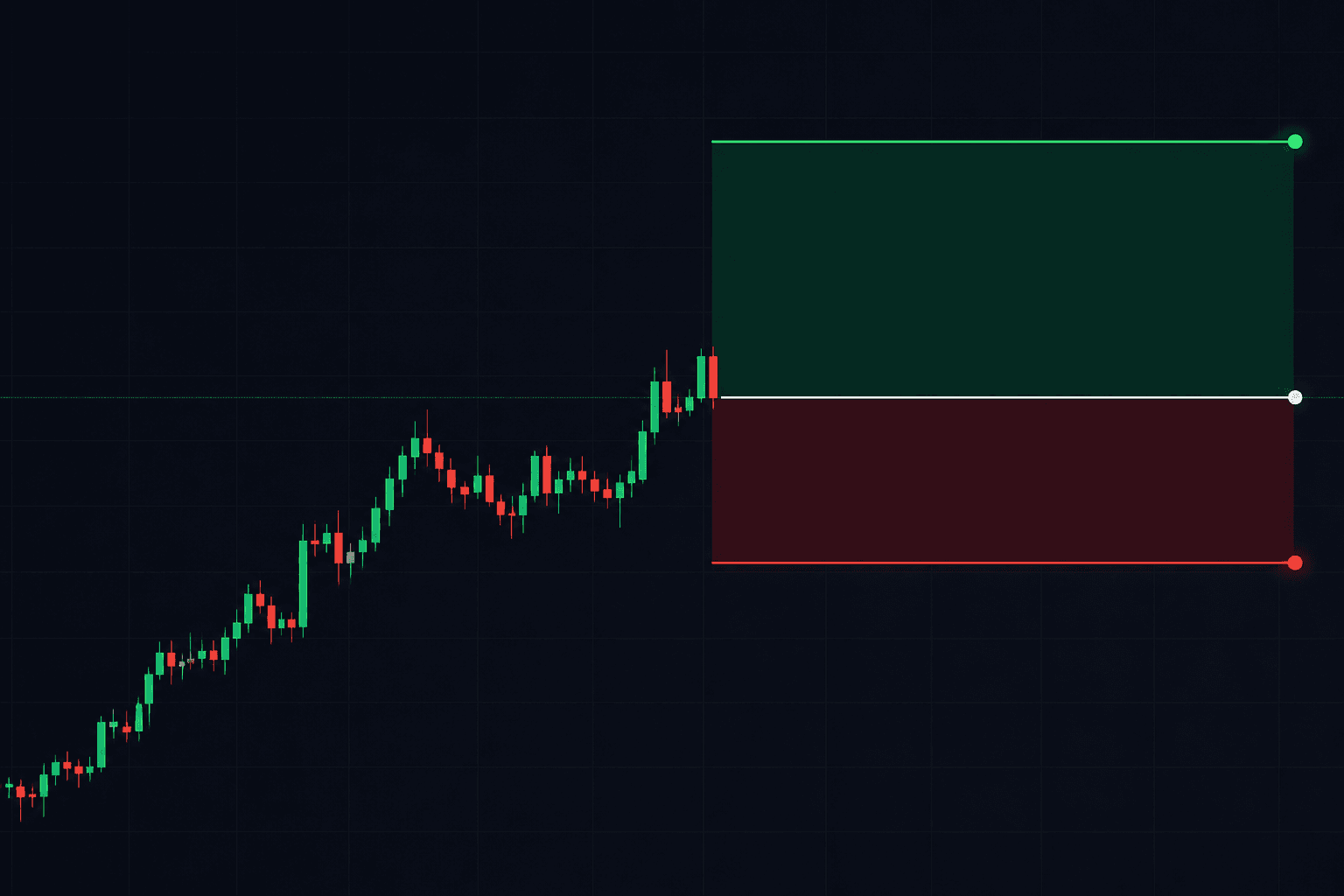
Every trade you open in the forex market has two possible outcomes: it goes your way, or it doesn't. What determines whether you walk away a winner or a loser is rarely the entry itself — it is almost always how you manage the trade once it is open. That is where stop loss and take profit orders come in. A stop loss automatically closes your trade if price moves against you beyond a defined point, capping your maximum loss on any single trade. A take profit does the opposite — it locks in your gains when price reaches your target, so you don't sit and watch a winning trade reverse into a loss. Together, they form the backbone of any serious forex risk management system.
1. What Is a Stop Loss in Forex?
A stop loss is a pending order placed on your broker's platform that automatically closes your trade at a specific price level if the market moves against your position. It is your insurance policy — the maximum amount you are willing to lose on a single trade before getting out.
Suppose you buy EUR/USD at 1.0850 expecting it to rise. You place a stop loss at 1.0820. If the market drops to 1.0820, your position closes automatically. Your loss is 30 pips — no more, no less. You don't have to be glued to your screen. You don't have to make an emotional decision in the heat of the moment. The stop does the work for you.
⚠ Critical Rule
Never open a trade without a stop loss. No strategy, no matter how good, wins every single time. Without a stop loss, a single bad trade can wipe out weeks or months of gains — or your entire account.
There are several types of stop loss orders you should know about when you're learning forex trading risk management:
Hard Stop Loss: A fixed price level where your trade closes. The simplest and most common type.
Mental Stop Loss: A level you plan to close at manually. This is almost always a bad idea — emotions will make you move it.
Trailing Stop Loss: A dynamic stop that moves with price as your trade goes profitable. Covered in detail in Section 7.
Volatility-Based Stop: Set based on the Average True Range (ATR) of the pair — accounts for how much the pair normally moves.
2. What Is a Take Profit in Forex?
A take profit (TP) is the mirror image of a stop loss. It is a price target you set in advance where your trade automatically closes in profit once reached. It removes the psychological burden of deciding when to exit a winning trade.
Using the same example: you buy EUR/USD at 1.0850 with a stop loss at 1.0820. You set your take profit at 1.0910. If price reaches 1.0910, your position closes automatically with a 60-pip gain — whether you are at your desk or asleep.
✅ Why Take Profits Matter
Without a defined take profit, greed takes over. Traders keep adjusting targets higher, watching a 50-pip winner turn into a 20-pip winner, then a loss. Defining your exit before you enter removes that decision from the moment entirely.
Take profits are placed based on logical price levels — support and resistance zones, Fibonacci retracements, previous swing highs and lows, or a fixed risk-reward ratio. The key is that they should be pre-planned before you enter the trade, not decided while the trade is running.
3. Stop Loss vs Take Profit: Key Differences at a Glance
Feature | Stop Loss | Take Profit |
|---|---|---|
Purpose | Limits your maximum loss | Locks in your target profit |
Triggers when | Price moves against you | Price moves in your favour |
Placement | Below entry (buy) / Above entry (sell) | Above entry (buy) / Below entry (sell) |
Based on | Structure, volatility, account risk % | Support/resistance, R:R ratio, Fibonacci |
Psychology | Prevents panic decisions during drawdown | Prevents greed from erasing profits |
Can be moved? | Only in your favour (never widen it) | Can be adjusted as trade develops |
4. How to Set a Stop Loss in Forex
The single biggest mistake traders make is placing stop losses based on how much money they're comfortable losing rather than where the market actually tells them the trade is wrong. Your stop loss should be placed at a level that, if hit, invalidates your entire trade idea.
Method 1: Structure-Based Stop Loss Placement
This is the gold standard of stop loss placement. You identify a key structural level — a recent swing high, swing low, support zone, or resistance zone — and place your stop just beyond it. If price reaches that level, the market has spoken: your thesis was wrong.
📌 Example — Buying EUR/USD
You spot a bullish setup on EUR/USD and decide to buy at 1.0850. The most recent swing low (the point at which buyers previously stepped in) is at 1.0805. You place your stop loss at 1.0795 — just below that swing low. If price breaks below 1.0795, the buyers have failed and your bullish thesis is invalid.
Method 2: Volatility-Based Stop Loss (ATR Method)
The Average True Range (ATR) tells you how much a currency pair moves on average in a given period. Using ATR to place your stop means you're giving your trade enough breathing room to handle normal market fluctuations without getting stopped out by random noise.
Stop Loss Distance = ATR × Multiplier (commonly 1.5× to 2×)
📌 Example — ATR Stop Loss on GBP/USD
GBP/USD has a 14-period ATR of 80 pips on the 4-hour chart. Using a 1.5× multiplier: 80 × 1.5 = 120 pips. Your stop loss is placed 120 pips from your entry. This gives the trade enough room to breathe without being overly exposed.
ATR-based stops are especially useful for volatile pairs. When you're trading different forex pairs in 2026, keep in mind that a stop that works for EUR/USD might be too tight or too wide for GBP/JPY, which is far more volatile.
Method 3: Percentage-Based Stop Loss
A simpler approach: decide you will never risk more than a fixed percentage of your account on any single trade (typically 1–2%), and then calculate your position size so that your stop loss — wherever it is structurally placed — equals that dollar risk.
Risk Per Trade ($) = Account Balance × Risk % (e.g., 1%)
Position Size = Risk Per Trade ÷ (Stop Loss in Pips × Pip Value)
💡 Pro Tip
Combine methods: place your stop at a structural level, then verify it falls within your maximum 1–2% account risk tolerance. If the structural stop is too wide (i.e., risking 5% of your account), reduce your position size rather than move the stop to a worse location.
Stop Loss Placement Rules to Live By
Never move a stop loss against you (widening it). This is the #1 account-blowing mistake.
Give your stop enough room — placing it too tight means getting stopped out by normal market noise.
Place stops beyond key levels, not at them. Liquidity clusters around obvious levels, and big players know where retail stops sit.
Consider the spread. On volatile pairs especially, account for the bid-ask spread in your stop placement.
5. Take Profit Strategy: How to Set Your Target Correctly
Setting a take profit is as much an art as a science. The goal is to place your target at a realistic level that price is likely to reach — not the maximum theoretical move the market could make. Here are the most reliable methods.
Method 1: Support & Resistance Take Profit
The most intuitive approach. If you're buying, your take profit goes just below the next major resistance zone — the area where sellers are likely to push price back down. If you're selling, your TP goes just above the next major support zone.
📌 Example
You buy USD/JPY at 148.00. You identify resistance at 149.80 based on previous swing highs. You place your take profit at 149.65 — just below that resistance to account for the fact that price may not perfectly touch the level before reversing.
Method 2: Fibonacci Take Profit Levels
Fibonacci retracement and extension levels are widely watched by institutional traders and algorithms, making them self-fulfilling to a degree. For take profit targets, the 161.8% and 261.8% Fibonacci extensions of the prior move are reliable targets, especially on trending pairs.
Method 3: Fixed Risk-Reward Ratio Take Profit
The simplest method: if your stop loss is 40 pips, you set your take profit at a minimum of 80 pips (2:1 R:R), or 120 pips (3:1 R:R). This method ensures you are always targeting more profit than your potential loss, which is the mathematical foundation of sustainable trading. This is closely linked to understanding how leverage works in forex — the bigger your leverage, the more critical a defined R:R becomes.
Method 4: Partial Take Profits
Rather than closing your entire position at one target, consider scaling out. Close 50% of your position at the first target (say, 1:1 R:R), move your stop to breakeven, and let the remainder run toward a larger target. This approach locks in profit while keeping you in trades that go on to make bigger moves.
✅ Partial TP Strategy in Action
You buy 2 lots of EUR/GBP. At your first target (50 pips), you close 1 lot and move your stop to breakeven. Your remaining lot now has zero risk and can run toward your second target at 100+ pips. Worst case: you broke even on the overall trade.
6. Risk Reward Ratio in Forex: The Number That Drives Long-Term Success
The risk-reward ratio (R:R) is the relationship between how much you stand to lose (your stop loss distance) and how much you stand to gain (your take profit distance) on a trade. It is arguably the single most important concept in forex risk management for beginners and experienced traders alike.
Risk : Reward = Stop Loss Distance : Take Profit Distance
e.g., 40 pips SL : 80 pips TP = 1:2 Risk-Reward Ratio
Why a Minimum 1:2 R:R Changes Everything
Consider two traders. Trader A takes trades with no defined R:R and wins 60% of the time. Trader B uses a strict 1:2 R:R and only wins 40% of the time. Who does better?
Trader | Win Rate | R:R | Result per 10 Trades (risking $100) |
|---|---|---|---|
Trader A | 60% | 1:1 | +$600 − $400 = +$200 |
Trader B | 40% | 1:2 | +$800 − $600 = +$200 |
Trader C | 40% | 1:3 | +$1,200 − $600 = +$600 |
Trader B achieves the same result as Trader A while being wrong 60% of the time — because the R:R compensates. Trader C, with the same 40% win rate and a 1:3 R:R, triples the outcome. This is why professional traders focus obsessively on risk-reward before they even think about win rate.
📊 Minimum Viable R:R by Strategy
Scalpers typically need 1:1 to 1:1.5 (compensated by very high win rates). Swing traders should target 1:2 minimum. Position traders and trend followers often target 1:3 to 1:5 or more, accepting lower win rates in exchange for massive winners.
How to Calculate R:R Before You Trade
Before entering any trade, run this quick calculation. Say you're looking to go long on GBP/USD:
Entry: 1.2740
Stop Loss: 1.2700 (40 pips of risk)
Take Profit: 1.2820 (80 pips of potential gain)
Risk-Reward Ratio: 40:80 = 1:2 ✅
If the R:R is less than 1:1.5, reconsider. Either find a tighter stop by identifying a closer structural level, find a wider take profit at a more distant resistance, or simply don't take the trade. Not every setup is worth taking, and skipping low-quality trades is itself a form of risk management. This discipline is especially important when you're using leverage in your forex account — a poor R:R trade magnified by 100:1 leverage can destroy an account in minutes.
7. Trailing Stop Loss: Let Your Winners Run
A trailing stop loss is a dynamic stop that moves automatically as price moves in your favour. Instead of sitting fixed at one price level, it trails behind price by a set distance — locking in progressively more profit as the trade moves your way, while still closing the trade if price reverses.
How Trailing Stop Loss Works
📌 Trailing Stop Example
You buy EUR/USD at 1.0850 and set a trailing stop of 30 pips.
As price rises to 1.0900, your stop automatically moves up to 1.0870.
As price rises to 1.0950, your stop moves up to 1.0920.
Price then reverses and drops to 1.0920 — your trade closes at 1.0920.
Result: You captured 70 pips of the move instead of only 60 (your original TP), without manually adjusting anything.
When to Use a Trailing Stop
Strong trending markets: When EUR/USD or GBP/USD is trending cleanly on the daily chart, a trailing stop lets you ride the trend without guessing the top.
News-driven breakout trades: After a major breakout, price can run far beyond any fixed TP. A trailing stop captures the extended move.
When you can't monitor the trade: A trailing stop does the profit-locking for you if you can't watch the chart.
When NOT to Use a Trailing Stop
Range-bound or choppy markets: In sideways conditions, price oscillates and a trailing stop will get triggered on normal pullbacks before the real move resumes.
High-volatility news events: Spreads widen massively during events like NFP or FOMC — your trailing stop can trigger on a temporary spike even if your direction is correct.
Very short timeframes: On 1-minute charts, the noise-to-signal ratio is too high for trailing stops to work reliably.
💡 ATR-Based Trailing Stop
Instead of a fixed-pip trail, many professional traders use an ATR-based trailing stop — e.g., trail at 2× ATR. As volatility increases, the trail widens; as volatility decreases, it tightens. This adapts to market conditions far better than a fixed-pip trail.
Trade Forex With Precision Tools on MT5
Olympus Capital offers raw spreads from 0.0 pips, ultra-fast execution, and full MT5 support — so you can place stop losses and take profits exactly where they need to be, with zero slippage on normal market conditions.
Open Your Account — $100 Free Trades
8. Common Stop Loss & Take Profit Mistakes (And How to Fix Them)
Mistake 1: Setting a Stop Loss Too Tight
Placing a 5-pip stop on EUR/USD when the pair moves 10–15 pips in normal fluctuation is not risk management — it's guaranteed losses. You'll get stopped out repeatedly before price moves in your direction. Fix: always check the ATR and give your stop at least enough room to clear normal market noise.
Mistake 2: Not Having a Stop Loss At All
Some traders skip stop losses entirely, telling themselves they'll close manually if things go wrong. They never do. One position held through a 200-pip adverse move "because it will come back" can wipe out months of gains. This is especially catastrophic on leveraged forex accounts. A hard stop loss is non-negotiable.
Mistake 3: Moving Your Stop Loss Against You
The most emotionally tempting mistake in trading. Price approaches your stop, and instead of accepting the loss, you move the stop further away. This converts a small, manageable loss into a large, account-threatening one. Your original stop was placed at a level that invalidated your trade idea — respect it.
Mistake 4: Setting Take Profits Too Far Away
Dreaming of 500-pip winners when the pair only moves 80 pips on average per day leads to trades that never hit target and eventually reverse into losses. Your take profit must be realistic given the pair's typical range and the timeframe you're trading.
Mistake 5: Closing Winners Early Out of Fear
The opposite problem — closing a trade at 20 pips because you're nervous, when your plan called for a 60-pip target. Systematic early exits destroy your R:R and make your strategy unprofitable even with a decent win rate. If your plan is solid, trust it. If you can't trust it, test it on a demo account first — Olympus Capital's demo accounts let you practise your entire exit strategy risk-free.
Mistake 6: Ignoring Spreads and Overnight Fees
On pairs with wide spreads, your effective stop loss is tighter than it looks, because the trade starts at a loss equal to the spread. Similarly, if you hold XAUUSD or commodity positions overnight, swap fees can eat into your take profit. Always factor the full cost of the trade into your R:R calculation.
9. Frequently Asked Questions
What is a good stop loss distance in forex?
There is no single "good" distance — it depends on the pair's volatility, the timeframe you're trading, and where key structural levels sit. A useful rule of thumb: check the 14-period ATR and ensure your stop is at least 1× ATR away from your entry. For swing trades on the 4-hour or daily chart, stops of 30–100 pips are common depending on the pair.
Should I always use a 1:2 risk-reward ratio?
A 1:2 R:R is an excellent baseline and ensures profitability even with a 40–45% win rate. That said, your strategy and timeframe dictate the ideal ratio. Scalpers may work with 1:1.2 because of their high win rates. Trend followers often target 1:3 or better. The key is that your overall expected value — win rate × average win minus loss rate × average loss — must be positive.
Can I set a stop loss and take profit at the same time?
Yes, and you should. On MetaTrader 5 (the platform used at Olympus Capital), when you open a trade you can set the Stop Loss and Take Profit in the same order window. You can also modify them afterward by right-clicking the trade in your terminal. Setting both simultaneously is best practice.
What is the difference between a stop loss and a stop limit order?
A stop loss (or stop market order) triggers a market order when price reaches your stop level — you're guaranteed an exit, but not a guaranteed price (slippage can occur). A stop limit order triggers a limit order at your stop level — you get a guaranteed price, but in fast-moving markets the order may not fill at all. For most forex traders, a standard stop loss (market order) is preferable because an exit — even with slight slippage — is always better than no exit in a fast-moving market.
How does a trailing stop loss differ from a regular stop loss?
A regular stop loss is fixed — it stays at the price you placed it until the trade closes. A trailing stop loss is dynamic — it moves in the direction of your profit as the trade goes your way, but never moves against you. It's the ideal tool for riding trends while protecting accumulated gains.
Is it okay to trade without a take profit?
It can be acceptable for experienced traders using a trailing stop loss or actively managing their trades in real time. However, for most traders — especially beginners — trading without a defined take profit leads to greed-driven decisions that turn winners into losers. Always have at least a planned exit target, even if you adjust it as the trade develops.
Ready to Apply What You've Learned?
Open a live or demo account with Olympus Capital and start placing stop losses and take profits with real market conditions — raw spreads, fast execution, and full MT5 support.