2mins read
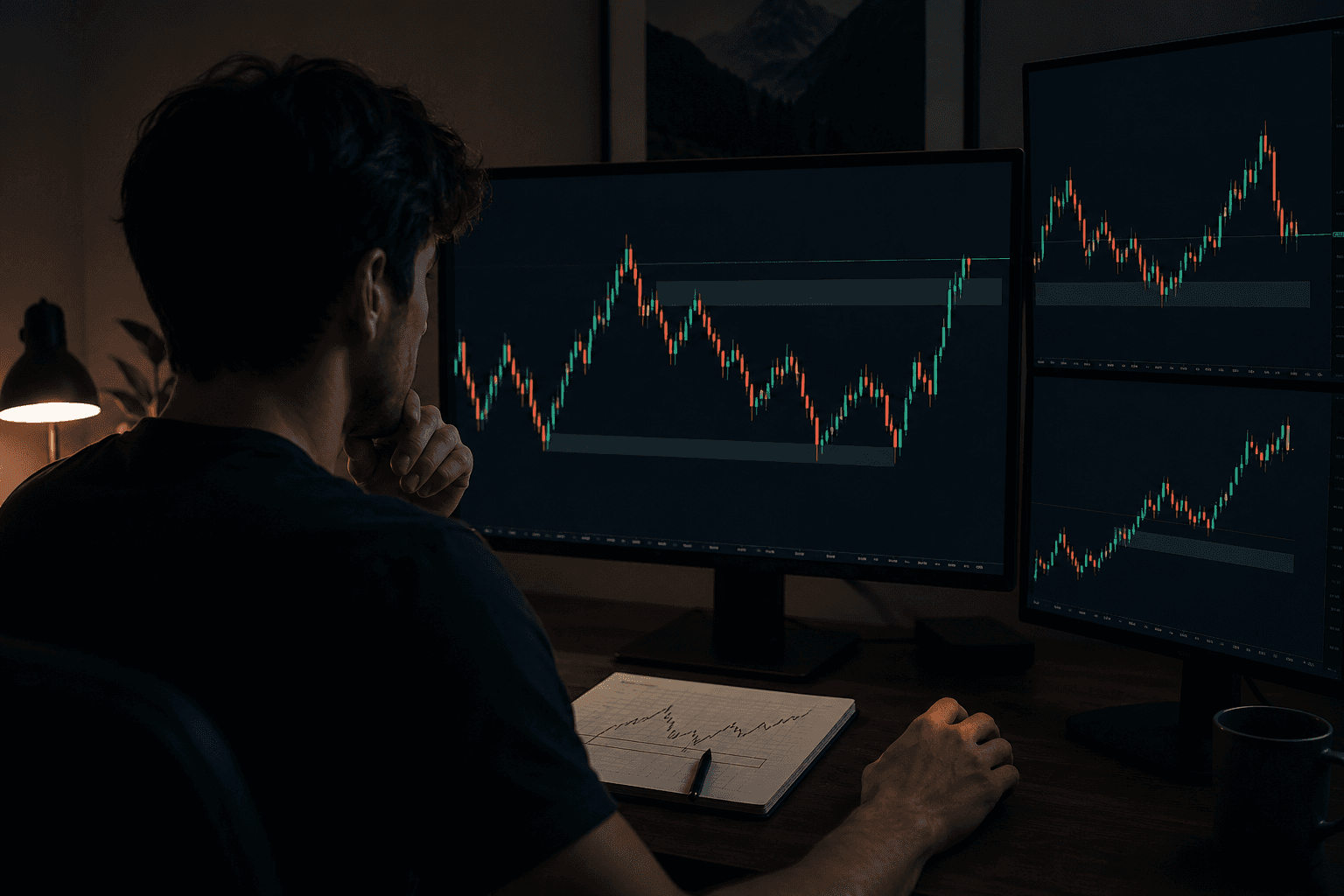
Watch a professional forex trader for five minutes, and you'll notice something remarkable: they're staring at a clean chart with nothing but candlesticks. No flashy indicators. No moving averages. No RSI or MACD cluttering the screen. Just price bars and nothing else. This isn't laziness or minimalism—it's mastery. They're reading price action. Price action is the pure, unfiltered study of how price moves through support and resistance levels, how candlesticks form patterns that signal reversals or continuations, and how to spot the exact moment when professional traders are entering and exiting the market. It's not a theory or an opinion—it's the actual mechanics of how forex markets work. Most retail traders fail because they ignore price action and chase indicators instead. They see an RSI signal and jump in without understanding why price is actually moving. Professional traders do the opposite: they watch the price action first, understand what's happening at support and resistance, and only then confirm with indicators. This simple shift in perspective—prioritizing candlestick patterns and price behavior over indicators—is what separates profitable traders from account blowers.
Price action trading is a method of analyzing forex markets by studying candlestick charts and price movement patterns without relying on technical indicators. Instead of using MACD or RSI to confirm trades, price action traders interpret what candlesticks are telling them directly: Where are traders buying? Where are they selling? What patterns signal reversals? Where is support and resistance? This direct approach to reading price movement is what separates casual traders from professionals.
Understanding Price Action: The Foundation
Price action analysis is based on a simple truth: candlesticks and price movement tell a story. Every candlestick represents one trading period—one minute, one hour, one day—and shows you what traders decided to do during that time. By reading this story across multiple candlesticks, you can predict what traders will do next.
The core principle of price action trading is that price respects support and resistance levels. When price approaches these levels, specific candlestick patterns emerge that signal whether price will break through or bounce back. These patterns—pin bars, inside bars, engulfing patterns—are the alphabet of price action. Learn to read them, and you can predict price movement.
Major Candlestick Patterns Every Trader Must Know
Candlestick patterns form the foundation of price action analysis. These patterns appear at key moments—usually at support and resistance levels—and tell you whether the next move will be up or down.
1. Pin Bars (Rejection Candles)
A pin bar is one of the most powerful candlestick patterns in forex trading. It forms when price moves in one direction, gets rejected, and closes near the opposite end of the candle. The result looks like a pin or needle—hence the name.
How to identify a pin bar:
Long wick (the needle part) on one side
Small body (the solid part) on the opposite side
Forms at support or resistance levels
Signals that price was rejected at that level
Pin bar trading strategy: When you see a pin bar forming at resistance with a long upper wick and small red body, it signals that buyers pushed price up but sellers rejected it. This is a strong sell signal. Wait for price to break below the pin bar's body, then enter a short position.
2. Inside Bars (Break-Before-Break Pattern)
An inside bar is a smaller candle that forms completely within the range of the previous larger candle. It signals consolidation—price is gathering energy before a bigger move.
How to identify an inside bar:
Second candle's high is lower than first candle's high
Second candle's low is higher than first candle's low
Inside bar is completely enclosed within previous candle's range
Usually followed by a breakout move
Inside bar trading strategy: When you see an inside bar form near support or resistance, it signals that a breakout is coming. Place your entry order just above the inside bar if you're bullish, or just below if you're bearish. When price breaks the inside bar range, momentum typically accelerates significantly.
3. Engulfing Bars (Reversal Pattern)
An engulfing bar forms when a larger candle completely encompasses the previous candle. A bullish engulfing bar (green engulfing red) signals a reversal from down to up. A bearish engulfing bar (red engulfing green) signals a reversal from up to down.
Engulfing bar trading strategy: When you see a bullish engulfing pattern at support, price has reversed. Enter a long position above the engulfing bar. When you see a bearish engulfing pattern at resistance, price is reversing down. Enter a short position below the engulfing bar.
Support and Resistance Price Action: The Critical Context
Candlestick patterns are worthless if they don't occur at significant support and resistance levels. This is why professional traders emphasize support resistance price action analysis—the combination of pattern recognition with level analysis.
Support levels are where buyers step in and prevent further downside. Resistance levels are where sellers appear and prevent further upside. When price approaches these levels, specific candlestick patterns emerge. This is where your edges come from.
Professional price action trading workflow:
Identify key support and resistance levels on your chart
Wait for price to approach these levels
Watch for candlestick patterns to form (pin bars, inside bars, engulfing)
Enter trades when the pattern confirms the level's strength
Complete Price Action Trading Strategies
Strategy 1: Pin Bar at Resistance Reversal Trade
Identify a strong resistance level
Wait for price to approach the resistance
Watch for a pin bar with a long upper wick to form
Enter short when price closes below the pin bar's body
Set stop loss above the pin bar's high
Target previous support level as profit target
Strategy 2: Inside Bar Breakout Setup
Identify support or resistance level
Wait for price to consolidate near the level with an inside bar
Place pending buy order above inside bar high (if bullish level)
When price breaks above inside bar range, order triggers
Set stop loss just below the inside bar
Ride the momentum breakout to next resistance
Strategy 3: Engulfing Bar Trend Reversal
Identify downtrend approaching support level
Wait for a bullish engulfing candlestick to form
Confirm trend change with higher high on next candle
Enter long above engulfing bar high
Stop loss below the engulfing bar
Trail stop as uptrend develops
Why Price Action Trading Works: The Professional Perspective
Price action works because it shows you what smart money is actually doing. When institutional traders see support being tested, they position themselves. These positions create recognizable candlestick patterns. By learning to read these patterns, you're literally seeing the footprints that professional traders leave on your chart.
Unlike indicators (which are lagging by definition), candlestick patterns form in real-time. You see the rejection at support or resistance as it happens. This is why professional traders can enter trades with such confidence—they're not waiting for a confirmation signal or a trend line break. They're seeing price action unfold in front of them.
Common Price Action Mistakes to Avoid
Trading candlestick patterns without support/resistance context
Not waiting for candle to fully close before confirming the pattern
Trying to trade pin bars and inside bars in the middle of trends
Using unconfirmed support/resistance levels for entries
Trading every candlestick pattern you see instead of waiting for high-probability setups
Key Takeaways: Price Action Trading Mastery
Price action is reading candlestick patterns and price movement without indicators
Pin bars signal rejection at support and resistance levels
Inside bars signal consolidation before major breakout moves
Engulfing bars signal trend reversals and momentum shifts
Always analyze candlestick patterns in context of support and resistance
Price action patterns only matter when they form at significant price levels
Professional traders use price action as their primary analysis tool
Price action trading separates professional traders from casual losers. It requires discipline, patience, and the ability to wait for high-probability setups at support and resistance levels. Start by mastering the three core patterns—pin bars, inside bars, and engulfing bars—and always ensure they form at significant price action levels. As you develop this skill, you'll stop looking at charts and start reading them. You'll see what professional traders see: the story of money flowing through support and resistance, told through candlestick patterns that repeat endlessly. That's when price action becomes your edge.


