

Forex Carry Trade Strategy: Earn Rate Differentials Safely
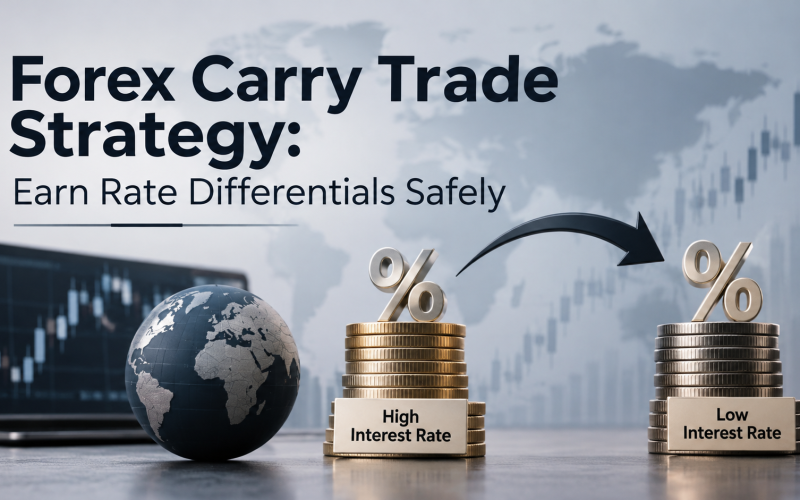
The carry trade is one of the oldest strategies in currency markets. The idea is simple: borrow in a low-interest currency, invest in a higher-interest currency, and keep the difference. In forex, this shows up as a daily swap or rollover credit on positions held overnight. The strategy can produce steady income in calm markets, but it has a well-known weakness: sudden reversals can erase months of gains in a short period. This guide explains how carry works, where its risks come from, and how to manage it responsibly.
How a Forex Carry Trade Works
When you buy one currency against another, you are effectively borrowing the currency you sell and holding the one you buy. Each currency carries an interest rate, so holding the pair overnight generates a daily financing amount, often called a swap or rollover. If the currency you buy pays a higher rate than the one you sell, the swap may be positive for you. If it pays less, the swap is typically a cost.
Illustration
Suppose a broker’s overnight swap for a long position is a credit on one pair and a debit on its reverse. A trader who holds the credit side collects the difference each night. The actual amounts depend on the broker, the pair, the position size, and current rates, so always check the swap schedule in your platform’s contract specifications.
Important: Swap rates change over time and are set by brokers using market rates plus their own markup. Verify current swap values before assuming a trade is positive-carry.
Where the Return Comes From
A carry trade has two potential sources of profit or loss:
- Carry income: the daily swap credit, which accumulates while the position is held
- Price movement: the change in the exchange rate, which can add to or subtract from the carry income
Many carry traders are drawn to the steady swap income, but the price movement often dominates the outcome. A pair that pays a generous daily credit can still lose far more through a currency move than it earns in swaps.
The Unwind Risk
Carry trades tend to perform well when markets are calm and investors are willing to take risk. They can reverse sharply when conditions change. During periods of stress, traders often close positions at the same time, and the higher-yielding currency may fall quickly as funding positions are unwound.
Why the loss can be large:
Months of positive swap income can be offset in a few sessions
Gaps around news or risk events can skip past stop losses
Many traders exit together, which amplifies the move
Key lesson: A carry trade is not a savings account. The interest income is compensation for accepting currency risk, and that risk can materialize suddenly.
Choosing Currencies for Carry
Carry traders typically compare the interest rate paths of two central banks. Relevant factors include:
| Factor | Why It Matters |
|---|---|
| Current rate differential | Determines the base carry income |
| Expected rate path | A narrowing differential can erode carry even if the current swap looks attractive |
| Central bank stability | Sudden policy shifts can reverse the trend quickly |
| Volatility of the pair | Higher volatility increases price risk relative to carry income |
| Risk sentiment sensitivity | Some currencies tend to weaken when markets turn cautious |
Our fundamental analysis guide covers how to read these rate and policy signals in more depth.
Sizing a Carry Position
Position size should reflect the risk of the currency move, not the attractiveness of the swap. A practical approach:
- Estimate a realistic adverse move for the pair, using recent volatility and historical stress periods.
- Set a stop loss at a level that reflects your thesis being wrong, not just a comfortable distance.
- Size the position so that a stop-out at that level stays within your risk-per-trade limit.
- Account for the swap cost if the carry is negative, since it reduces the margin for error.
Example framework:
Account: $10,000, risk limit 1% = $100
Stop distance: 200 pips
Pip value needed: $100 ÷ 200 = $0.50 per pip
That is about 0.5 mini lots, depending on pair and account currency
Use our lot sizes guide to confirm pip values before sizing.
Managing the Position
- Monitor the rate outlook: review central bank guidance and economic data, since a narrowing differential reduces the case for holding
- Watch volatility: rising volatility is a warning sign that price risk is growing relative to income
- Plan for news: close or reduce positions ahead of major releases if your risk limit could be exceeded
- Set review triggers: define in advance the conditions that prompt you to reduce or exit, such as a sharp break in the pair’s trend
- Consider hedging: some traders offset part of the currency exposure with a related position, though hedges carry their own costs and risks
Common Carry Trade Mistakes
- Chasing the highest swap without assessing price risk.
- Overleveraging because the income feels steady.
- Ignoring the rate path, and assuming today’s differential will last.
- Holding through stress without a plan for exits.
- Forgetting costs, including spreads and negative swaps on the other side.
🎯 Key Takeaways
- Carry is the interest rate differential, earned as a daily swap on overnight positions.
- Price movement can outweigh carry income, sometimes by a wide margin.
- Unwinds can be sudden, especially when markets turn risk-averse.
- Consider the rate path, not just the current swap.
- Size from realistic adverse moves, not from the attractiveness of the income.
- Define review triggers in advance, and plan for news and volatility spikes.
