

Common Beginner Mistakes in Forex and How to Avoid Them
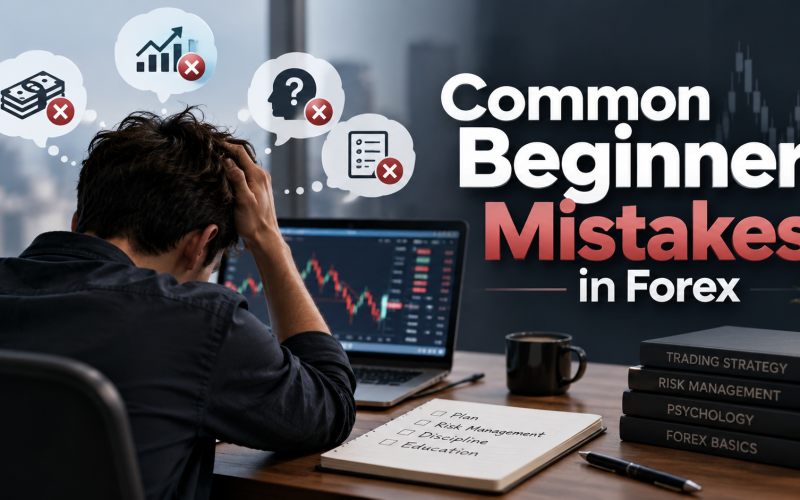
Most new forex traders do not fail because they chose the wrong indicator. They fail because of a handful of predictable behaviors: trading too often, risking too much, refusing to use a stop loss, and chasing losses. The good news is that these mistakes are well documented, which means they are avoidable. This guide covers the seven mistakes that do the most damage to beginner accounts, why each one happens, and a specific fix for each.
Mistake 1: Trading Without a Stop Loss
What it looks like: You open a trade, the price moves against you, and you tell yourself it will come back. You leave the trade open with no exit point.
Why it is dangerous: A small losing trade becomes a large one, and a large one can wipe out the account. Leverage makes this worse, because a few hundred pips of movement against an unprotected position can trigger a margin call.
Fix: Set a stop loss before you click buy or sell. Decide the maximum amount you will lose on the trade, and let the stop enforce it. If you cannot place a sensible stop, the trade is too large or the setup is not ready.
Mistake 2: Risking Too Much on One Trade
What it looks like: A beginner with a $500 account trades 1 standard lot because they want a big win fast.
Why it is dangerous: Even a 50-pip move against a full lot costs $500, which is the entire account. Losing streaks are normal in trading, and oversized positions turn a normal streak into a blown account.
Fix: Risk a small fixed percentage of your account per trade, commonly 1 to 2 percent. On a $500 account, that is $5 to $10 of risk per trade. Size your position so that your stop loss equals that amount. The full method is covered in our position sizing guide.
Mistake 3: Overleveraging
What it looks like: A new trader sees 1:500 leverage on offer and uses it to take positions far larger than the account can safely carry.
Why it is dangerous: Leverage does not change the profit or loss per pip for a given lot size. It only lets you open larger lots with less capital, which means the same pip move hurts far more.
Fix: Treat available leverage as a ceiling, not a target. Your position size should come from your risk rules, not from how much leverage your broker allows. Read the leverage guide to understand how margin works before you open a live position.
Mistake 4: Overtrading
What it looks like: You feel you must always be in a trade. You take marginal setups, trade during dead hours, and open several positions at once.
Why it is dangerous: Every trade carries spread and commission costs, and low-quality setups have a lower win rate. Overtrading often reflects boredom or a need for action, not a real opportunity.
Fix: Define your setup criteria in writing before you trade. If a trade does not meet every criterion, skip it. Doing nothing is a valid position. Limit yourself to a set number of trades per day or week until you can prove your edge.
Mistake 5: Revenge Trading After a Loss
What it looks like: You take a loss and immediately open a bigger trade to win it back. After that loss, you open another, and then another.
Why it is dangerous: Revenge trades are driven by emotion, not analysis. They usually have worse setups, larger sizes, and no plan. One emotional sequence can erase weeks of disciplined trading.
Fix: Set a daily loss limit, for example 3 percent of the account. When you hit it, stop trading for the day. Stepping away after a loss is a rule you follow, not a sign of weakness.
Mistake 6: Ignoring Economic News
What it looks like: You hold a position into a major release such as an interest rate decision or non-farm payrolls, unaware that the event is scheduled.
Why it is dangerous: Spreads widen sharply during major releases, and prices can jump past your stop loss. Your risk plan may not protect you as intended.
Fix: Check an economic calendar every morning. Know which high-impact events are due that day and that week. Either close positions before major releases or reduce size. Keep in mind that a stop loss does not guarantee a fill at its exact price during fast moves.
Mistake 7: Expecting Quick Riches
What it looks like: You deposit a small amount and expect to double it in a month. A few early wins make you confident enough to increase size.
Why it is dangerous: Unrealistic targets push traders toward high leverage and oversized positions. Early luck is often mistaken for skill, and the first large loss can be devastating.
Fix: Set goals around process, not profit. For example: follow my plan on every trade this month, and keep losses within my risk limit. Measure your results over a large number of trades rather than a few days.
Build Your Plan Before You Trade
Most of these mistakes share one root cause: trading without a written plan. A simple plan covers five points:
- The markets and timeframes you trade
- Your entry criteria
- Your stop loss rule and maximum risk per trade
- Your profit target or exit rule
- Your daily loss limit and trade limit
Write it down, and review every trade against it.
🎯 Key Takeaways
- Always use a stop loss. Set it before you enter.
- Risk a small fixed percentage per trade, typically 1 to 2 percent.
- Treat leverage as a ceiling. Let your risk rules set position size.
- Trade only your setups. Skipping a trade is a valid decision.
- Stop after your daily loss limit. Do not trade to win back losses.
- Know the economic calendar. Avoid surprises from scheduled releases.
- Judge your process, not your short-term profit.
